DNA Dilution Calculator for ng/µL, nM, and copies/µL

Calculate how much DNA stock and diluent you need for a target working concentration. Use Basic mode for ng/µL dilutions. Use Advanced mode when qPCR standards, sequencing libraries, or primer stocks require nM or copy-number units.

Calculate stock DNA and diluent volumes

Enter the stock concentration, target concentration, and final volume. The tool applies C1V1 = C2V2 and converts copy number or molarity when you provide DNA length.

Choose a dilution workflow

Start with ng/µL, then switch to copy number or nM when the experiment needs molecule-based dilution.

Stock and target setup

Use the same physical meaning for stock and target. The tool normalizes nM and copies/µL into ng/µL when length is available.

Molecule settings

Length matters when you convert between mass concentration, nM, and copies per microliter.

Uses the common average of 660 g/mol per base pair.

Live result

Add 5.000 µL stock DNA

Mix with 95.00 µL nuclease-free water or TE buffer to make 100.0 µL at the target concentration.

DNA dilution setup showing stock DNA and diluent volumesStock DNAWorking stockstock DNAdiluent

Stock DNA

5.000 µL

Diluent

95.00 µL

Dilution factor

20.00×

Target copies

1.52 × 10^9/µL

Per-sample pipetting plan

Stock DNA5.000 µL
nuclease-free water or TE buffer95.00 µL
Final working stock100.0 µL

Advanced totals and molecule values

Total stock for 1 sample(s)5.500 µL
Total diluent with overage104.5 µL
Target molarity2.525 nM
DNA mass in final tube500.0 ng
Amount in final tube0.253 pmol

Normalized concentration check

Stock as ng/µL

100.0

Target as ng/µL

5.0000

Molecular weight

1.98 × 10^6 g/mol

Stock molarity

50.51 nM

Stock copies

3.04 × 10^10/µL

Total final volume

110.0 µL

DNA dilution workflow showing stock DNA concentration, target working concentration, pipetted DNA volume, diluent volume, and qPCR copy-number dilution planning
Figure 1. DNA dilution changes concentration by increasing final volume. The same molecule count from the transferred stock DNA spreads through water or TE buffer, so ng/µL, nM, and copies/µL decrease in a predictable ratio.

What the DNA dilution result tells you

The answer gives the exact stock DNA volume and diluent volume for your working tube. It also reports normalized ng/µL, nM, and copies/µL when the molecule length is available.

This matters because different experiments use different concentration languages. PCR setup often uses ng of template. qPCR standards often use copies/µL. Primer stocks often use µM or nM, so an oligo dilution workflow may use molarity rather than mass concentration.

The calculator keeps those units connected. If you work from a DNA mass value but need a molecule count, use the DNA copy number result before preparing a qPCR dilution series.

Inputs, outputs, and what each part controls

Each field has a specific laboratory meaning. Use the table before you copy the pipetting plan into a protocol.

Stock concentration

The measured DNA concentration before dilution, such as 100 ng/µL or 1 × 10⁹ copies/µL.

Target concentration

The working concentration you want in the final tube. This must be lower than the stock concentration.

Final volume

The total tube volume after stock DNA and diluent are mixed.

Molecule type and length

The information needed to convert between ng/µL, nM, and copies/µL.

Overage

Extra volume added for multiple samples so pipetting loss does not leave the final tube short.

Small-volume warning

A flag that appears when the calculated stock volume is too small for reliable pipetting.

DNA dilution formula and unit conversions

Stock volume

V1 = (C2 × V2) / C1

This formula gives the amount of stock DNA to add.

Diluent volume

Diluent = V2 − V1

Add water or buffer until the final tube reaches the required volume.

Mass to molarity

nM = ng/µL × 10⁶ / MW

Use this when a protocol asks for molar DNA input. A dedicated ng/µL to nM conversion helps when you only need unit conversion.

Worked examples for PCR, qPCR, and library dilution

PCR template example: 100 ng/µL to 5 ng/µL

You have genomic DNA at 100 ng/µL. You need 100 µL of a 5 ng/µL working stock for routine PCR.

V1 = (5 × 100) / 100 = 5 µL. Add 5 µL DNA stock and 95 µL nuclease-free water or TE buffer. The tube now contains 500 ng total DNA at 5 ng/µL.

qPCR standard example: 10⁹ to 10⁶ copies/µL

A plasmid stock contains 1 × 10⁹ copies/µL. You need 100 µL of a 1 × 10⁶ copies/µL standard.

The required dilution factor is 1,000×. Direct dilution needs 0.1 µL stock in 99.9 µL diluent, which is too small for reliable pipetting. Prepare an intermediate dilution first, then dilute again to the final copy number.

Sequencing library example: 12 nM to 4 nM

A sequencing library measures 12 nM. You need 30 µL at 4 nM for pooling. C1V1 = C2V2 gives V1 = (4 × 30) / 12 = 10 µL stock library. Add 20 µL low-EDTA buffer or the diluent recommended by the sequencing workflow.

Practical checks before you dilute DNA

Measure concentration before dilution. A Nanodrop, Qubit, fluorometer, or qPCR quantification method can give different values because each method responds to different molecules and contaminants.

Mix stock DNA gently before pipetting. Genomic DNA can shear with harsh vortexing, while plasmids and PCR products usually tolerate gentle flicking or low-speed mixing.

Choose a diluent that fits the next reaction. Nuclease-free water works for immediate PCR use. TE buffer protects DNA during storage but can affect magnesium-dependent enzymes when too much EDTA enters the reaction.
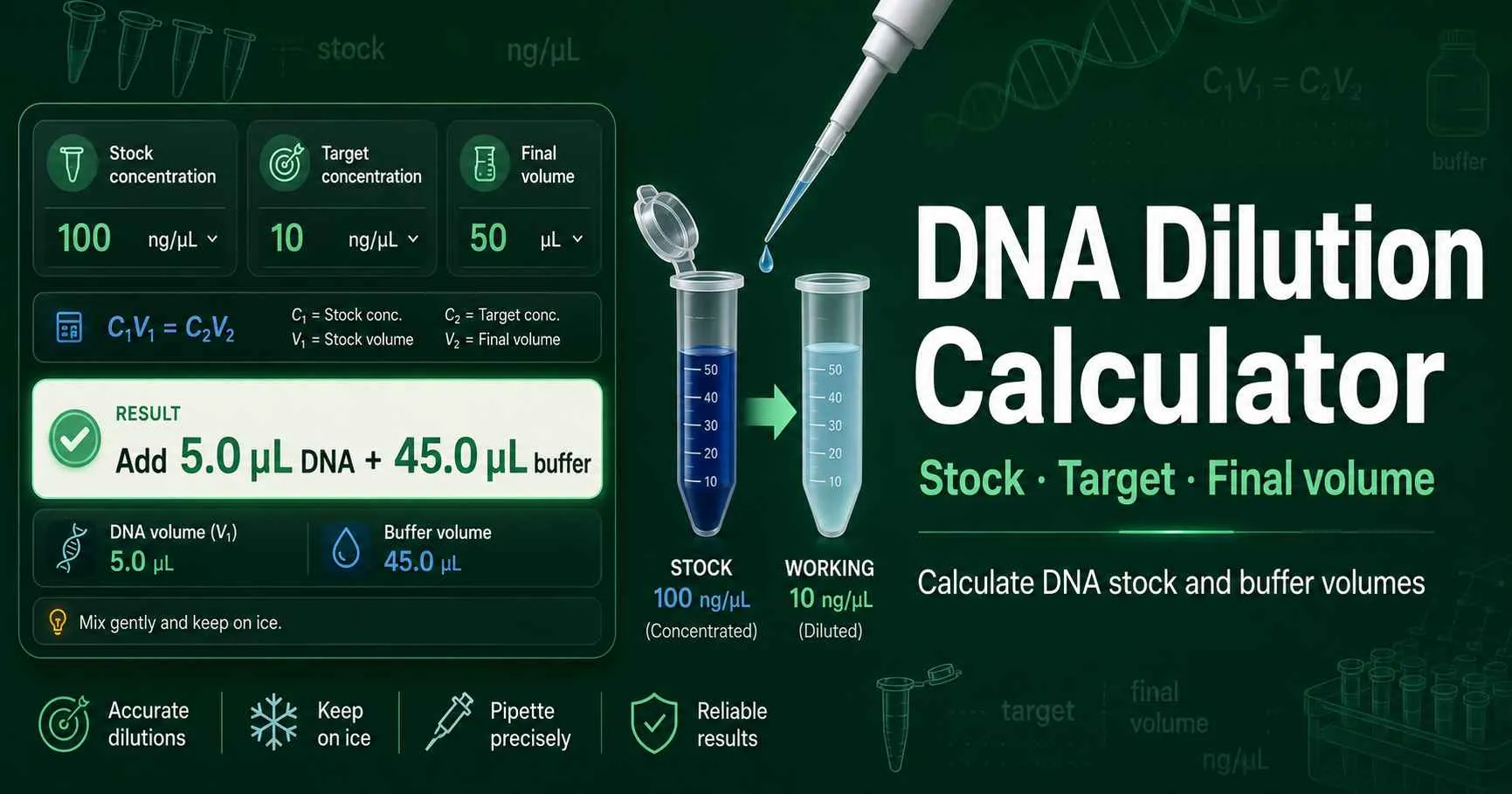
Use these tools when your dilution plan needs primer stocks, molarity conversion, or qPCR copy-number targets.

DNA dilution questions students and lab users ask

How do I dilute DNA from a stock concentration to a target concentration?

Use C1V1 = C2V2. C1 is the stock DNA concentration, C2 is the target concentration, and V2 is the final working volume. Solve for V1, then add diluent until the tube reaches V2. For example, 100 ng/µL stock to 5 ng/µL in 100 µL needs 5 µL stock DNA and 95 µL water or TE buffer.

Can I use this tool for copies per microliter instead of ng per microliter?

Yes. Advanced mode converts copies/µL into mass concentration after you enter DNA length and molecule type. The conversion uses molecular weight and Avogadro’s number. This is useful for qPCR standards because absolute quantification often starts from known template copy number rather than mass alone.

Why does DNA length matter in copy-number dilution?

A longer DNA molecule weighs more than a shorter DNA molecule. One nanogram of a 4,000 bp plasmid contains fewer molecules than one nanogram of a 150 bp PCR product. The calculator uses length to connect ng/µL, nM, and copies/µL in the same dilution plan.

What buffer should I use to dilute DNA?

Use nuclease-free water when you need a simple working stock for immediate PCR setup. Use TE buffer when you need better long-term stability, because Tris buffers pH and EDTA chelates divalent cations that nucleases need. Avoid high EDTA in sensitive enzymatic reactions when the final template volume is large.

What should I do when the calculated stock volume is too small to pipette?

Make an intermediate dilution first. Volumes below 1 µL often increase pipetting error, especially with viscous genomic DNA or low-retention tips that are not available. The calculator flags small stock volumes and suggests an intermediate dilution so you can pipette a larger, more reliable volume.

Can I use the calculator for primer working stocks?

Yes. Choose single-stranded DNA, enter the primer length, and use nM units in Advanced mode. A 100 µM primer stock equals 100,000 nM, and a 10 µM working stock equals 10,000 nM. This setup gives the same 1:10 dilution that many PCR and qPCR protocols use.

Does dilution change the total number of DNA molecules?

Dilution changes concentration, not the number of molecules transferred into the new tube. When you move 5 µL of stock DNA into a larger final volume, you transfer the molecules inside that 5 µL. The added water or buffer spreads those molecules across a larger volume, so copies/µL and ng/µL decrease.