ORF Finder Calculator for DNA Reading Frames

Find open reading frames in DNA and translate candidate coding regions instantly. This ORF Finder scans forward and reverse-complement frames, marks start and stop codons, ranks ORFs by length, and reports amino-acid sequences for cloning, annotation, and classroom genetics work.

Live ORF Finder Calculator

Paste a DNA sequence and the tool updates every ORF result as you change reading-frame, start-codon, and minimum-length settings.

Load an ORF Finder example sequence

Start with a ready sequence, then paste your own FASTA or plain DNA sequence.

DNA sequence input

Paste a coding strand, genomic fragment, plasmid insert, or FASTA record. The tool keeps A, C, G, and T.

Length

56 nt

GC content

46.4%

Removed

0

ORF scan settings

Control which strand, start codons, and minimum protein length the scanner uses.

DNA sequence previewDNA coding-region preview5′3′3′5′Codon boundaries appear every three bases. The ORF scanner reads each frame separately.

Live ORF result

Longest ORF: 36 nt / 11 aa

Frame +1 spans bases 7 to 42 and starts with ATG.

ORFs

1

Top frame

+1

Complete

Yes

Six-frame ORF map

Coloured bars show detected ORFs. Red ticks mark stop codons in each frame.

Six reading frame ORF mapSix-frame ORF mapFrame +1Frame +2Frame +3Frame -1Frame -2Frame -3

ORF table

Sort order starts with the longest ORF because longer uninterrupted coding frames usually deserve first review.

RankFrameCoordinatesLengthStartStopGC%Protein preview
1+174236 nt / 11 aaATGTAA44.4%MAELKRDGIAA

ORF length comparison

This chart helps you compare candidate coding regions before you inspect the protein sequence.

Frame +1, bases 74236 nt
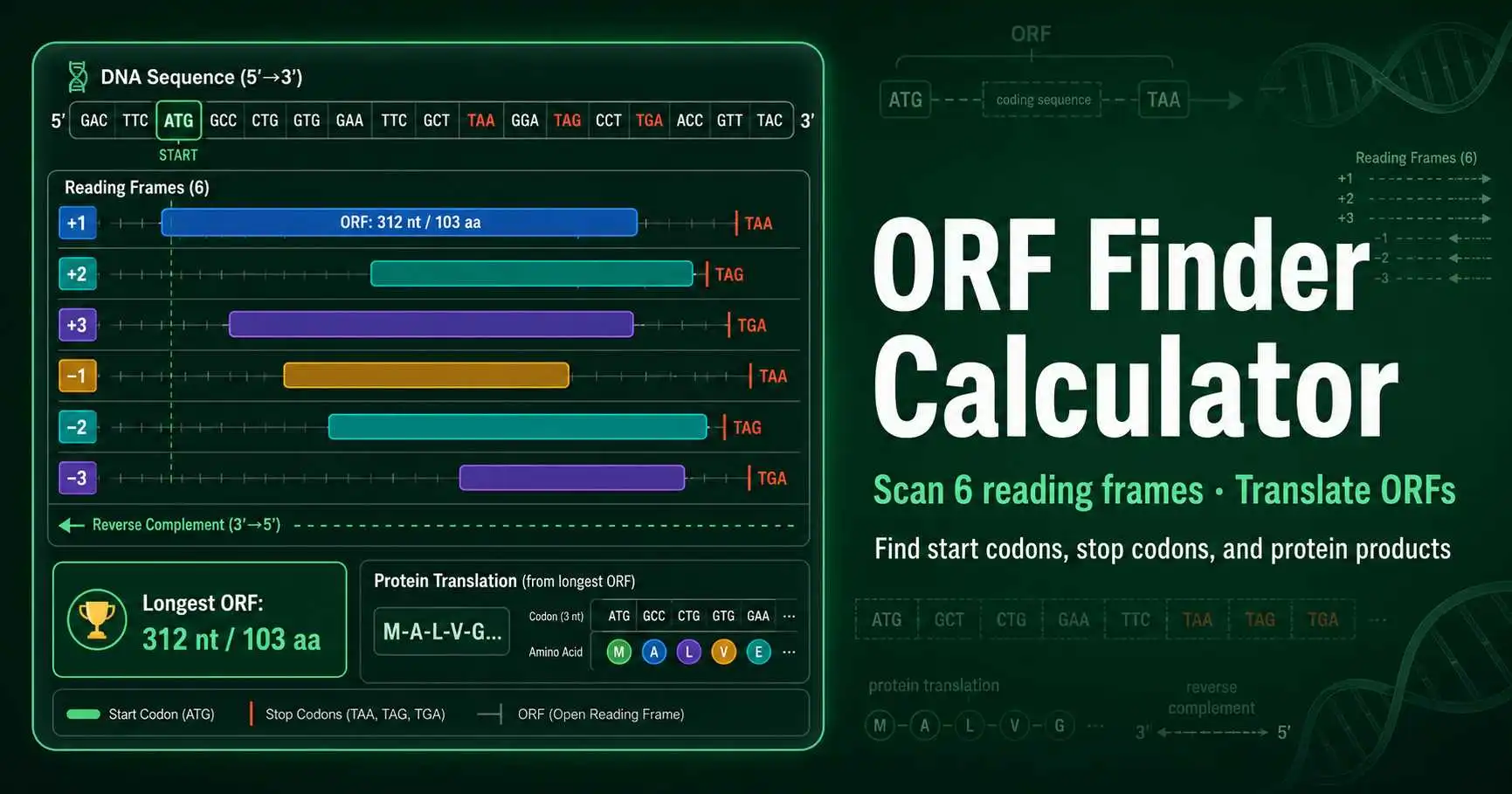
Six-frame ORF Finder diagram showing DNA start codons, stop codons, open reading frames, and translated protein products
Figure 1. ORF detection compares the three forward reading frames with the three reverse-complement frames. ATG marks the canonical DNA start codon, while TAA, TAG, and TGA mark termination codons that bound each candidate protein-coding region.

What is an open reading frame in DNA?

An open reading frame is a DNA interval that can translate in one codon frame without meeting an internal stop codon. Many ORF workflows start at ATG and end at TAA, TAG, or TGA. That simple rule gives students and researchers a fast first pass through plasmid inserts, bacterial contigs, and coding-sequence fragments.

NCBI describes ORFfinder as a tool that searches a submitted DNA sequence, returns the range of each ORF, and gives the corresponding protein translation. Review NCBI ORFfinder. This calculator follows the same core idea for educational use, then adds visual frame maps and sortable candidate tables.

A long ORF does not automatically mean a real gene. Functional annotation also checks conserved domains, transcript evidence, ribosome-binding context, codon usage, and evolutionary conservation. For translation review after ORF detection, use the Codon Usage & Translation Tool to inspect codon counts and amino-acid properties.

What each part of ORF Finder Calculator does

The sequence input accepts FASTA text, copied plasmid sequence, or a plain DNA fragment. It strips headers, spaces, numbers, and punctuation so the scan uses only A, C, G, and T. The live length and GC cards help you spot incomplete pastes or unusually GC-rich inserts before you interpret ORFs.

The reading-frame selector controls strand logic. Use all six frames when you do not know the coding orientation. Use forward or reverse-only scanning after primer design, Sanger sequencing, or cloning maps identify direction.

The start-codon rule changes biological sensitivity. ATG-only mode matches most introductory genetics problems. Alternative-start mode includes GTG, TTG, and CTG, which can matter in bacterial annotation and synthetic biology screening.

The ORF map gives quick visual feedback. Long coloured bars indicate candidate coding regions, while red tick marks show stop codons. The result table then provides exact frame, coordinate, length, start codon, stop codon, GC percentage, and protein preview.
How to use ORF Finder Calculator

  1. 1

    Paste DNA sequence into ORF Finder Calculator

    Enter a plain DNA sequence or FASTA text. The scanner keeps A, C, G, and T and removes spaces, numbers, and headers.

  2. 2

    Choose ORF Finder reading frames

    Scan all six reading frames when strand orientation is unknown, or limit the scan to forward or reverse frames when you know direction.

  3. 3

    Set ORF Finder start codon and length filters

    Use ATG only for standard classroom work, or include GTG, TTG, and CTG for bacterial alternative-start screening.

  4. 4

    Review ORF Finder coordinates and protein translation

    Compare ORF length, frame, start codon, stop codon, GC percentage, and translated amino-acid sequence.

ORF Finder reading frames and codon boundaries

DNA codons use triplets, so the same nucleotide string can produce three different forward-frame translations. The reverse complement adds three more possibilities. A real coding insert usually makes biological sense in one dominant frame, but sequencing reads and metagenomic contigs often arrive without orientation labels.

Translation starts with an initiation codon and stops at a termination codon. OpenStax explains how mRNA codons direct amino-acid addition during translation and how stop codons terminate the process. Read the OpenStax translation section.

FrameFirst codon starts atTypical useWhat to inspect
+1Base 1Known coding strand sequenceATG context and stop position
+2 / +3Base 2 or base 3Frameshift comparisonPremature stop codons
−1 to −3Reverse complementUnknown insert orientationLong reverse-strand ORFs

ORF Finder examples for common sequence tasks

Example 1: clone insert with one clear ATG

A student pastes a 63-base insert that contains ATG at base 7 and TAA at base 52. The ORF length equals 48 nucleotides, including the stop codon, and the translated protein contains 15 amino acids before termination. The +1 frame outranks the shorter alternatives, so it becomes the first coding candidate to inspect.

After that, the student can check target-region GC percentage with the GC Content Calculator before primer design.

Example 2: PCR product with unknown orientation

A PCR amplicon may contain a coding region on either strand. Six-frame scanning can reveal a long ORF in frame −2 even when forward frames contain many stop codons. That pattern tells the user to inspect the reverse-complement sequence before ordering primers or planning expression.

When the sequence comes from an oligo or primer workflow, compare primer behaviour in the Oligo Analyzer after identifying the likely coding orientation.

ORF Finder workflow for cloning, annotation, and teaching

Start with ORF detection, then translate the longest candidates. Next, compare codon usage, predicted protein length, GC percentage, and any known vector or primer constraints. This sequence of checks helps avoid a common mistake: choosing the longest ORF before confirming orientation and biological context.

Molecular workflows often connect ORF analysis with concentration and dilution planning. After you identify a coding insert, you may prepare primers with the Oligo Concentration Calculator or dilute working stocks with the Solution Dilution Calculator. Internal consistency across sequence analysis and wet-lab preparation reduces avoidable errors.

What ORF Finder Calculator cannot confirm by itself

This tool finds candidate open reading frames, but it does not annotate promoters, ribosome-binding sites, introns, untranslated regions, signal peptides, or protein domains. Eukaryotic genomic DNA often needs transcript-aware analysis because splicing joins exons before translation. Viral and mitochondrial genomes may use genetic-code variations that this educational scanner does not model.

Use ORF length as a ranking signal. Then validate the candidate with translation, similarity search, expression evidence, and organism-specific annotation rules. The output supports education and research planning; it does not replace a curated genome annotation pipeline.

ORF Finder Calculator FAQs

What does an ORF Finder Calculator do?
An ORF Finder Calculator scans a DNA sequence for open reading frames. It searches for start codons such as ATG, follows the same reading frame in codon triplets, and stops when it reaches TAA, TAG, or TGA. The tool reports the ORF position, strand, frame, DNA length, amino-acid length, and translated protein sequence. Long ORFs often mark candidate protein-coding regions, but they still need biological evidence.
Why does ORF Finder scan six reading frames?
Double-stranded DNA can encode a candidate ORF on either strand. Each strand has three possible reading frames because codons use groups of three nucleotides. A six-frame scan checks frames +1, +2, +3, −1, −2, and −3. This matters when you receive an insert, contig, or PCR product without a confirmed coding orientation.
Which start and stop codons does this ORF Finder use?
The default setting uses ATG as the start codon, which corresponds to AUG in mRNA and usually codes for methionine. The optional alternative-start mode also accepts GTG, TTG, and CTG, which some bacteria can use as initiation codons. The standard stop codons are TAA, TAG, and TGA in DNA. The protein preview removes the terminal stop symbol so the amino-acid length reflects the translated coding region.
How should I choose the minimum ORF length?
Short random ORFs appear often in long DNA sequences because stop codons occur by chance. For classroom examples, 8 to 30 amino acids makes the frame logic visible. For bacterial gene finding, many workflows review longer ORFs first, often above 100 amino acids, then compare protein similarity and codon usage. Raise the minimum length when a long contig produces too many short candidates.
Can an ORF prove that a DNA region encodes a protein?
No. An ORF only shows that a reading frame can run from a start codon to a stop codon without internal termination. Real protein-coding genes also show transcription evidence, ribosome binding or Kozak context, conserved protein domains, codon-usage patterns, and evolutionary conservation. In eukaryotes, introns can interrupt genomic ORFs before splicing. Treat an ORF as a candidate, not proof of translation.
What is the difference between an ORF and a coding sequence?
An ORF describes a stretch of DNA that can translate in one frame from start to stop. A coding sequence, or CDS, is the annotated protein-coding part of a gene after researchers confirm the biological product. A prokaryotic ORF can match a CDS closely because bacterial genes usually lack introns. A eukaryotic genomic ORF can look fragmented because spliceosomal introns interrupt exons.
Why does a frameshift change ORF prediction?
A frameshift insertion or deletion changes how the sequence splits into codons. One extra base can move every downstream triplet into a different frame. That new frame often meets a premature stop codon, which shortens the predicted ORF. ORF maps help students see why indels that are not multiples of three can disrupt protein sequence more severely than many substitutions.
Should I analyze GC content after finding an ORF?
Yes, GC content can reveal useful sequence context after ORF detection. A GC-rich ORF may affect PCR primer design, melting temperature, and cloning strategy. Very different GC content from the surrounding contig can also suggest horizontal gene transfer in microbial genomes. Use GC percentage as supporting evidence, not as a stand-alone gene call.

Use these tools after ORF detection to translate the coding sequence and evaluate sequence composition.