Example 1: coding strand translation
DNA sequence ATG-GCC-ATT uses frame +1. The mRNA codons become AUG-GCC-AUU after thymine changes to uracil. The protein begins M-A-I, which means methionine, alanine, and isoleucine.
Translate a DNA coding sequence into protein, compare reading frames, inspect the reverse complement, and identify the longest ATG-started open reading frame. This tool helps biology students, molecular cloning users, and sequence-analysis learners connect nucleotide triplets with amino-acid products.
Paste DNA and the translation updates instantly. No submit button interrupts the workflow.
Paste a DNA coding sequence. The tool removes spaces, numbers, punctuation, and converts U to T.
Select the strand, reading frame, and genetic code before comparing the protein output.
Live translation result
Current frame +1 on the forward coding strand produces 2 stop codons.
GC
56.4%
Starts
2
Stops
2
Copy this amino-acid sequence for downstream annotation or ORF comparison.
Best candidate: Forward frame 1, bases 1–24.
Length: 7 amino acids ending at a stop codon.
The bars group translated residues by broad biochemical behaviour. Methionine appears as a start class.
Each row shows the DNA codon, mRNA codon, amino acid, and residue class.
| # | DNA codon | mRNA codon | Amino acid | Property | Bases |
|---|---|---|---|---|---|
| 1 | ATG | AUG | MMethionine | Start | 1–3 |
| 2 | GCC | GCC | AAlanine | Hydrophobic | 4–6 |
| 3 | ATT | AUU | IIsoleucine | Hydrophobic | 7–9 |
| 4 | GTA | GUA | VValine | Hydrophobic | 10–12 |
| 5 | ATG | AUG | MMethionine | Start | 13–15 |
| 6 | GGC | GGC | GGlycine | Special | 16–18 |
| 7 | CGC | CGC | RArginine | Positive | 19–21 |
| 8 | TGA | UGA | *Stop codon | Stop | 22–24 |
| 9 | AAG | AAG | KLysine | Positive | 25–27 |
| 10 | GGT | GGU | GGlycine | Special | 28–30 |
| 11 | GCC | GCC | AAlanine | Hydrophobic | 31–33 |
| 12 | CGA | CGA | RArginine | Positive | 34–36 |
| 13 | TAG | UAG | *Stop codon | Stop | 37–39 |
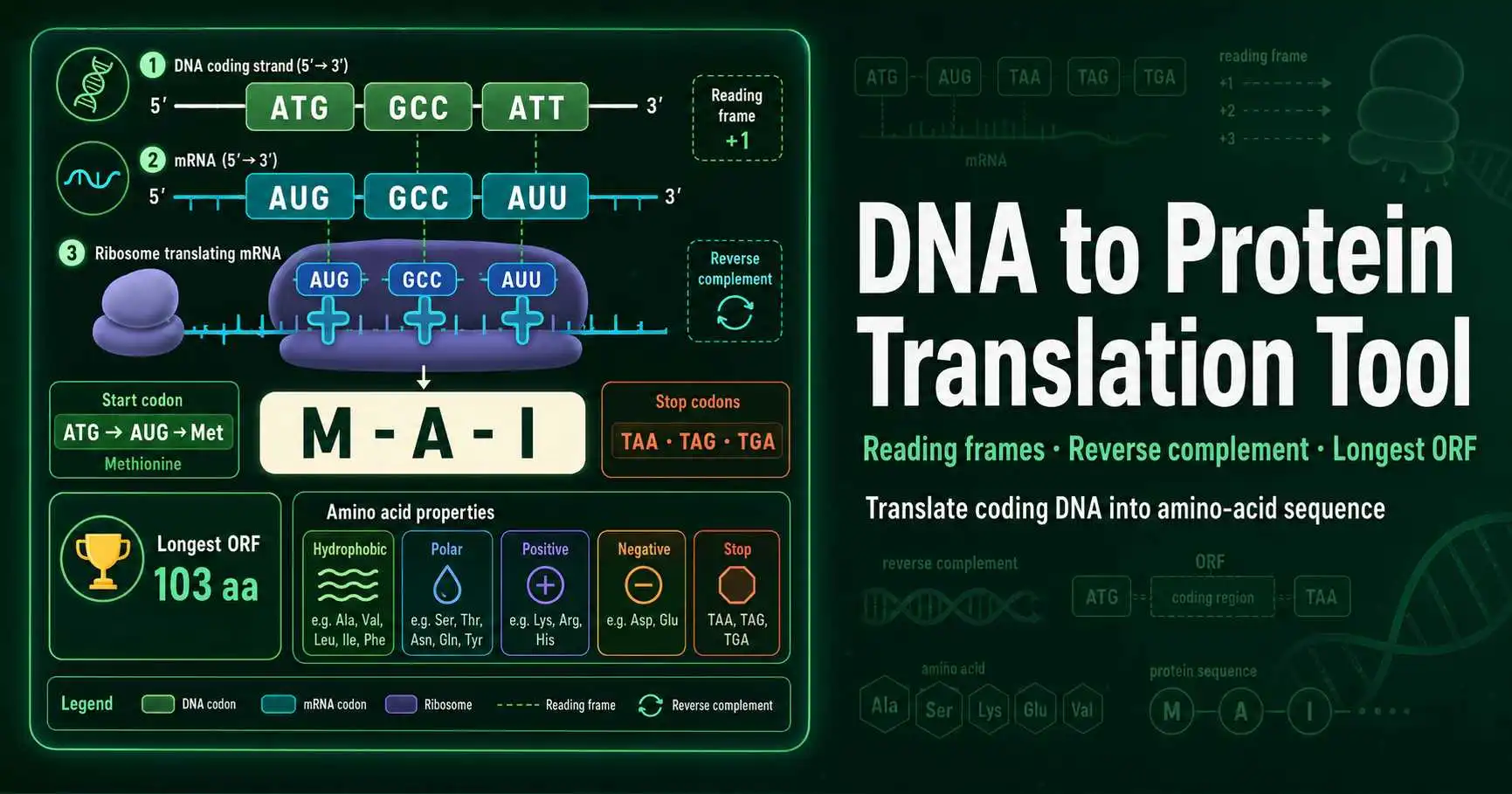
DNA to protein translation connects a nucleotide sequence with a peptide sequence through the genetic code. A coding DNA strand uses triplets such as ATG, GCT, and TAA. Transcription changes the DNA coding pattern into mRNA codons such as AUG, GCU, and UAA.
Ribosomes read mRNA from 5′ to 3′ in non-overlapping codons. Transfer RNAs bring amino acids that match those codons through anticodon pairing. One shifted nucleotide changes the codon grouping, so reading frame selection can transform the entire translated product.
Use this translator after checking sequence composition with the GC Content Calculator. If you want codon-frequency counts after translation, compare the result with the Codon Usage & Translation Tool.
Enter a DNA sequence using A, C, G, and T. The tool removes spaces and converts U to T automatically.
Select forward or reverse complement, then choose frame +1, +2, or +3 to control codon grouping.
Use the standard nuclear code for most classroom examples, or vertebrate mitochondrial code for vertebrate mtDNA.
Review the translated amino-acid sequence, start and stop codons, amino-acid properties, and longest ORF candidate.
The sequence input card cleans pasted DNA and keeps the original workflow visible. Example presets load common classroom cases, including a clean ORF, a shifted frame, and a reverse-strand sequence.
The strand selector controls whether the tool reads the forward coding strand or reverse complement. Reading-frame buttons decide which base starts the first codon. The genetic-code menu separates standard nuclear translation from vertebrate mitochondrial translation.
The result banner gives the immediate protein length, GC percentage, start count, and stop count. The codon table then shows each DNA codon, mRNA codon, amino acid, residue property, and nucleotide coordinate. The longest ORF panel searches all six frames for the most plausible ATG-started protein candidate.
DNA sequence ATG-GCC-ATT uses frame +1. The mRNA codons become AUG-GCC-AUU after thymine changes to uracil. The protein begins M-A-I, which means methionine, alanine, and isoleucine.
Add one extra A before ATGGCC and the frame changes. AAT-GGC-C now gives N-G instead of M-A. Frameshift mutations often introduce early stop codons because every downstream triplet changes.
A double-stranded DNA molecule has six possible reading frames. Three occur on the forward strand, and three occur on the reverse complement. The correct frame usually contains a biologically plausible start codon, a long amino-acid sequence, and a stop codon at the expected end.
| Frame | First codon starts at | Use case |
|---|---|---|
| +1 | Base 1 of the forward sequence | Most common when the pasted sequence starts at ATG. |
| +2 | Base 2 of the forward sequence | Useful when an upstream base precedes the coding region. |
| +3 | Base 3 of the forward sequence | Checks whether the coding sequence begins after two extra bases. |
Translation checks whether a cloning insert preserves the expected open reading frame. A single missing base can create a premature stop codon. A reverse-complement mistake can produce a short, stop-rich protein instead of the expected product.
Protein translation also supports primer and amplicon review. After locating a coding region with the ORF Finder Calculator, translate the candidate sequence and check whether the amino-acid output matches the expected domain length.
Raw eukaryotic genomic DNA may contain introns. Translation before splicing can add false codons, early stop signals, and incorrect residue order. Use cDNA or verified coding sequence when you need a final protein product.
Sequence direction matters. A coding sequence, template strand, and reverse complement can look similar at a glance but translate differently. Always confirm 5′ to 3′ orientation before copying protein results into a report or cloning plan.
A DNA to protein translation tool converts a DNA coding sequence into an amino-acid sequence. It reads the sequence in codons, where each complete three-base triplet specifies one amino acid or a stop signal. ATG usually translates to methionine and often marks the start of a coding region. The tool also shows the reading frame, reverse-complement output, and amino-acid property profile.
Paste the coding strand when you already know the sequence runs 5′ to 3′ in the same direction as the mRNA. The coding strand contains T where mRNA contains U, so ATG becomes AUG after transcription. If your sequence came from the opposite strand, select reverse complement before reading the protein. The tool lets you compare both strands without editing the original input.
Translation reads nucleotides in groups of three. Starting at base 1, base 2, or base 3 creates different codons from the same DNA sequence. For example, ATGGCC gives ATG-GCC in frame +1, but TGG-CC in frame +2 after the first base shifts. A one-base insertion or deletion can therefore change every downstream codon.
The asterisk symbol marks a stop codon. In the standard nuclear genetic code, TAA, TAG, and TGA terminate translation. Stop codons do not add amino acids to the growing peptide chain. You can hide the asterisk when you want a clean residue string, but keeping it visible helps identify truncated products.
Yes. The longest ORF scan searches the forward sequence and reverse complement for ATG-started candidate products. It reports the strand, frame, nucleotide coordinates, amino-acid length, and whether the candidate ends at a stop codon. This quick scan helps you identify the most plausible protein product before deeper annotation. For full gene prediction, you still need exon boundaries and organism-specific evidence.
Protein translation asks which amino-acid sequence a DNA or mRNA sequence encodes. Codon usage asks how often each synonymous codon appears across that coding sequence. Two codons can encode the same amino acid, such as GCT and GCC for alanine. Codon usage matters in cloning, expression systems, and synthetic gene design because organisms prefer different synonymous codons.
Mitochondrial genomes use code differences from the standard nuclear code. In vertebrate mitochondria, ATA encodes methionine, TGA encodes tryptophan, and AGA or AGG usually act as stop codons. Those differences can change a translated protein substantially. Choose the vertebrate mitochondrial code only when the sequence comes from vertebrate mitochondrial DNA.
It can translate any A, C, G, and T sequence, but introns will disrupt the predicted protein. Eukaryotic mRNA splicing removes introns before ribosomes translate codons. If you paste raw genomic DNA from a multi-exon gene, the output can contain false stop codons or wrong amino acids. Use a coding DNA sequence or spliced cDNA when you want a biologically meaningful protein product.
Use these tools to continue from translated proteins into codon frequency and open-reading-frame checks.