Minor Allele Frequency Calculator

Calculate minor allele frequency from genotype counts, allele counts, or AC/AN-style variant data. The tool identifies the major allele, minor allele, MAF, observed heterozygosity, expected heterozygosity, and frequency class so you can interpret SNP data quickly.

Calculate MAF from AA, Aa, aa, AC, or AN values

Start with genotype counts in Basic mode. Switch to Advanced mode when you need custom allele labels, allele-count input, a MAF filter cutoff, or multiallelic data.

Choose the data type you have

Use genotype counts for AA/Aa/aa data. Use allele counts when a VCF or database gives AC and AN values.

Input counts

Enter non-negative counts. The result updates as soon as any value changes.

Quick presets

Load a realistic dataset, then adjust the counts for your own sample.

Live result

MAF = 35.00%

The minor allele is G. The major allele is A. MAF is at least 5%, so both alleles occur often in this sample.

Status

Common variant

Major frequency

65.00%

Expected He

0.455

Allele frequencies

A frequency65.00%
G frequency35.00%

Allele copy view

Allele copies in a population sampleG: minor allele copiesA: major allele copies

Genotype and Hardy-Weinberg summary

Sample size

100

Allele copies

200

Observed Ho

0.46

F estimate

-0.011

GenotypeObserved countExpected countMeaning
AA4242.25Homozygous for allele 1
AG4645.5Heterozygous genotype
GG1212.25Homozygous for allele 2
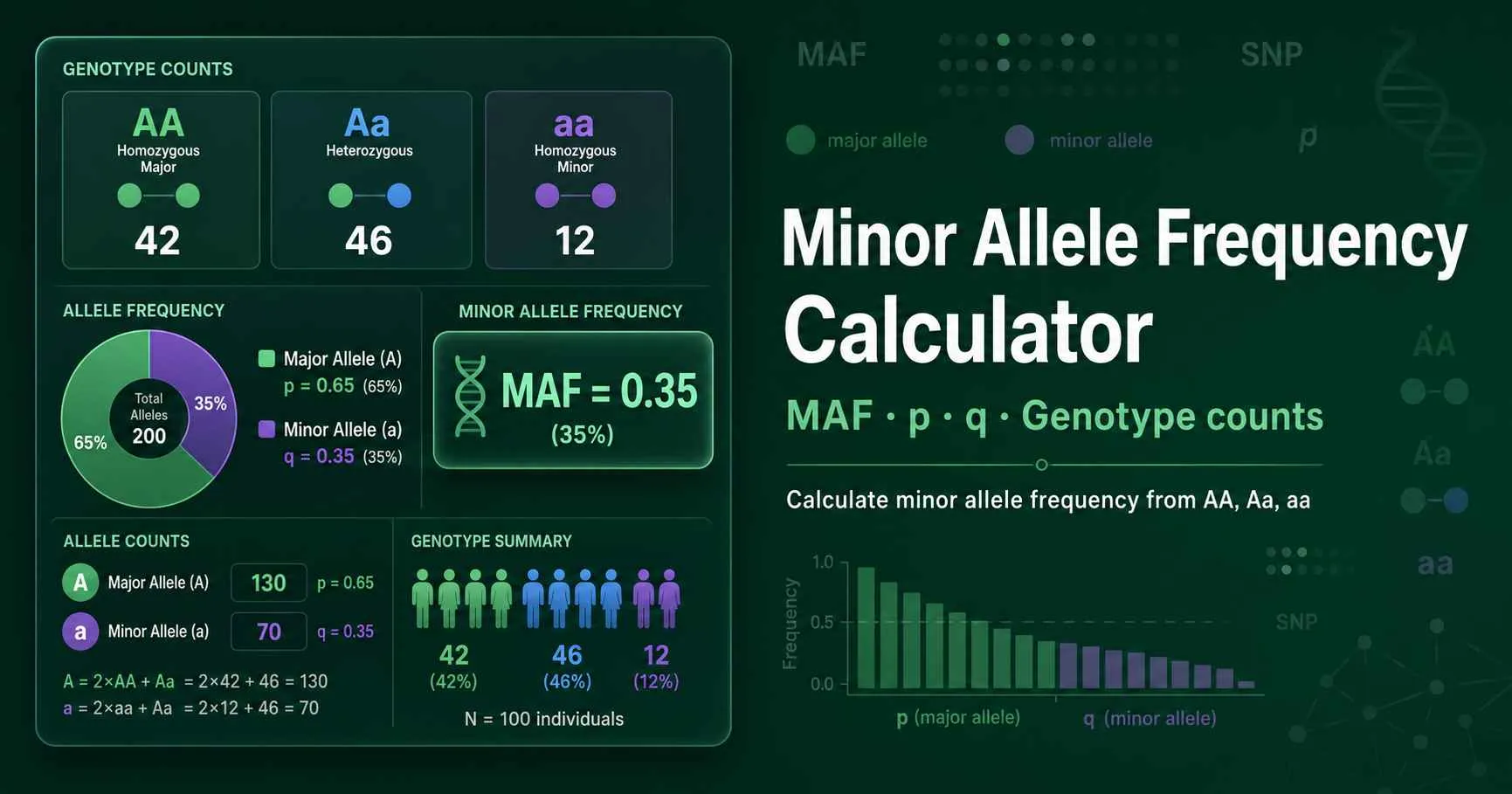
Minor allele frequency diagram showing genotype counts, allele copy counts, MAF, Ho, He, and SNP frequency classes
Figure 1. A minor allele frequency workflow converts genotype counts such as AA, Aa, and aa into allele copy counts. The same idea applies to SNP allele count fields such as AC and AN, then MAF reports the second most common allele in the population sample.

Minor allele frequency tells you how common the less frequent allele is

MAF answers a direct question: how often does the less common allele appear in this sample? For a biallelic SNP, one allele has frequency p and the other has frequency q. The minor allele frequency equals the smaller of p and q.

Use MAF before association testing, population comparison, variant filtering, or classroom Hardy-Weinberg analysis. If you need the full p and q values first, use the allele frequency calculator before deciding which allele is minor.

Ensembl describes minor alleles for 1000 Genomes variants and notes that multiallelic sites can report the second most common allele as the minor allele. That detail matters because REF and ALT labels do not always reveal frequency rank. Read Ensembl’s population allele-frequency guide.

What each input and result means

The calculator separates genotype data, allele-count data, and interpretation metrics. This helps students and lab users avoid mixing sample counts with chromosome counts.

AA, Aa, aa counts

Observed genotype counts from diploid individuals.

Purpose: Use this when you counted genotypes directly.

AC and AN style counts

Allele count and total allele number from variant data.

Purpose: Use this when data comes from a VCF or population database.

MAF

The frequency of the second most common allele.

Purpose: Use it to classify rare, low-frequency, or common variants.

Ho and He

Observed and expected heterozygosity.

Purpose: Use them to check whether heterozygote counts look unusual.

MAF formula from genotype counts

Biallelic SNP formula

For AA, Aa, and aa counts, calculate allele copies first. A diploid sample with N individuals contains 2N allele copies.

p(A) = (2AA + Aa) / 2N
q(a) = (2aa + Aa) / 2N
MAF = min(p, q)

AC and AN formula

Variant files often report allele count as AC and allele number as AN. For a biallelic variant, ALT frequency equals AC divided by AN.

ALT frequency = AC / AN
REF frequency = 1 − ALT frequency
MAF = smaller frequency

Worked examples for SNP datasets

Example 1: MAF from AA, AG, and GG

A SNP has AA = 42, AG = 46, and GG = 12 in 100 individuals. The A count equals 2(42) + 46 = 130. The G count equals 2(12) + 46 = 70.

The total allele number equals 200. A frequency equals 0.65, and G frequency equals 0.35. MAF equals 0.35, so G is the minor allele in this sample.

Example 2: MAF from AC and AN

A variant table reports AC = 8 and AN = 1,000. The ALT frequency equals 0.008, or 0.8%. The reference frequency equals 99.2%.

MAF equals 0.8%, so this variant falls below a 1% rare-variant threshold. Check call rate, sequencing depth, and population match before you interpret the result.

How to interpret MAF values

Rare: below 1%

Rare variants need larger samples and careful genotype quality checks. One extra heterozygote can change the estimate.

Low frequency: 1–5%

Low-frequency variants can matter in association studies, but power drops quickly when allele counts are small.

Common: 5% or higher

Common variants usually support stable allele-frequency estimates, especially when sample size is adequate.

MAF works best when you interpret it with genotype frequencies, not alone. The genotype frequency calculator helps you compare AA, Aa, and aa classes when heterozygote counts look unusual.

Quality checks before using MAF filters

MAF filters can clean noisy data, but they can also remove real biology. A rare allele may represent a young mutation, a local population signal, or a meaningful variant in a small cohort.

Check call rate, missingness, duplicate concordance, read depth, and population structure before you apply a hard cutoff. Compare observed heterozygosity with expected heterozygosity using the heterozygosity calculator when a SNP shows fewer heterozygotes than expected.

This tool supports education and research planning. It does not classify clinical variants, diagnose disease risk, or replace population-matched reference databases.

Minor allele frequency FAQs

What is minor allele frequency?

Minor allele frequency, or MAF, measures how often the second most common allele appears in a defined population sample. For a biallelic SNP with allele frequencies p and q, MAF equals the smaller value. MAF can never exceed 0.5 at a biallelic locus because the minor allele cannot outnumber the major allele. Researchers use MAF to separate common variants, low-frequency variants, and rare variants before downstream analysis.

How do I calculate MAF from AA, Aa, and aa genotype counts?

Count allele A as 2AA + Aa and allele a as 2aa + Aa. Divide each allele count by 2N, where N equals the number of genotyped individuals. The smaller allele frequency gives the MAF. For AA = 42, Aa = 46, and aa = 12, allele a has frequency 0.35, so MAF equals 35%.

How do I calculate MAF from AC and AN values?

AC usually means alternate allele count, and AN means total allele number across called chromosomes. For a biallelic variant, alternate allele frequency equals AC divided by AN. The reference allele frequency equals 1 minus that value. MAF equals the smaller of those two frequencies, so an AC of 14 and AN of 200 gives MAF = 7% if the alternate allele is the minor allele.

What MAF cutoff should I use?

Many studies label MAF below 1% as rare and MAF between 1% and 5% as low frequency. A 5% cutoff often appears in classroom examples and association-study filtering. Your cutoff should match the study goal, sample size, sequencing depth, and population structure. Do not remove low-MAF variants automatically when rare variation matters for your research question.

Can MAF change between populations?

Yes. MAF belongs to a specific population, cohort, or sample. An allele can appear common in one ancestry group and rare in another because drift, migration, selection, and founder effects change allele frequencies. Always compare MAF values with a population-matched reference when you interpret human SNP data. Pooled global MAF can hide local patterns.

Is the minor allele always the alternate allele?

No. The alternate allele in a VCF is not always the minor allele. VCF REF and ALT labels follow a reference genome coordinate system, not a frequency ranking. If ALT frequency rises above 50% in a sample, the reference allele becomes the minor allele. This calculator reports the minor allele from the entered counts rather than assuming ALT is minor.

Can I use this calculator for multiallelic variants?

Yes, use Advanced allele-count mode when more than two alleles appear. For multiallelic variants, many databases report the second most common allele as the minor allele. This page follows that interpretation in allele-count mode. Review each allele separately when the third or fourth allele has biological or clinical relevance.