PCR Product Size Calculator

Find the expected PCR product size from a DNA template, forward primer, and reverse primer. The calculator reports primer binding sites, amplicon coordinates, product GC content, basic primer Tm values, and multiple-product warnings.

Live PCR Product Size Calculator

Paste your template and primer sequences. Results update instantly as the primer pair changes.

PCR product size presets

Load a clean product, a longer amplicon, or a multiple-site example. All results update as you edit the sequences.

Template DNA sequence

Paste the strand you want to search. The calculator removes spaces, line breaks, and numbering.

Length

109

GC

53.2%

Matches

1

Primer pair

Enter both primers 5′ to 3′. The reverse primer is automatically reverse-complemented before template matching.

Reverse-primer binding sequence on template

TACGATCGTACCGTAA

Live PCR result

98 bp PCR product predicted

The product spans template bases 12 to 109, including both primer-binding regions.

Amplicons

1

Product GC

52.0%

Tm gap

2.6°C

PCR product size diagramPrimer orientation on template DNA5′3′3′5′Forward primerReverse primerPredicted product: 98 bp

Primer quality summary

Forward primer

ATGACCAAGTTCGACG

Length: 16 bases

GC: 50.0%

Basic Tm: 43.4 °C

Reverse primer

TTACGGTACGATCGTA

Length: 16 bases

GC: 43.8%

Basic Tm: 40.8 °C

Predicted PCR products

Exact-match products appear only when the forward primer binds upstream of the reverse-primer binding site.

ProductForward startReverse startCoordinatesLengthGC%
Product 112941210998 bp52.0%

Amplicon sequence preview

The preview highlights the first 80 bases of the predicted PCR product.

ATGACCAAGTTCGACGATGCTACCGGATCCGTTACGGTACCGGTTAGCTAGGATCCTAACCGGTACCGTAACGGATCGAT

ATGACCAAGTTCGACGATGCTACCGGATCCGTTACGGTACCGGTTAGCTAGGATCCTAACCGGTACCGTAACGGATCGATCGTACGATCGTACCGTAA

PCR product size diagram showing forward primer, reverse primer, DNA template, and expected amplicon length
Figure 1. PCR amplification uses a forward primer, a reverse primer, template DNA, and DNA polymerase to copy the sequence between two primer-binding sites. The diagram shows how primer orientation defines the amplicon boundary, product size, and strand direction.

What is PCR product size?

PCR product size is the length of the DNA fragment amplified between a forward primer and a reverse primer. The value includes both primer sequences and the internal template region. Molecular biologists often call this fragment an amplicon.

Kary Mullis developed polymerase chain reaction in the 1980s, and PCR rapidly became a core method for cloning, diagnostics, sequencing preparation, and genotyping. The National Human Genome Research Institute describes PCR as a fast technique that amplifies small DNA segments for analysis. Read the NHGRI PCR fact sheet.

Product size depends on primer position and orientation. A forward primer must bind upstream of the reverse-primer binding sequence. DNA polymerase then extends each primer in the 5′ to 3′ direction, producing a fragment bounded by those sites.

How to use PCR Product Size Calculator

  1. 1

    Paste the DNA template sequence

    Enter the template strand as A, C, G, and T bases. The calculator removes spaces, line breaks, and numbering.

  2. 2

    Enter the forward PCR primer

    Type the forward primer in 5′ to 3′ orientation so the tool can find its exact site on the template strand.

  3. 3

    Enter the reverse PCR primer

    Type the reverse primer in 5′ to 3′ order. The calculator reverse-complements it before matching the template.

  4. 4

    Read the predicted amplicon size

    Use the result banner, product table, and diagram to check product length, coordinates, Tm gap, and multiple-product warnings.

What each part of PCR Product Size Calculator does

The template box stores the DNA strand searched for primer-binding sites. The calculator cleans FASTA-style spacing and numbering, then keeps only A, C, G, and T bases. Use the GC Content Calculator when you need a separate sequence-composition check before primer design.

The primer pair card accepts the forward and reverse primers in 5′ to 3′ order. The reverse-primer binding display shows the reverse complement that the calculator actually searches on the template. This helps users catch the most common orientation mistake.

The result banner reports the shortest valid forward-to-reverse amplicon first. The primer quality cards show length, GC percentage, and a basic Tm estimate. For reaction-condition-sensitive Tm work, compare the same primers in the DNA Melting Temperature Tm Calculator.

The product table lists every exact-match amplicon found in the template. Multiple products suggest repeated binding sites, so you should inspect primer specificity with the Oligo Analyzer before ordering primers.
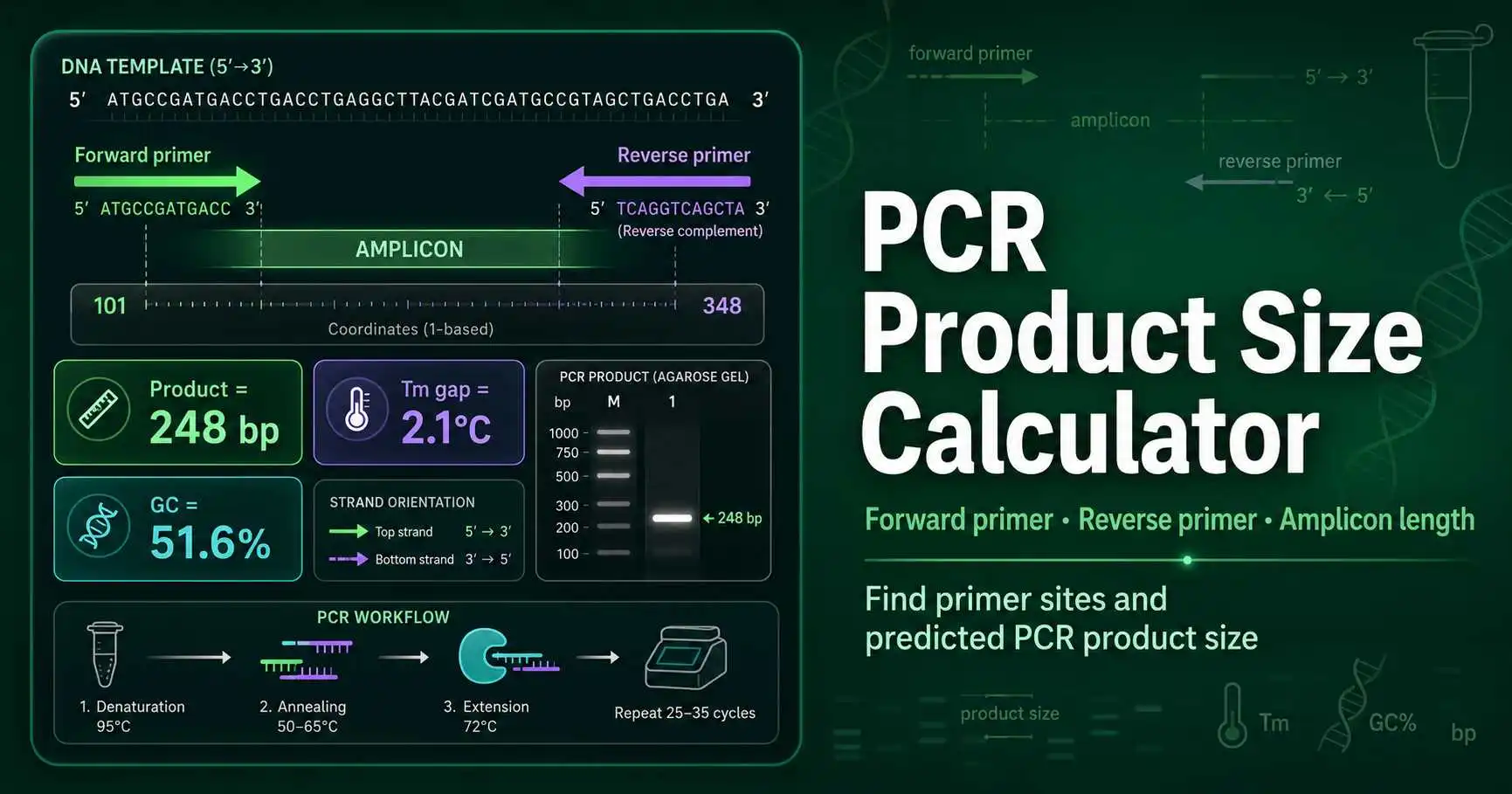
PCR primer orientation and amplicon coordinates

Primer orientation decides whether PCR can amplify a region. The forward primer binds one strand and points toward the target. The reverse primer binds the opposite strand and also points toward the target after reverse-complement matching.

Coordinates work like a ruler on the pasted template. If the forward primer starts at base 25 and the reverse-primer binding site ends at base 164, the expected product length equals 140 bp. This full count includes the primer sequences because they become part of the final amplified DNA.

ComponentDirection enteredTemplate searchWhy it matters
Forward primer5′→3′Exact sequenceDefines the left edge of the amplicon.
Reverse primer5′→3′Reverse complementDefines the right edge of the amplicon.
PCR productForward-to-reverseBetween primer sitesPredicts the gel band size in base pairs.

PCR product size examples

Example 1: single 96 bp amplicon

A forward primer begins at base 10 and a reverse-primer binding site ends at base 105. Product size equals 105 − 10 + 1, so the expected PCR band is 96 bp. This product should appear as one clean band when both primers bind uniquely.

Example 2: repeated primer site

A template contains two forward-primer sites and one reverse-primer binding site. The calculator can return two possible products, such as 120 bp and 285 bp. In a gel, that design may create two bands unless one site fails under the chosen annealing conditions.

PCR amplicon size in cloning, sequencing, and genotyping

Product-size prediction helps before ordering primers. Cloning workflows need the correct insert length. Sanger sequencing needs a product that covers the target but still produces clean reads. Genotyping assays often use size differences to separate alleles on agarose or capillary systems.

Amplicon length also affects amplification efficiency. Short products amplify faster and often work better with degraded DNA. Longer products can capture more sequence context, but they demand stronger template quality, longer extension time, and suitable polymerase chemistry.

PCR product size calculator accuracy notes

This calculator uses exact sequence matching. It does not score mismatches, secondary structure, primer dimers, genomic repeats outside the pasted template, or polymerase-specific extension limits. Those factors can change the result in real assays.

Treat the output as a product-size prediction from the sequence you pasted. For clinical, forensic, diagnostic, or regulated laboratory work, validate primer specificity with an accepted alignment workflow and local assay controls.

PCR Product Size Calculator FAQs

What does a PCR Product Size Calculator do?
A PCR Product Size Calculator finds where a forward primer and reverse primer bind on a DNA template. It reports the expected amplicon length in base pairs, including both primer-binding regions. This tool searches exact matches, so it works best when you already know the template sequence. It also reports primer Tm, GC content, and warnings for multiple possible products.
How do I enter the reverse primer for PCR product size?
Enter the reverse primer in the normal 5′ to 3′ order, exactly as you would order it from an oligo supplier. The calculator reverse-complements that primer before searching the template strand. This step matters because the reverse primer binds the opposite strand and extends toward the forward primer. If you paste the binding sequence instead, the tool may not find the correct product.
Does PCR product size include the primer sequences?
Yes. Standard amplicon length includes the forward primer sequence, the internal template sequence, and the reverse-primer binding region. If the forward primer starts at base 101 and the reverse-primer binding region ends at base 350, the product length equals 250 bp. Gel bands usually correspond to that full amplified fragment. This calculator reports coordinates using the same inclusive product logic.
Why did the PCR Product Size Calculator find more than one product?
Multiple predicted products mean at least one primer sequence occurs more than once in the template. Repeated sequences, paralogous regions, and low-complexity DNA can create several forward-to-reverse combinations. In the lab, those products can appear as extra gel bands or mixed sequencing traces. Redesign one primer so the pair targets a unique region.
What primer Tm difference is acceptable for PCR?
Many routine PCR designs keep forward and reverse primer Tm values within about 3–5 °C. A large difference can make one primer bind efficiently while the other binds poorly. This calculator flags a Tm gap above 5 °C as a design note. For final primer ordering, use a nearest-neighbor Tm calculator with salt, magnesium, and primer concentration settings.
Can this calculator detect mismatched primer binding?
No. This version uses exact primer matching so students can see the core orientation and coordinate logic clearly. Real PCR can tolerate some mismatches, especially away from the 3′ end, but mismatch effects depend on polymerase, annealing temperature, template complexity, and primer chemistry. Use exact matching first when you want a clean expected product size. Then check questionable primers with alignment software before running the assay.
What PCR product size should I choose for routine PCR?
Routine endpoint PCR often works well with products from about 100 bp to 1,000 bp when template quality and polymerase choice match the target. qPCR assays usually use shorter products, often around 70–200 bp, because short amplicons amplify efficiently. Long-range PCR can amplify larger products, but it needs enzyme and cycling conditions designed for long templates. Choose product length based on the assay goal, not only primer position.

Use these molecular tools to refine primer design after you calculate the expected amplicon size.