Scenario preset buttons
These buttons load common genetics questions instantly. They cover carrier mothers, affected fathers, X-linked dominant crosses, and Y-linked father-to-son transmission.
Use this sex-linked inheritance calculator to predict offspring probabilities for X-linked recessive, X-linked dominant, and Y-linked traits. The tool separates daughters and sons because sex chromosomes change the meaning of each genotype. It works for classroom problems about hemophilia, red-green color vision, Duchenne muscular dystrophy, and father-to-son Y-linked transmission.
Choose a preset or select each parent genotype manually. The result updates instantly and shows affected sons, affected daughters, carrier daughters, and unaffected children.
Start with a common classroom cross, then adjust the inheritance type and parental genotypes.
Select whether the allele sits on the X chromosome or Y chromosome.
The mother contributes an X chromosome to every child.
One usual allele and one recessive trait allele. She passes each allele to half of children.
The father contributes an X chromosome to daughters and a Y chromosome to sons.
He passes Xᴬ to daughters and Y to sons.
Live result
X-linked recessive cross: XᴬXᵃ × XᴬY. Probabilities assume equal sex ratio, equal gamete frequency, complete penetrance, and no embryonic selection.
Affected children
25%
Overall probability that a child shows the trait phenotype.
Affected sons
25%
Probability among all possible children, not only among sons.
Affected daughters
0%
Probability among all possible children, not only among daughters.
Carrier daughters
25%
Carrier status applies to X-linked recessive female offspring in this tool.
Unaffected children
75%
Children without the trait phenotype. X-linked recessive carriers appear here clinically unaffected.
Each row combines gametes into a child genotype, sex, phenotype, and probability.
| Maternal gamete | Paternal gamete | Child sex | Genotype | Phenotype | Probability |
|---|---|---|---|---|---|
| Xᴬ | Xᴬ | daughter | XᴬXᴬ | not carrierNon-carrier daughter | 25% |
| Xᵃ | Xᴬ | daughter | XᴬXᵃ | carrierCarrier daughter | 25% |
| Xᴬ | Y | son | XᴬY | unaffectedUnaffected son | 25% |
| Xᵃ | Y | son | XᵃY | affectedAffected son | 25% |
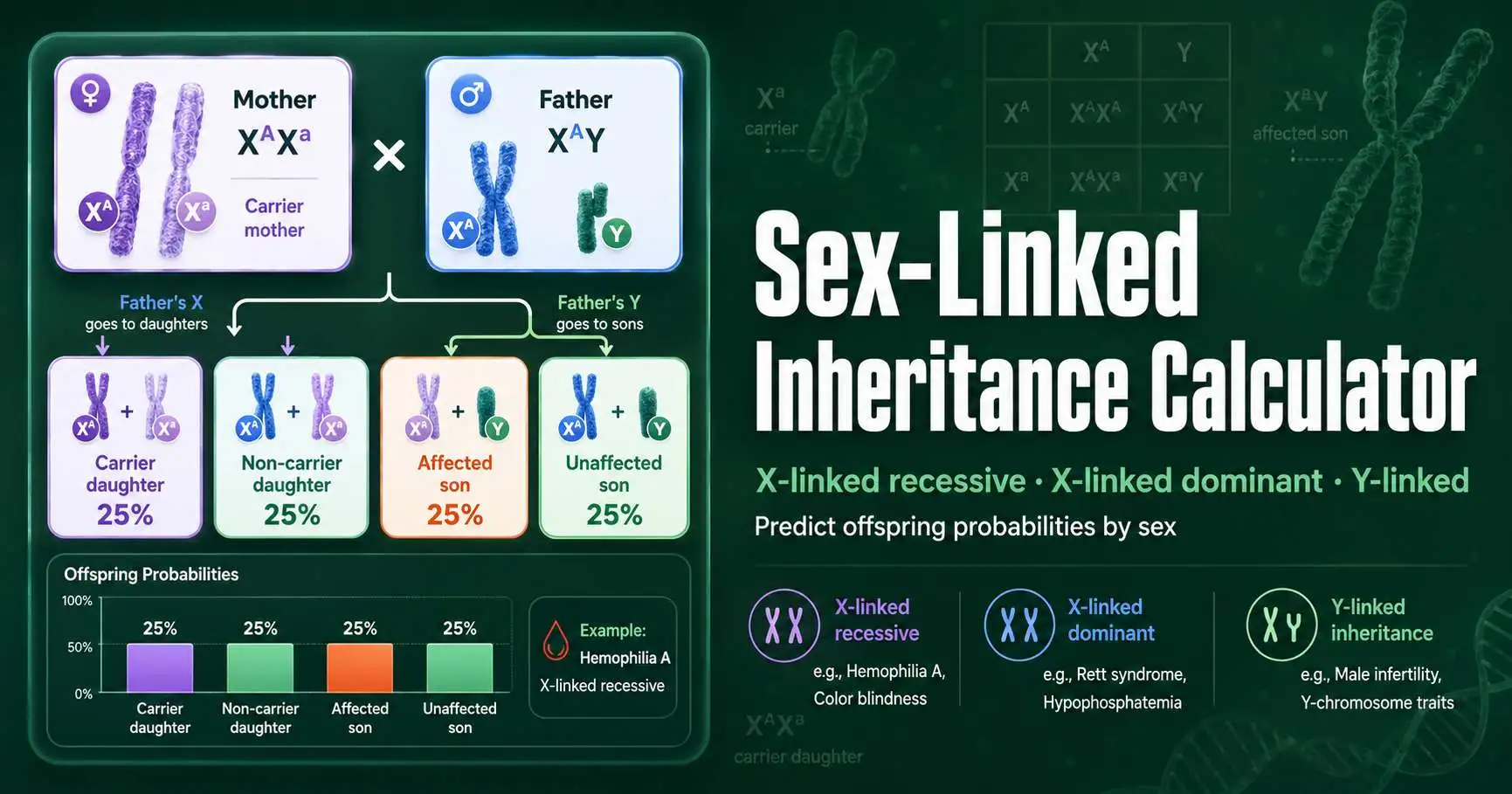
A sex-linked inheritance calculator predicts how alleles on sex chromosomes move from parents to children. It handles X-linked recessive, X-linked dominant, and Y-linked patterns. A standard autosomal Punnett square can miss these patterns because sons and daughters inherit different paternal sex chromosomes.
Thomas Hunt Morgan connected a visible trait with the X chromosome in fruit flies in 1910. That experiment helped unite Mendel’s segregation model with chromosome behavior during meiosis. Modern biology uses the same logic for human genes such as F8, F9, DMD, OPN1LW, and OPN1MW.
The key rule sounds simple: fathers give X to daughters and Y to sons. That rule changes risk estimates. OpenStax describes sex linkage as a non-Mendelian extension of classical inheritance. Read the OpenStax sex-linked inheritance section.
Choose X-linked recessive, X-linked dominant, or Y-linked inheritance before selecting parental genotypes.
Select whether the mother is non-carrier, carrier, affected, or unaffected depending on the chosen inheritance model.
Select the father genotype so the tool can assign paternal X chromosomes to daughters and paternal Y chromosomes to sons.
Use the result cards and table to compare affected sons, affected daughters, carriers, and unaffected children.
Use Xᴬ and Xᵃ for X-linked recessive problems. Use Xᴰ and Xᵈ for X-linked dominant problems. Use Y* for a Y chromosome that carries a Y-linked trait allele.
These buttons load common genetics questions instantly. They cover carrier mothers, affected fathers, X-linked dominant crosses, and Y-linked father-to-son transmission.
This card sets the biological rule. X-linked recessive, X-linked dominant, and Y-linked traits use different phenotype logic, so the calculator changes the available genotypes.
These cards define the parental sex chromosomes. The SVG previews show why maternal X gametes and paternal X or Y gametes produce different daughter and son outcomes.
The summary cards answer the main risk question quickly. The table shows the gamete pairing, child sex, genotype, phenotype, and probability for every offspring class.
X-linked recessive traits often appear more often in males because males have one X chromosome. A carrier mother XᴬXᵃ can have affected sons even when the father has genotype XᴬY. Daughters from that cross can inherit Xᵃ, but one Xᴬ allele often masks the recessive phenotype.
X-linked dominant traits follow a different question. One Xᴰ allele can produce the trait, so an affected father XᴰY transmits the allele to all daughters. He does not pass that allele to sons, because sons receive his Y chromosome.
Y-linked inheritance tracks the paternal Y chromosome. A father with a Y-linked allele transmits it to all sons and no daughters. This pattern creates a direct father-to-son line in a pedigree.
Cross XᴬXᵃ × XᴬY. Daughters receive Xᴬ from the father, so half become XᴬXᵃ carriers and half become XᴬXᴬ non-carriers. Sons receive Y from the father, so half become XᵃY affected sons and half become XᴬY unaffected sons.
Across all children, the probabilities equal 25% carrier daughter, 25% non-carrier daughter, 25% affected son, and 25% unaffected son.
Cross XᵈXᵈ × XᴰY. Every daughter receives Xᴰ from the father and Xᵈ from the mother, so all daughters have genotype XᴰXᵈ. Every son receives Y from the father and Xᵈ from the mother, so all sons have genotype XᵈY.
Among daughters, the affected probability equals 100%. Among sons, the affected probability equals 0% in this simplified model.
Medical genetics uses sex-linked probability to read pedigrees and choose the right testing strategy. Hemophilia A involves the F8 gene, and hemophilia B involves the F9gene. Both genes sit on the X chromosome, so inheritance risk changes sharply between sons and daughters.
MedlinePlus explains that hemophilia A and hemophilia B follow an X-linked recessive inheritance pattern. It also notes that fathers cannot pass X-linked traits to sons because sons receive the paternal Y chromosome. Read the MedlinePlus hemophilia genetics summary.
This tool answers probability questions for education. It does not replace pedigree analysis, molecular testing, chromosomal studies, or genetic counseling. X-inactivation, mosaicism, penetrance, de novo variants, and Turner syndrome can change real clinical interpretation.
The calculator assumes a 1:1 sex ratio and equal gamete transmission. It also assumes complete penetrance, so every genotype maps to the expected phenotype. Those assumptions match most textbook problems but simplify real human and animal genetics.
X-inactivation can make heterozygous females show variable signs for some X-linked conditions. New variants can arise in a child even when no parent carries the variant in blood cells. Some traits also involve autosomal modifiers that change severity.
Use this page for learning, homework checking, and inheritance pattern practice. Do not use it to make medical, reproductive, or diagnostic decisions.
Use these tools when a problem moves from sex chromosome inheritance into autosomal Punnett squares or carrier risk reasoning.