How Accurate Are Baby Trait Predictors?
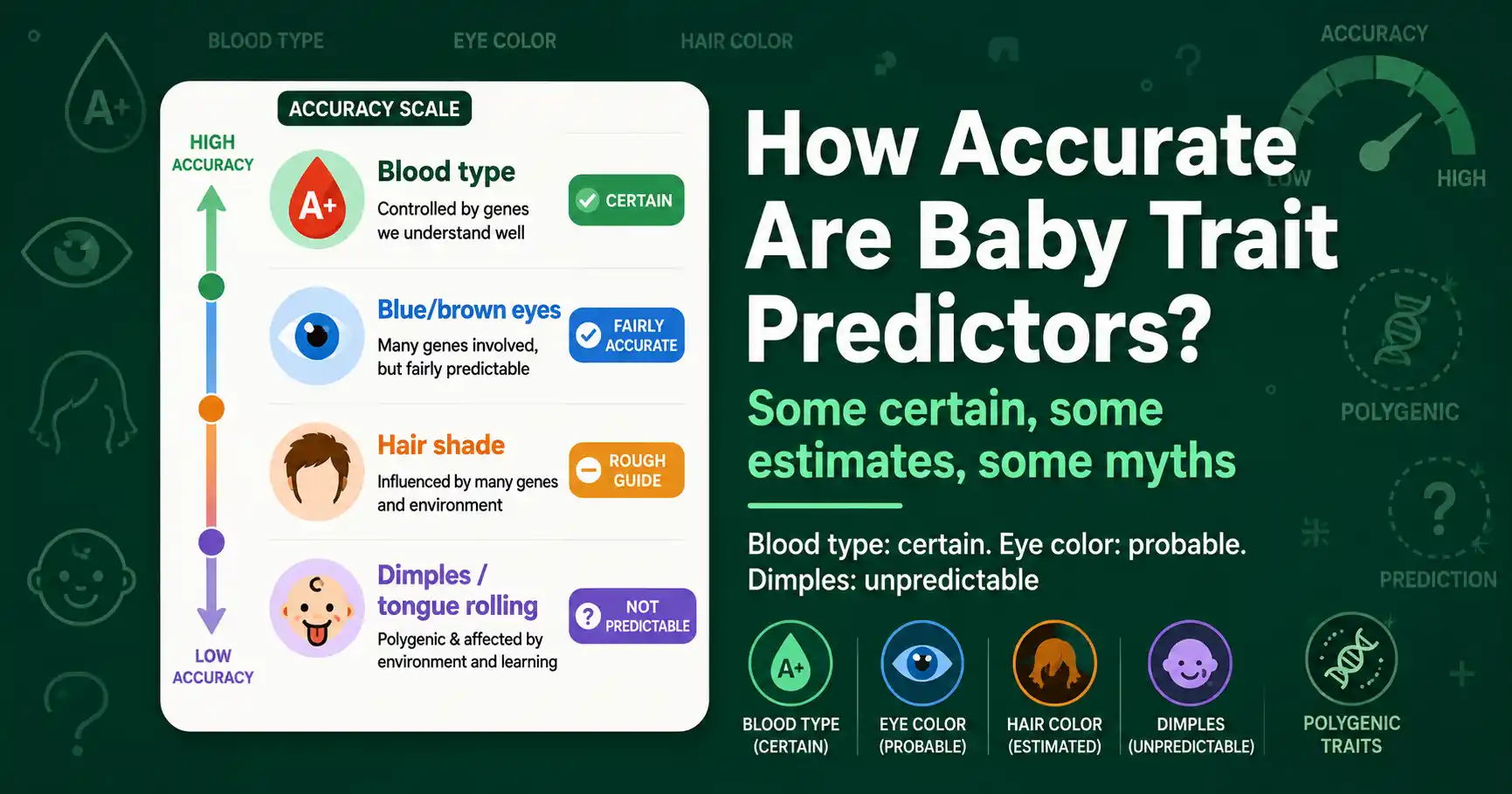
Baby trait predictors vary enormously in how reliable they are. Blood type prediction is essentially certain, since it follows strict genetic rules. Eye color prediction is fairly good for blue and brown, but poor for green and hazel. Hair color prediction is a rough guide at best. And many popular traits, dimples, attached earlobes, tongue rolling, are not reliably predictable from genetics at all. Knowing which is which tells you when to trust a result and when to take it as entertainment.
This is the honest capstone of this series. It explains the accuracy of each trait predictor, what limits them, and how to use them sensibly. To try a predictor that is upfront about what it can and cannot tell you, use the baby genetics calculator and treat the output as probability rather than a guarantee.
The Accuracy Hierarchy
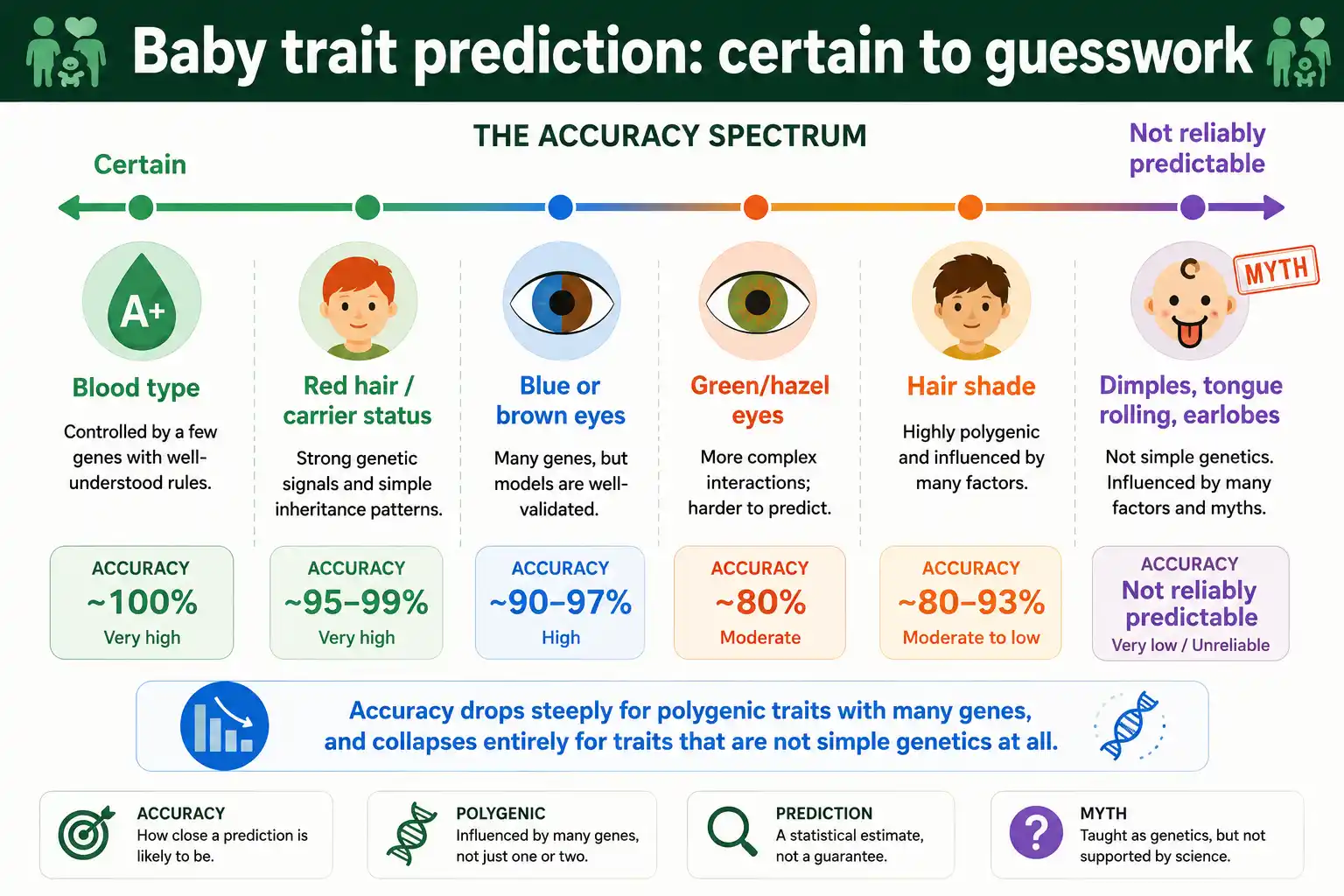
Not all baby traits are equally predictable. They fall into a clear hierarchy based on how many genes are involved and how well those genes are understood.
At the top is blood type, which is fully predictable from both parents' ABO and Rh types. The inheritance rules are strict, and the chart of possible outcomes is complete and certain, as our guide on the baby blood type chart shows. Two type O parents can only have a type O child, without exception. Blood type prediction is the most reliable prediction in this whole cluster, because it rests on a single gene with well-characterized alleles.
Below blood type are single-gene or few-gene traits where the genetics is understood but some uncertainty remains: red hair (largely governed by MC1R, reliable for detecting carrier status), and the coarser categories of eye color, blue versus brown. These can be predicted with meaningful accuracy but not certainty.
Below that are the polygenic traits: the full range of eye color including green and hazel, hair color shade, and skin tone. These can be estimated as probability ranges, but the estimates are genuinely imprecise because many genes each make a small contribution that the parents' visible color does not reveal.
At the bottom are the popular "fun" traits that are mostly myths, as covered in our guide on recessive traits in babies: tongue rolling, attached earlobes, dimples, widow's peak. These do not follow simple one-gene rules, so any predictor that claims to forecast them reliably is overpromising.
Eye Color: Good for Blue and Brown, Poor for In-Between
Eye color prediction is the most-studied case, and the research shows a striking gap between the easy cases and the hard ones.
A forensic DNA tool called IrisPlex, which reads six specific gene variants rather than relying on parent eye color, achieves an accuracy of around 97 percent for blue eyes and 91 percent for brown, but falls to about 80 percent for intermediate colors like green and hazel. A study published in the European Journal of Human Genetics via PMC found that blue and brown eye colors can be reliably predicted from DNA, while intermediate eye color defies prediction with current tools.
Consumer tools that estimate from parents' eye colors, rather than from DNA, are less precise still, because the parent's visible color reveals only some of what their genes contain. The tool knows the parents show brown or blue, but it does not know which specific gene variants are behind that brown or blue, so it can only assign population-average probabilities rather than personalized ones. The accuracy is genuinely useful for the common outcomes, most brown-parent pairs have brown children, most blue-parent pairs have blue, but the green and hazel predictions and any borderline case should be held lightly. Think of the eye color estimate as a well-informed probability, not a promise.
Hair Color: Direction More Than Shade
Hair color prediction is less accurate than eye color prediction, for a straightforward reason: more genes are involved and the relationship between parent color and child color is noisier.
DNA-based tools, such as the HIrisPlex system that reads 22 genetic variants, achieve accuracy figures of around 93 percent for red hair, 87 percent for black, 82 percent for brown, and 81 percent for blonde. These are impressive for a research tool using actual DNA. A consumer predictor using only parent hair color does considerably worse, because it cannot know which specific variants underlie the parent's visible shade. A parent who is "light brown" could be carrying gene variants pointing anywhere from blonde to dark brown in their children.
The practical takeaway is that hair predictors are better at direction than shade. A dark-haired pair is more likely to have a dark-haired child than a light one, and two light-haired parents are more likely to have a light child than a dark one. But predicting whether the child will be medium brown versus dark blonde is far beyond what parent-color tools can reliably do. Add to this that many babies' hair darkens through childhood, and the first-year hair is a poor guide to the adult shade. Hair color is best enjoyed as a guess with a real genetic basis rather than a prediction with a track record.
Blood Type: Actually Certain
Blood type stands apart from the rest because it is not a prediction at all. It is a logical consequence of the parents' genotypes, and when those are known, the possible outcomes are exact and exhaustive.
The ABO and Rh systems are governed by a small number of well-characterized alleles with clear dominance relationships. Given both parents' types, you can list exactly which types their child can have, and which are impossible. Two O parents: only O children. AB parent with O parent: only A or B children, never AB or O. These rules have no exceptions under normal circumstances. The only uncertainty is which of the possible outcomes the child actually gets, not whether the possibilities are correct. Blood type is the only trait in this cluster where "predictor" is almost a misnomer, since it is more of a logical deduction than an estimate.
Why Polygenic Traits Are Hard to Predict
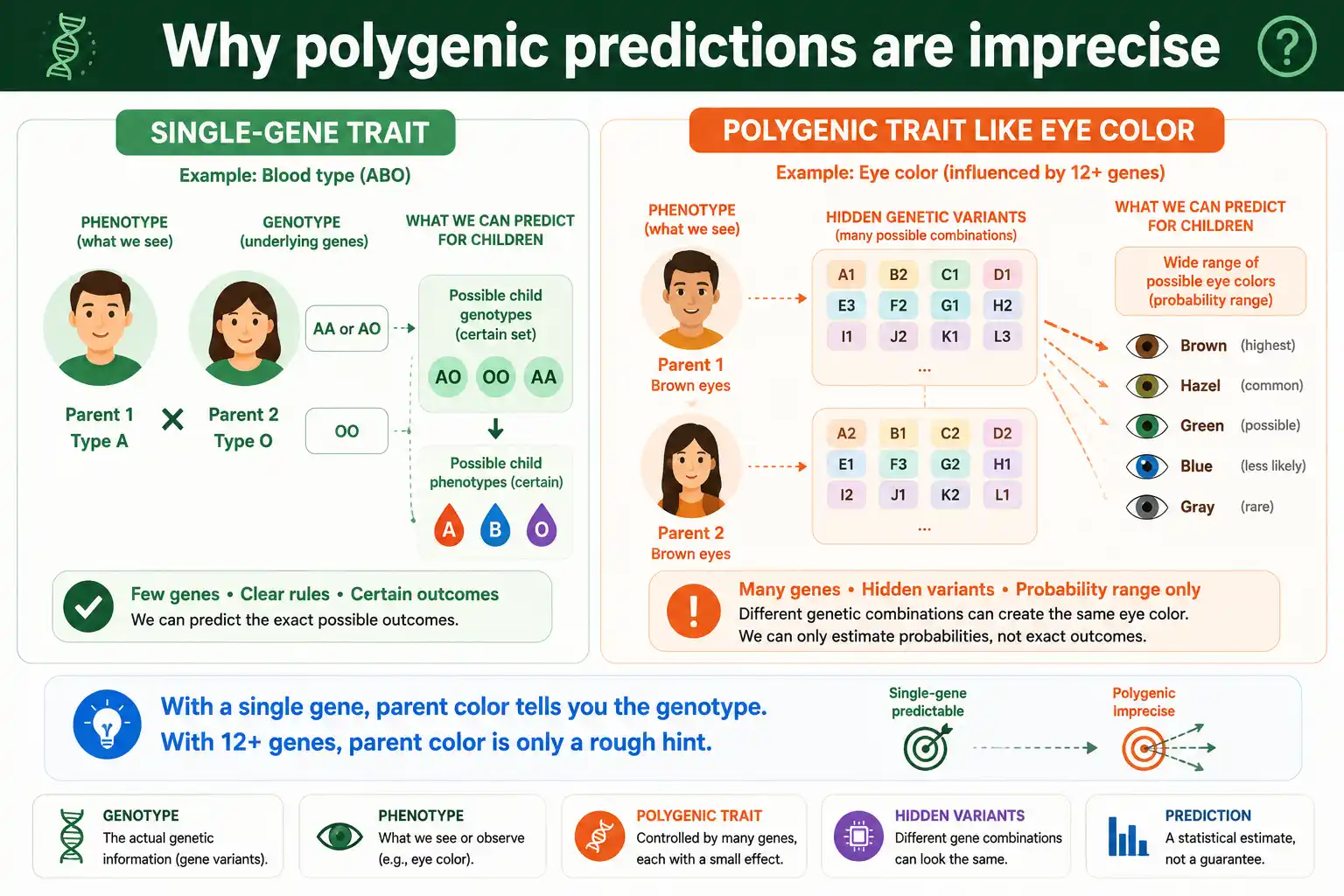
The reason eye color, hair color, and most appearance traits resist precise prediction is that they are polygenic: controlled by many genes, each making a small contribution. Understanding why this is hard to predict is genuinely useful.
When a single gene with two alleles controls a trait, there are only a few possible genotype combinations, and the parent's visible trait tells you most of what you need to know. But when 12 or more genes each nudge a trait up or down, two parents with the same visible outcome, say brown eyes, can carry very different combinations of the underlying genes. A brown-eyed parent who carries mostly "high melanin" variants at most genes will have darker-eyed children on average than a brown-eyed parent who carries one strong high-melanin variant and many low-melanin ones. The visible color looks the same but the genetic recipe differs. Without reading the actual DNA, there is no way to tell which recipe a brown-eyed parent carries.
This is why polygenic predictions are inherently probabilistic and inherently imprecise. They use the parent's visible phenotype as a rough proxy for their genotype, apply population-average genetics, and return a probability range. The range is real information, it genuinely reflects the likely distribution of outcomes across many families with those parental colors, but it is not personalized to that specific couple's actual gene variants. The Genetics Home Reference explanation of polygenic traits describes how this multi-gene architecture makes continuous traits like color fundamentally different from single-gene predictions.
What Makes a Trustworthy Predictor
Given these limits, what separates a good baby trait predictor from a misleading one? A few honest markers.
A trustworthy predictor names which traits it can estimate and which it cannot. It presents outputs as probabilities with ranges, not as single certain answers. It is upfront that green and hazel eye colors and intermediate hair shades are harder to predict than the endpoints. It does not claim to forecast tongue rolling, dimples, or attached earlobes, since those are not reliably inherited single-gene traits. And it notes that predictions improve with more family information, such as grandparents' traits, but never become certain.
A misleading predictor presents precise percentages for traits it cannot meaningfully distinguish, lists tongue rolling or dimples alongside blood type as if they are equivalently predictable, or gives a single definitive answer rather than a range. The Science Media Centre guide to genetic prediction accuracy puts it well: the gap between what DNA can predict in research settings and what consumer tools deliver is substantial, and claims of high accuracy often apply only to the most predictable endpoint colors, not to the full spectrum.
Frequently Asked Questions
How accurate are baby eye color predictors?
Eye color predictors are most accurate for blue and brown, where DNA-based forensic tools reach about 90 to 97 percent accuracy. Consumer tools using parent eye color are less precise, since they cannot see the specific gene variants behind the parent's color. Green and hazel eyes are genuinely hard to predict, with accuracy dropping to around 80 percent even with DNA tests. For an honest estimate, treat any result as a probability range rather than a certainty.
Can a predictor tell you your baby's exact hair color?
No predictor can reliably forecast an exact hair shade. DNA-based research tools reach roughly 80 to 93 percent accuracy for broad categories like red, black, brown, or blonde, with consumer tools using parent hair color doing worse. Within categories, distinguishing light brown from dark blonde or auburn from copper is beyond what current tools can reliably do, especially since many babies' hair darkens with age.
Are any baby trait predictions actually reliable?
Blood type prediction is fully reliable, giving all the possible types and ruling out impossible ones with certainty. Carrier status for clearly recessive conditions, like red hair through MC1R, is also reliable if both parents are tested. Eye color for blue or brown is fairly reliable as a probability. Everything else, hair shade, green or hazel eye color, and traits like dimples or tongue rolling, is a rough guide at best or an unpredictable myth at worst.
Knowing What You Can and Cannot Know
Baby trait predictors span the full range from certainty to guesswork. Blood type sits at the certain end, because it follows strict genetic rules with no exceptions. Blue and brown eye color predictions are useful probability estimates, accurate enough to be informative. Hair color predictions are rough directions rather than precise forecasts. And traits like dimples, tongue rolling, and attached earlobes are not reliably predictable from genetics, so any predictor that claims otherwise is overpromising.
The honest use of any baby trait predictor is as a fun, genetically grounded estimate rather than a guarantee. The genetics is real, the limits are real too, and knowing where the boundary falls makes you a more informed reader of whatever any tool tells you. To explore what the science actually supports across the traits we have covered, our guide on baby eye color prediction goes deepest into the most-studied case, with the same scientific honesty about what probability really means.