Baby Blood Type Chart: What Will My Baby Have?
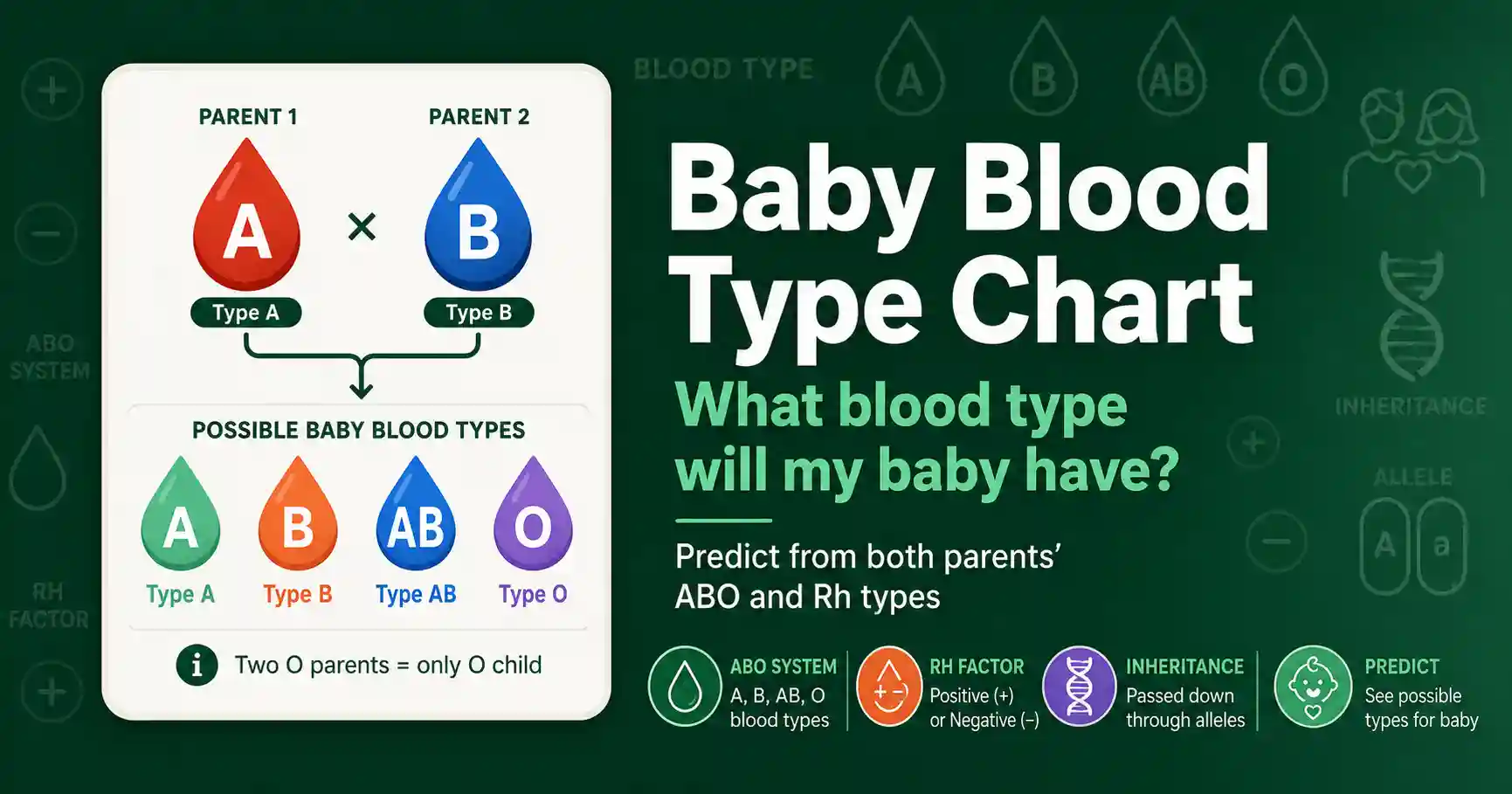
A baby's blood type is set by the ABO and Rh genes inherited from both parents. Each parent passes one ABO allele (A, B, or O) and one Rh factor, and the combination decides the child's type. Blood type is far more predictable than eye color, because only two genes are involved, so a simple chart can show exactly which types a child can and cannot have.
This guide gives the full parent-by-parent blood type chart, explains how the ABO and Rh systems are inherited, and covers the Rh factor's role in pregnancy. For a quick result from your own and your partner's types, our blood type calculator shows the possibilities instantly. To compare blood type with eye and hair colour in one place, use the baby genetics calculator.
How Blood Type Is Inherited
Blood type inheritance follows clear genetic rules, which is why it is so predictable. Two separate systems combine: the ABO system and the Rh factor.
The ABO system is controlled by one gene with three versions, or alleles: A, B, and O. Everyone carries two of these alleles, one from each parent. The A and B alleles are codominant, meaning if you have both, both show, giving type AB. The O allele is recessive and silent, so it only shows when paired with another O. This gives four blood types from the allele combinations: AA or AO makes type A, BB or BO makes type B, AB makes type AB, and OO makes type O.
Because each parent passes just one of their two alleles at random, the child's type depends on which alleles they happen to inherit. This is genuine Mendelian inheritance, the same kind shown in our explainer on multiple alleles, which uses ABO blood type as its main example. The predictability comes from there being only three alleles and clear dominance rules. The Medicover Genetics overview of blood type inheritance details how the ABO gene on chromosome 9 produces the four types.
The Baby Blood Type Chart
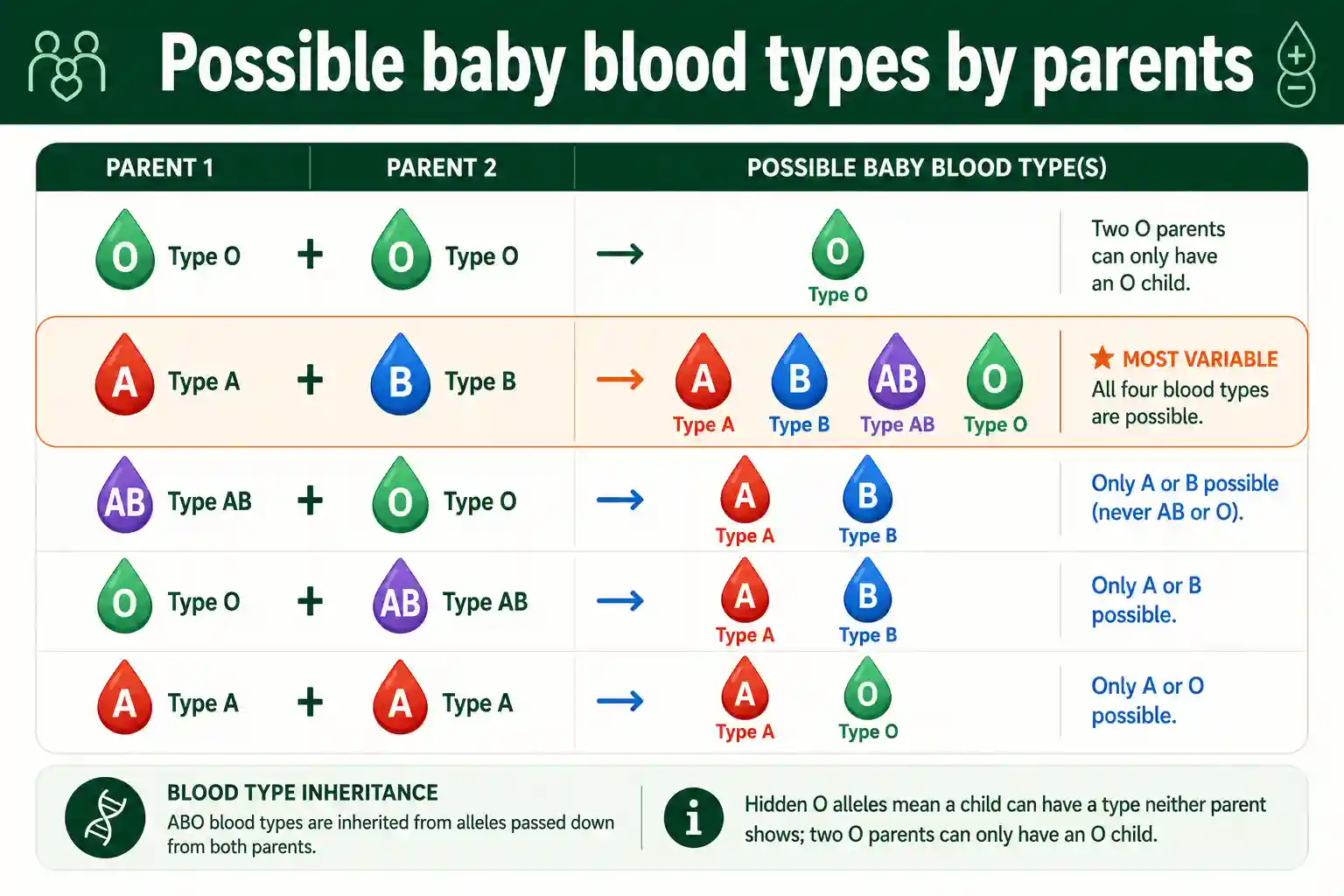
The chart below shows every possible child blood type for each combination of parents' ABO types. Because parents can carry hidden O alleles, some combinations have several possible outcomes.
| Parent 1 + Parent 2 | Possible child blood types |
|---|---|
| O + O | O |
| O + A | O, A |
| O + B | O, B |
| O + AB | A, B |
| A + A | O, A |
| A + B | O, A, B, AB |
| A + AB | A, B, AB |
| B + B | O, B |
| B + AB | A, B, AB |
| AB + AB | A, B, AB |
Two results stand out as useful checks. Two type O parents can only have a type O child, because neither has anything but O alleles to pass on. And an AB parent paired with an O parent can have an A or B child, but never AB or O, a combination that sometimes surprises people. The A-plus-B pairing is the most open, able to produce any of the four types, because the parents can pass A, B, or hidden O alleles in many combinations. The Stanford Medicine Children's Health guide to blood types in pregnancy explains how a baby can inherit the type of either parent or a combination. If you want to predict blood type alongside other features, you can estimate several baby traits together in one place.
The Rh Factor
Alongside the ABO type, every person is either Rh positive or Rh negative, and this is inherited separately from the A, B, O letters. The Rh factor is what adds the plus or minus sign to a blood type.
The Rh factor is a protein on the surface of red blood cells. If you have it, you are Rh positive; if not, Rh negative. It follows simple dominant-recessive inheritance: the Rh-positive version is dominant, so a single positive allele makes a person Rh positive. You inherit one Rh allele from each parent. This leads to one clean rule worth remembering: two Rh-negative parents can only have an Rh-negative child, because neither carries a positive allele to pass on. Any other combination can go either way, since an Rh-positive parent may carry a hidden negative allele.
So a full blood type, like A positive or O negative, combines the ABO result and the Rh result, which are inherited independently. A child's complete type is one of the ABO letters plus a positive or negative from the Rh system. This independence is why the two systems are read together but predicted separately.
The Rh Factor in Pregnancy
The Rh factor matters in pregnancy in a way the ABO type usually does not, and it is worth understanding. The concern is Rh incompatibility, when an Rh-negative mother carries an Rh-positive baby.
If an Rh-negative mother is pregnant with an Rh-positive baby, her immune system can treat the baby's Rh-positive blood as foreign and make antibodies against it. This rarely affects a first pregnancy, but it can pose a risk to later Rh-positive pregnancies. The good news is that this is well understood and routinely managed: Rh-negative mothers are given a medication, Rh immunoglobulin, often known by the brand RhoGAM, at the right times to prevent the immune response. This is standard prenatal care, which is one reason blood type is checked early in pregnancy.
This is a topic to discuss with an obstetrician or midwife, who tests blood type as a matter of routine and manages any Rh issue. If you are Rh negative and pregnant or planning a pregnancy, your prenatal care team will handle this, so it is worth raising at an early appointment rather than worrying about it on your own.
Common and Rare Blood Types
Parents often wonder how common their baby's likely type is. Blood types are not evenly distributed, so some are far more common than others, and the frequencies vary by population.
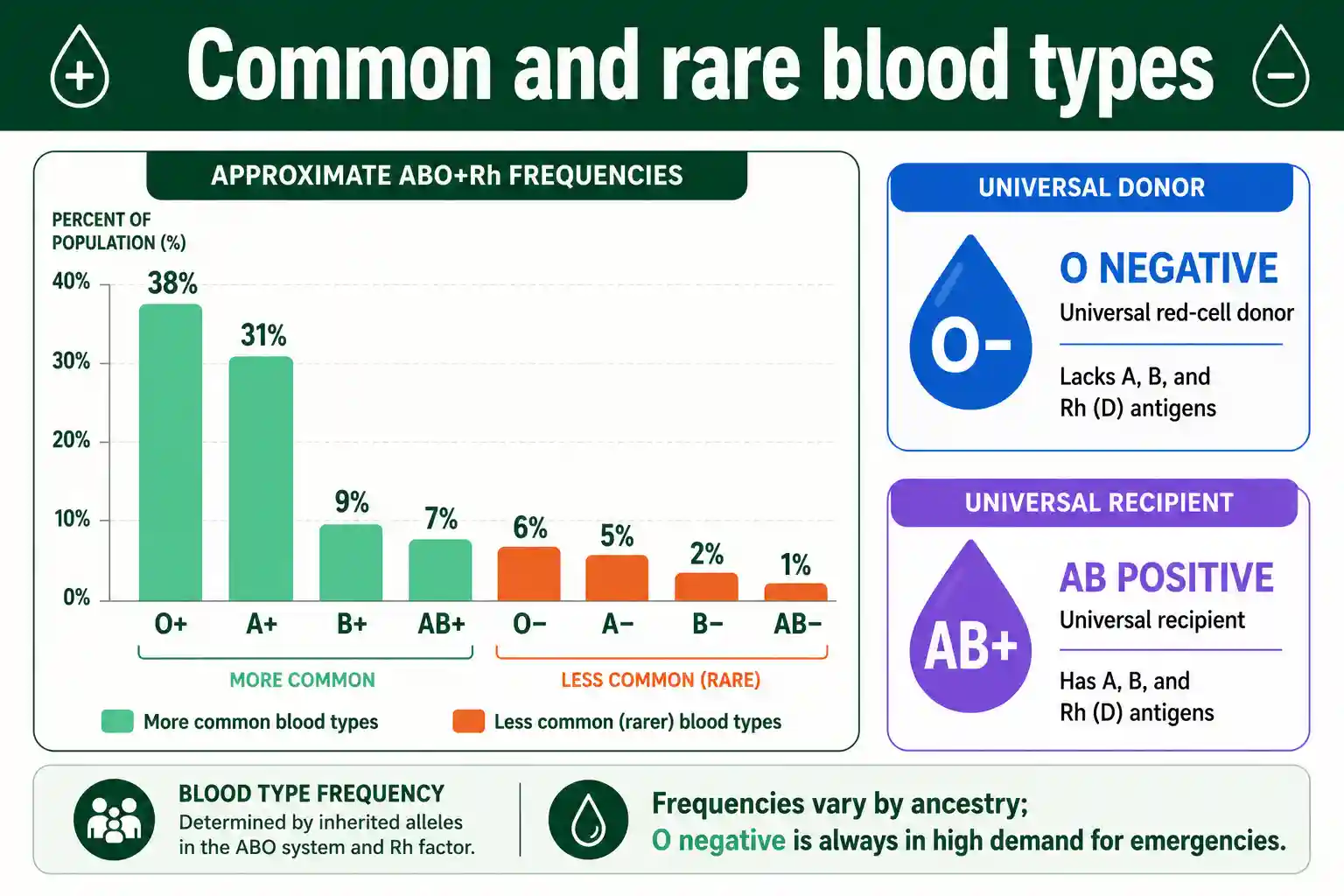
In general, O and A are the most common ABO types, while AB is the rarest. Adding the Rh factor, O positive and A positive are among the most common full types, while the negative types are rarer because Rh negative is the recessive, less frequent version. AB negative is one of the rarest types of all. These frequencies differ markedly between ancestries, so a type that is common in one population can be uncommon in another, which is part of why blood banks track donor diversity.
One type carries special significance. O negative is the universal red-cell donor, because its cells lack the A, B, and Rh antigens that another person's immune system might react to, so O-negative blood can be given safely in emergencies before a patient's type is known. AB positive, by contrast, is the universal recipient, able to receive red cells from any type. The American Red Cross overview of blood types breaks down how common each type is and why O negative is in such high demand. None of this changes the inheritance rules, but it explains why a baby's type can matter beyond curiosity.
Can Blood Type Reveal Paternity?
A common question is whether blood type can confirm who a baby's parents are. The honest answer is that blood type can sometimes rule a parent out, but it cannot confirm parentage.
The logic is one-directional. Because the inheritance rules are strict, certain parent-child combinations are impossible: for example, two type O parents cannot have a type A child, and an AB parent cannot have an O child. So a blood type mismatch can occasionally show that a presumed biological relationship is not possible. But blood type can never confirm a relationship, because millions of unrelated people share any given type. A child having a type consistent with a parent proves nothing on its own.
For this reason, blood type is not a substitute for genetic testing. Modern DNA paternity tests are accurate and definitive, while blood type offers only a rough, exclusion-only check. Anyone with real questions about parentage should seek proper DNA testing rather than relying on blood type, which was used before DNA testing existed but is far too blunt a tool to be conclusive. A blood type that appears inconsistent can also have an innocent genetic explanation, such as a rare allele or an unusual variant, which is another reason it should never be treated as proof on its own.
Frequently Asked Questions
Can two O parents have a baby with a different blood type?
No. Two type O parents can only have a type O child. Type O means both of a person's ABO alleles are O, so each parent can pass only an O allele, and the child receives O from both. This is one of the most reliable rules in blood type inheritance. The Rh factor can still be positive or negative depending on the parents' Rh alleles.
What blood types can an A and a B parent have children with?
All four. A type A parent and a type B parent can have a child with type A, B, AB, or O blood, depending on their exact alleles. If both parents carry a hidden O allele, they can have a type O child; if they pass their A and B alleles, the child is AB. This is the most variable of all parent combinations.
Can a baby have a blood type different from both parents?
Yes. The clearest example is two parents who are both type A or both type B but each carry a hidden O allele; they can have a type O child. Likewise, an A parent and a B parent can have an AB or an O child, types neither parent has. This happens because hidden recessive O alleles can combine in the child.
Knowing the Possibilities
A baby's blood type is one of the most predictable inherited traits, because it rests on just the ABO gene and the Rh factor. Each parent passes one ABO allele and one Rh factor, and the chart shows exactly which types a child can have: two O parents have only O children, two Rh-negative parents have only Rh-negative children, and an A-plus-B pairing can produce any of the four types.
The blood type chart is genuinely useful, unlike eye color predictions it gives firm possibilities and clear impossibilities, though it can rule a parent out without ever confirming parentage. If you are Rh negative and pregnant, the Rh factor is worth raising with your care team. To predict a more complex, less certain trait next, our guide on what determines your baby's hair color returns to the world of estimates rather than firm rules.