Multiple Alleles Explained: Examples and Genetics
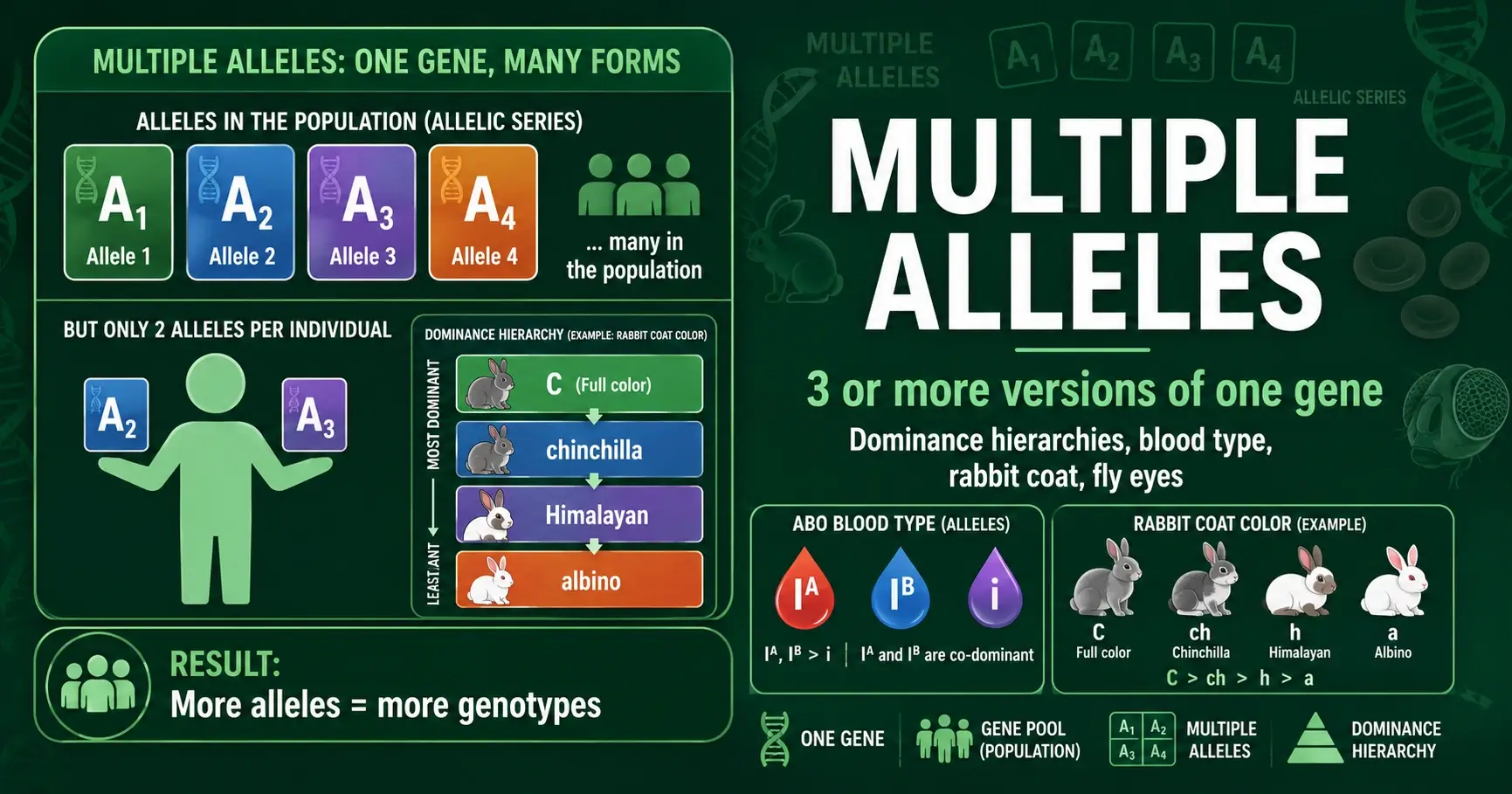
Multiple alleles means a single gene has three or more versions, called alleles, existing in a population. This goes beyond the simple two-allele model Mendel studied. Any one individual still carries only two alleles for the gene, one from each parent, but the population as a whole holds a larger pool to draw from. Human ABO blood type is the classic example, with three alleles producing four blood types.
The idea matters because most real genes have more than two versions, so multiple alleles describe genetics as it actually works rather than the simplified textbook case. With three or more alleles in play, traits can follow a ranked order of dominance, and the number of possible genotypes grows quickly. This guide explains what multiple alleles are, how dominance hierarchies sort them out, and walks through the best-known examples in humans, rabbits, and fruit flies. By the end you will be able to predict offspring from any multiple-allele cross.
What Are Multiple Alleles?
Multiple alleles are three or more alternative forms of the same gene found within a population. A gene controls a trait, and each allele is one variant of that gene. In the simple Mendelian model, a gene has just two alleles, one dominant and one recessive. Multiple-allele genes break that limit by having several variants circulating among individuals.
The crucial point is the difference between the individual and the population. Because humans and most animals are diploid, each person carries exactly two alleles for any gene, one inherited from each parent. That never changes. What changes with multiple alleles is how many options exist in the wider gene pool. A gene with four alleles still gives each individual only two of them, but across a whole population, many different two-allele combinations are possible.
This single fact, more alleles in the population but still two per person, drives everything else. It increases the variety of genotypes and phenotypes a trait can show, and it sets the stage for dominance hierarchies, where the several alleles rank against one another. To see how the alleles actually combine in offspring, it helps to be comfortable with the basic grid first, which the guide on how a Punnett square works lays out clearly.
The reason each person is capped at two alleles comes down to chromosomes. Humans and most familiar animals are diploid, meaning they carry chromosomes in pairs, one set from each parent. A given gene sits at a specific spot, or locus, on a chromosome, so an individual has exactly two copies of that locus and therefore two alleles, no matter how many versions exist in the population. This is why a person can be type A or type AB but never carries three blood-type alleles at once. The population pool can be large, but the diploid body samples only two from it, which keeps every genotype a simple pair.
How Many Genotypes Can Multiple Alleles Produce?
More alleles in a population mean more possible genotypes, and there is a simple formula to count them. For a gene with a given number of alleles, the number of possible genotypes equals n times n plus one, divided by two, where n is the number of alleles. The formula captures every homozygous and heterozygous combination without double counting.
Run the numbers and the growth is clear. Two alleles give three genotypes, the familiar homozygous dominant, heterozygous, and homozygous recessive. Three alleles give six genotypes. Four alleles give ten. The count climbs fast because each new allele can pair with itself and with every allele already present.
| Number of alleles | Possible genotypes |
|---|---|
| 2 | 3 |
| 3 | 6 |
| 4 | 10 |
| 5 | 15 |
This is why multiple-allele traits show more phenotypic variety than simple two-allele traits. The genotype count sets the ceiling on how many distinct genetic combinations exist, though the number of visible phenotypes is usually smaller, because dominance groups several genotypes under one appearance. That gap between genotype count and phenotype count is exactly where dominance hierarchies come in, and it is the reason two traits with the same number of alleles can still look very different in a population.
Dominance Hierarchies and Allelic Series
When a gene has multiple alleles, they often rank in a fixed order of dominance called a dominance hierarchy, or allelic series. Each allele in the series is dominant over the ones below it and recessive to the ones above it. This ranking decides which trait shows when two different alleles are paired in one individual.
The hierarchy is usually written with "greater than" signs. If a gene has alleles A1, A2, and A3 in that order of dominance, you would write A1 > A2 > A3. The top allele expresses its trait whenever it is present, no matter what it is paired with. The bottom allele only shows when an individual carries two copies of it, because anything above it in the series would mask it. Middle alleles show their trait only when no higher allele is present.
This explains why a multiple-allele trait can have many genotypes but fewer phenotypes. Several genotypes that all contain the same top-ranking allele will look identical, because that allele dominates. The hierarchy collapses the larger set of genotypes into a smaller set of visible traits, exactly the way a single dominant allele masks a recessive one in a simple cross. The mechanism behind the ranking is often dosage: the most dominant allele typically makes a full, working amount of a gene product, while lower alleles make less or none.
Example 1: ABO Blood Type in Humans
ABO blood type is the headline example of multiple alleles in humans, because it combines three alleles with a mix of dominance relationships. The gene has three versions: IA, IB, and i. The IA allele produces A antigens on red blood cells, IB produces B antigens, and i produces no antigen at all.
The relationships among the three are what make ABO interesting. The IA and IB alleles are codominant with each other, so a person carrying both shows both antigens, giving type AB blood. At the same time, both IA and IB are completely dominant over the recessive i allele. So the system mixes codominance, between IA and IB, with simple dominance, over i, all in one gene. The result is four blood types, A, B, AB, and O, arising from six possible genotypes.
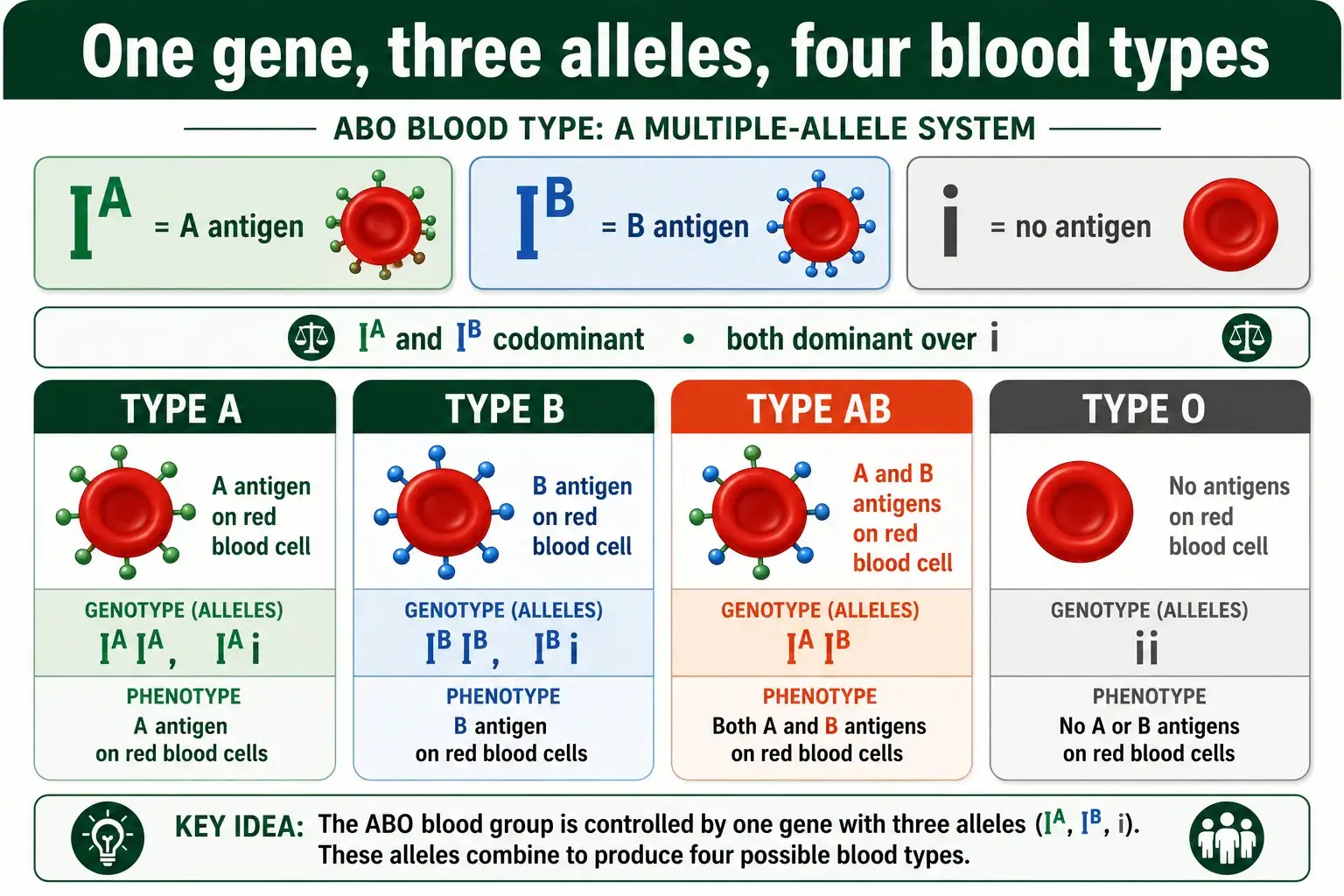
ABO is worth studying closely because it shows that "multiple alleles" and "codominance" are different ideas that happen to overlap here. Multiple alleles describe how many versions exist in the population, three in this case. Codominance describes how two of those alleles behave when paired. The two concepts are independent, and ABO just happens to display both. For a full breakdown of how each blood type cross plays out, including which parents can produce which children, the dedicated blood type calculator walks through every combination.
Example 2: Coat Color in Rabbits
Rabbit coat color is the textbook example of a clean dominance hierarchy, because all four alleles rank in a strict order with no codominance to complicate things. The coat color gene, often labeled C, has four alleles that produce four distinct coat patterns.
The four alleles and their phenotypes are: the full-color allele C, giving a fully colored coat; the chinchilla allele, giving a silvery black-tipped coat; the Himalayan allele, giving white fur with dark extremities; and the albino allele, giving an all-white coat with no pigment. They rank in the order C > chinchilla > Himalayan > albino. The full-color allele dominates all others, and the albino allele sits at the bottom, showing only when an animal carries two copies of it.
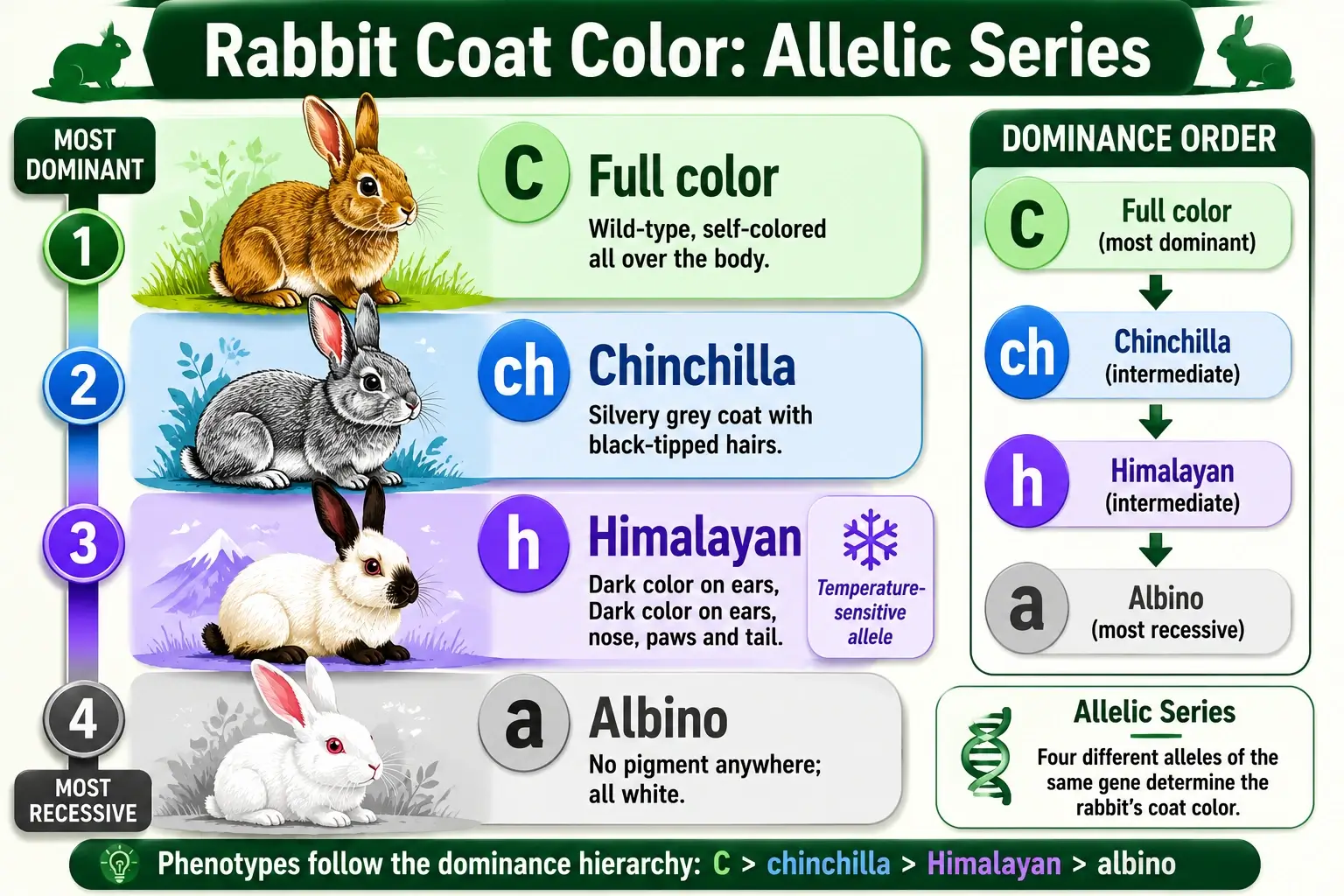
The Himalayan allele adds a memorable twist. It produces a temperature-sensitive pigment, so the rabbit grows dark fur only on its cooler body parts, the ears, nose, paws, and tail, while the warmer trunk stays pale. This is the same mechanism behind the coloring of Siamese cats. To predict rabbit coat colors, you apply the hierarchy to each genotype: a rabbit showing chinchilla fur, for instance, must carry at least one chinchilla allele and no full-color C allele above it. Because dosage determines the ranking, the full-color allele supplies a complete amount of pigment while the lower alleles supply progressively less. This dosage explanation is detailed in OpenStax Biology, which covers the rabbit allelic series in depth.
Example 3: Eye Color in Fruit Flies
Eye color in the fruit fly Drosophila holds a special place in genetics history, and it illustrates multiple alleles alongside another landmark discovery. The wild-type eye color is red, but the gene has many mutant alleles producing colors from white through various shades, forming an allelic series.
The history is what makes this example resonate. In 1910, Thomas Hunt Morgan mapped the eye color gene to the X chromosome, making it one of the first traits ever shown to be sex-linked. That discovery helped establish that genes reside on chromosomes, a cornerstone of modern genetics. The wild-type red allele is dominant to the mutant white allele, and over time researchers identified a whole series of eye-color alleles producing intermediate shades, demonstrating that a single gene can carry far more than two variants.
Because the gene sits on the X chromosome, fruit fly eye color also shows how multiple alleles interact with sex linkage. Male flies are hemizygous, carrying only one allele, so they express whatever single eye-color allele they inherit. The principle that a gene can have many alleles in a population, while X-linkage governs how those alleles pass between the sexes, comes together neatly in this classic system. Human eye color inheritance is more complex still, involving several genes rather than one, but the fruit fly remains the cleanest demonstration that one gene can hold a rich allelic series.
How to Solve a Multiple-Allele Punnett Square
Solving a multiple-allele cross uses the same Punnett square method as any other, with one extra step: you apply the dominance hierarchy when reading the phenotypes. The grid itself works identically, combining one allele from each parent in every box.
Start by writing each parent's genotype using the correct allele symbols, then list the gametes. Since each parent has two alleles, each produces two kinds of gamete, exactly as in a standard monohybrid cross. Fill the grid by combining gametes, which gives you the offspring genotypes. The only new part is the final step: translate each genotype to a phenotype by checking which allele ranks highest in that genotype.
Consider a rabbit cross between a full-color rabbit carrying a hidden Himalayan allele and a Himalayan rabbit carrying an albino allele. Write the genotypes, find the gametes, and fill the four boxes.
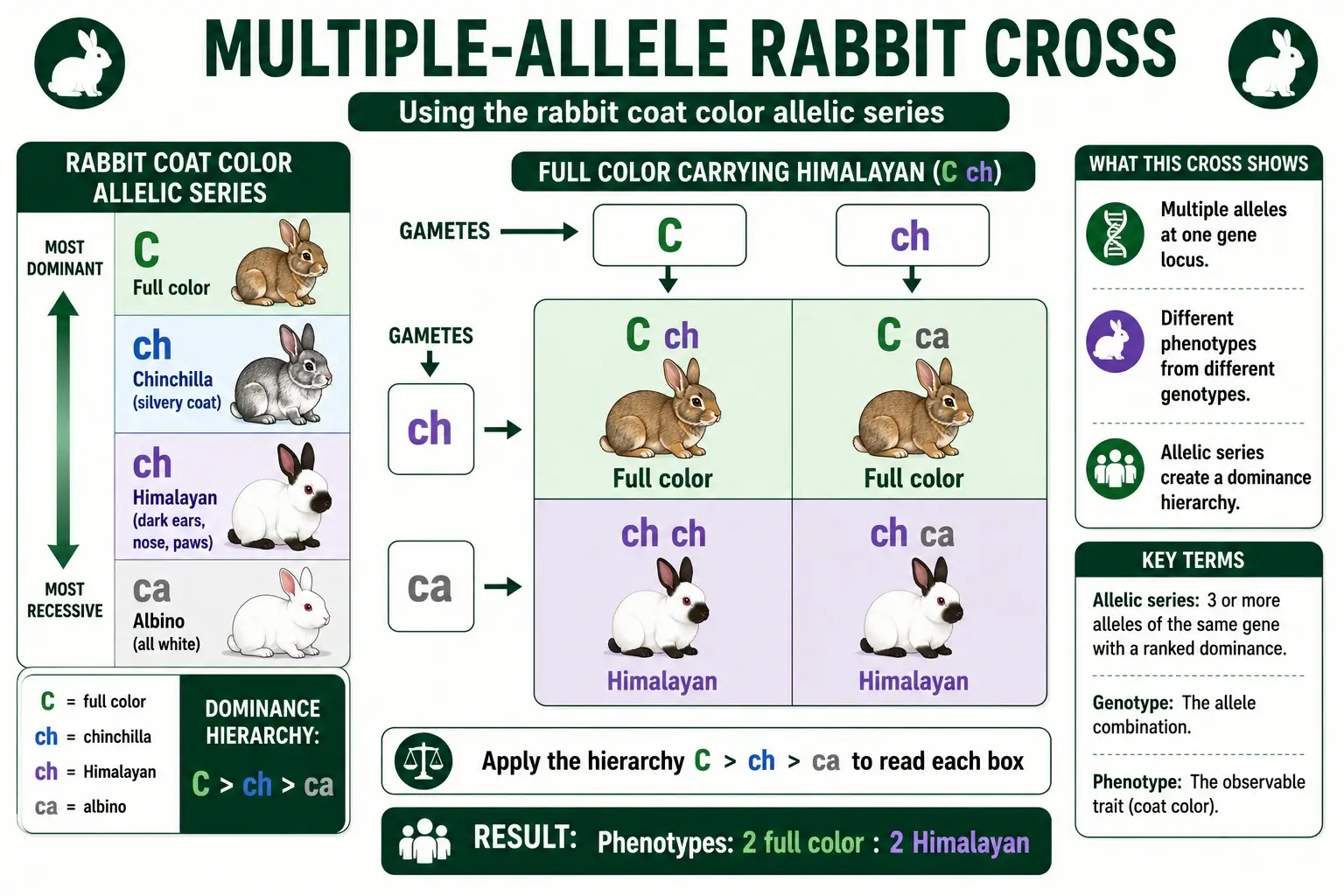
To read each box, apply the hierarchy: any box with the full-color C allele shows full color, a box with the Himalayan allele but no C shows Himalayan, and only a box with two of the lowest allele shows albino. The math of the grid is routine, but the hierarchy is what turns genotypes into the right phenotypes, so always keep the ranking in front of you.
How Scientists Discover an Allelic Series
A dominance hierarchy is not obvious from looking at one organism. Scientists work it out by making many crosses and watching which trait appears in the heterozygotes. The phenotype of each heterozygote reveals which of its two alleles is dominant, and stacking those results together builds the full ranking.
The logic is a process of comparison. Cross an organism carrying allele one with an organism carrying allele two, and the heterozygote's appearance tells you which allele wins that pairing. Repeat this for every pair of alleles in the system, and the wins and losses sort the alleles into a single ordered series. In rabbits, breeders confirmed that the full-color allele beat every other allele in heterozygotes, that chinchilla beat Himalayan and albino but not full color, and so on down the line, which is how the order was established.
This is also where the test cross earns its place. Because a dominant allele can hide a lower-ranked one, an organism showing a top phenotype might carry any of several recessive alleles underneath. Crossing it with an organism that carries only the lowest allele exposes what is hidden, since the offspring reveal the masked allele. The same principle Mendel used for two alleles extends naturally to a whole series, just with more possible outcomes to read. Patient crossing and careful counting, not a single observation, are what uncover the hierarchy.
Multiple Alleles in Real Genetics and Disease
Multiple alleles are not just a teaching curiosity. They shape real medical and biological outcomes, because most human genes carry many variants across the population, and some of those variants matter for health.
A clear medical example is cystic fibrosis. The gene behind it has hundreds of known mutant alleles, not just one faulty version. Different mutations affect the protein in different ways, which is part of why the condition varies in severity from person to person. Many patients are compound heterozygotes, carrying two different mutant alleles rather than two copies of the same one. Recognizing that a gene can hold many disease alleles, not a single broken form, changes how doctors interpret genetic tests and predict outcomes.
Multiple alleles also drive evolution and adaptation. The more allele variants a population holds, the more raw material natural selection has to work with. Drug resistance offers a stark illustration: the malaria parasite has evolved several different resistant alleles of the same gene, each conferring a different degree of resistance, and being effectively single-copy in its infectious stage, it expresses whatever resistant allele it carries. The same principle that fills a rabbit's coat-color gene with four variants fills disease and resistance genes with many, which is why multiple alleles are central to understanding genetic diversity, not an exception to it.
Some human genes take multiple alleles to an extreme. The HLA genes, which help the immune system recognize the body's own cells, are the most variable genes known in humans, with thousands of alleles documented across the population. This enormous diversity is no accident. A population carrying many different immune-recognition alleles is better equipped to fight a wide range of pathogens, because no single infection can wipe everyone out at once. It also explains why finding a matching donor for an organ or bone marrow transplant can be so difficult: with so many alleles in circulation, the odds that two unrelated people share the same set are low. Here multiple alleles move from a textbook concept to a matter of survival, both for individuals and for the species.
Multiple Alleles vs Polygenic Traits
Students often confuse multiple alleles with polygenic traits, but they are distinct ideas, and telling them apart sharpens your understanding of both. The difference comes down to how many genes are involved.
Multiple alleles involve one gene with several versions. ABO blood type is controlled by a single gene that happens to have three alleles. No matter how many alleles exist, it is still one gene determining the trait. Polygenic traits, by contrast, involve many genes working together to shape a single characteristic. Human height and skin color are polygenic, controlled by dozens of genes that each add a small effect.
The practical signature differs too. A multiple-allele trait usually produces a small number of distinct categories, like the four discrete blood types. A polygenic trait produces a smooth, continuous range, like the gradient of human heights, because the combined effect of many genes blends into a spectrum. So if a trait falls into clear categories, suspect multiple alleles or simple dominance; if it varies along a continuum, suspect polygenic inheritance. Many real traits combine both, but keeping the one-gene versus many-genes distinction clear is the key to classifying them.
Frequently Asked Questions
What is an example of multiple alleles?
The clearest example is human ABO blood type, controlled by one gene with three alleles: IA, IB, and i. Other examples include rabbit coat color, which has four alleles in a dominance hierarchy, and eye color in fruit flies.
How many alleles can a person have for one gene?
A person can have only two alleles for any gene, one inherited from each parent. Multiple alleles refers to the number of versions present in the whole population, which can be three or more, not the number any single individual carries.
What is a dominance hierarchy?
A dominance hierarchy is the ranked order in which multiple alleles dominate one another. Each allele is dominant over those below it and recessive to those above it, which determines the phenotype when two different alleles are paired in one individual.
Are multiple alleles the same as polygenic traits?
No. Multiple alleles mean one gene has several versions in a population. Polygenic traits mean many different genes each contribute to one characteristic. ABO blood type is multiple alleles; human height is polygenic.
Bringing It Together
Multiple alleles describe a gene with three or more versions in a population, even though each individual still carries just two. This expands the range of genotypes and phenotypes a trait can show, and it often produces a dominance hierarchy where the alleles rank in a fixed order. ABO blood type mixes three alleles with codominance, rabbit coat color shows a clean four-allele hierarchy, and fruit fly eye color demonstrates a rich allelic series on the X chromosome.
Across all of them, the method for predicting offspring stays the same: build the Punnett square, then carefully read each genotype against the dominance hierarchy. You can set up and solve any multiple-allele cross with the Punnett Square Calculator, which keeps the allele symbols and rankings organized for you. For a deeper academic treatment of allelic series and dominance, this overview is a reliable and well-illustrated reference to read here.