What Is a Punnett Square? Definition, Diagram, and How to Read One
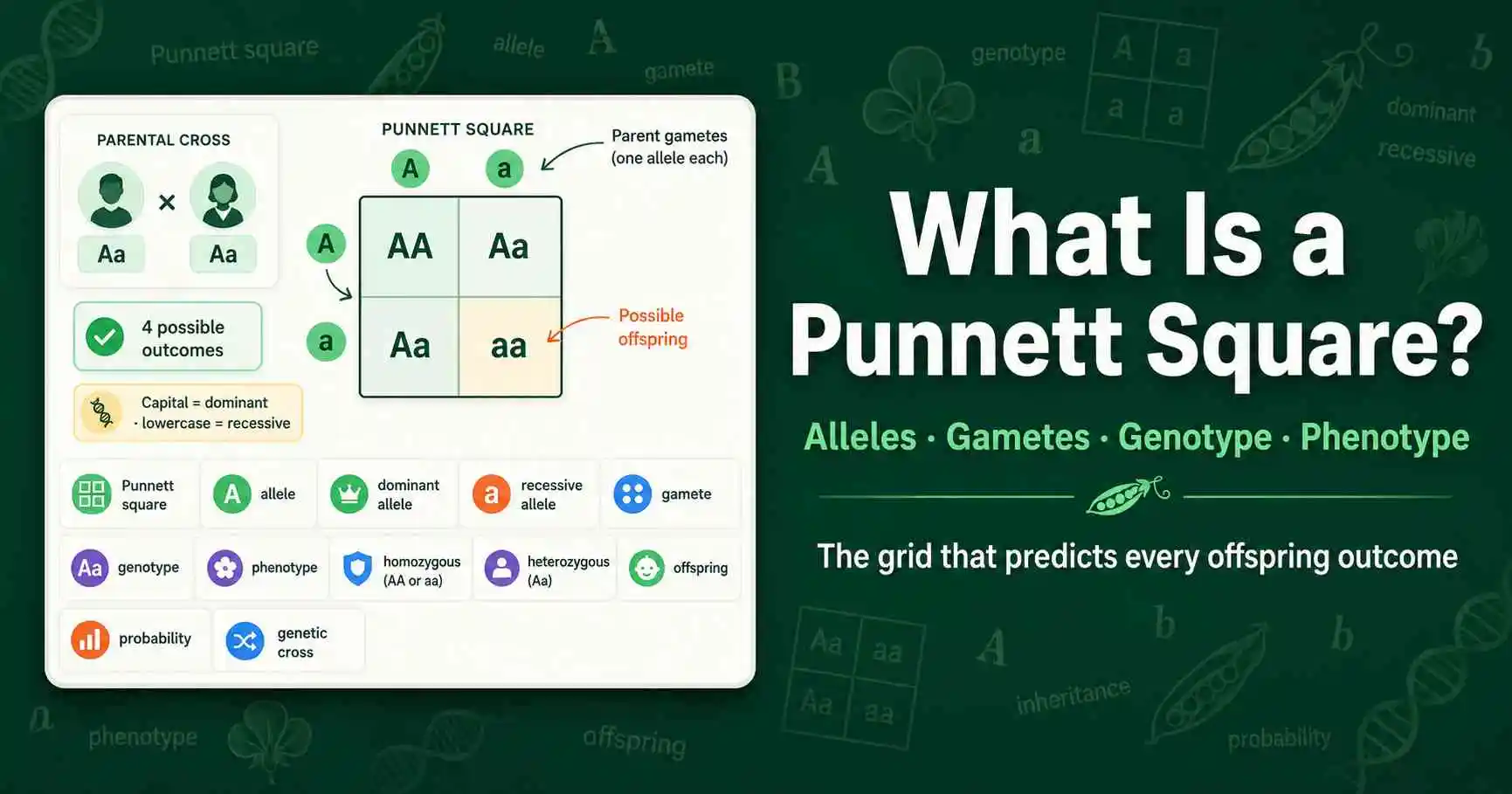
A Punnett square is a grid that predicts the possible genotypes and phenotypes of offspring from a genetic cross. You place one parent's alleles along the top and the other parent's down the side. Each box then shows a combination the offspring could inherit, along with how likely that outcome is.
That one tool turns a confusing genetics question into a picture you can read in seconds. Students reach for it during homework. Breeders use it to plan a mating. Genetic counselors use it to estimate the odds of an inherited condition. You can draw one by hand, or generate any cross instantly with our Punnett Square Calculator.
This guide covers what the diagram is, where it came from, what every part means, and how to read the result without second-guessing yourself.
What a Punnett Square Actually Shows
A Punnett square shows probability, not a guarantee. It lays out every allele combination two parents could pass on, then tells you the chance of each one. Cross the same two parents a hundred times and the real offspring will drift close to those predicted ratios, never matching them perfectly.
Each box in the grid is equally likely. That single rule is what makes the diagram work. If a genotype fills two of four boxes, it has a 50 percent chance of appearing. If it fills one box, the chance drops to 25 percent. You are counting outcomes, then turning those counts into ratios or percentages.
Who Invented the Punnett Square?
Reginald C. Punnett, a British geneticist, created the square in 1905. The diagram carries his name. He worked closely with William Bateson, and together they helped bring Gregor Mendel's forgotten work back into mainstream science. You can read more about its origin on Wikipedia's Punnett square entry.
The square is really a visual shortcut for Mendel's law of segregation, which says each parent passes only one allele per gene to each offspring. If you want to see that law in motion, the law of segregation simulator walks through it step by step.
The Parts of a Punnett Square
Three components make up every Punnett square: the alleles, the gametes, and the boxes. Understand these and the rest falls into place.
Alleles
An allele is one version of a gene. Most traits in a basic cross involve two alleles, written with letters. A capital letter marks the dominant allele. A lowercase letter marks the recessive one. So "T" might stand for tall and "t" for short. The pair an organism carries forms its genotype, such as TT, Tt, or tt.
Gametes
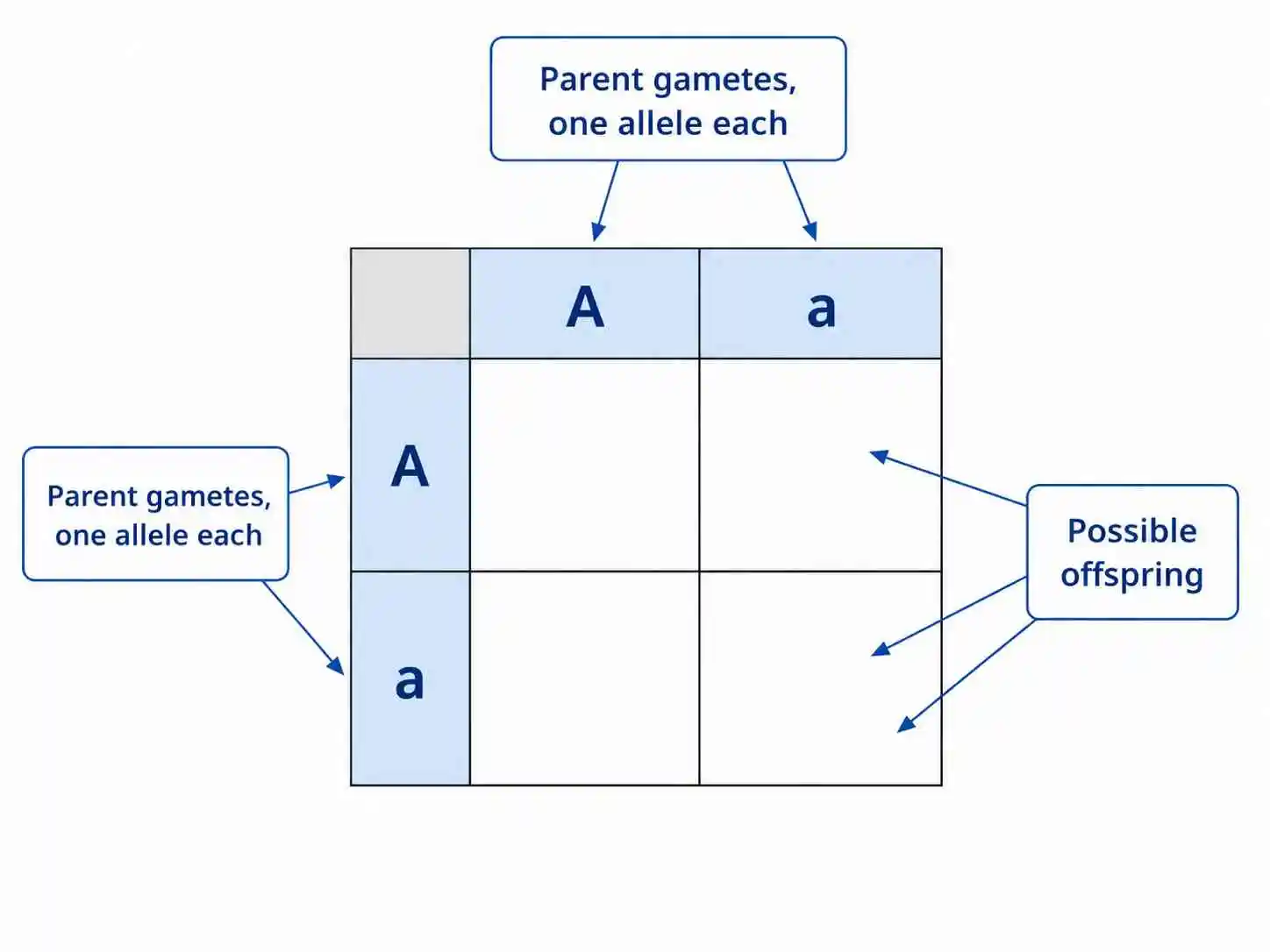
A gamete is a sex cell, like an egg or sperm. Here is the part students miss most often: each gamete carries only one allele per gene, never both. A parent with the genotype Tt produces two kinds of gamete, T and t. Those single alleles are what you write along the top and the side of the square.
The boxes
Each box combines one allele from the top with one allele from the side. The result is a possible offspring genotype. A one-trait cross gives you a 2x2 grid with four boxes. Fill every box, then count what you get.
Genotype vs Phenotype: What the Square Tells You
A genotype is the genetic code an organism carries. A phenotype is the trait you can actually see. The square gives you both, but you read them differently.
| Term | Meaning | Example |
|---|---|---|
| Genotype | The allele pair an organism carries | Tt |
| Phenotype | The visible trait that genotype produces | Tall |
Two different genotypes can share one phenotype. Both TT and Tt look tall, because the dominant T allele masks the recessive t. Only the tt genotype shows the recessive short trait. When you need the odds of a specific visible trait rather than a specific genotype, the phenotype probability calculator does the counting for you.
How to Read a Punnett Square
Reading a finished square comes down to four moves.
- Identify the parent genotypes from the letters on the top and side.
- Read each box as one possible offspring genotype.
- Count how many boxes share the same genotype.
- Turn those counts into a ratio, then a percentage.
Take a classic cross between two heterozygous parents, Aa and Aa. Each parent makes two gametes, A and a. Fill the grid and you get one AA, two Aa, and one aa.
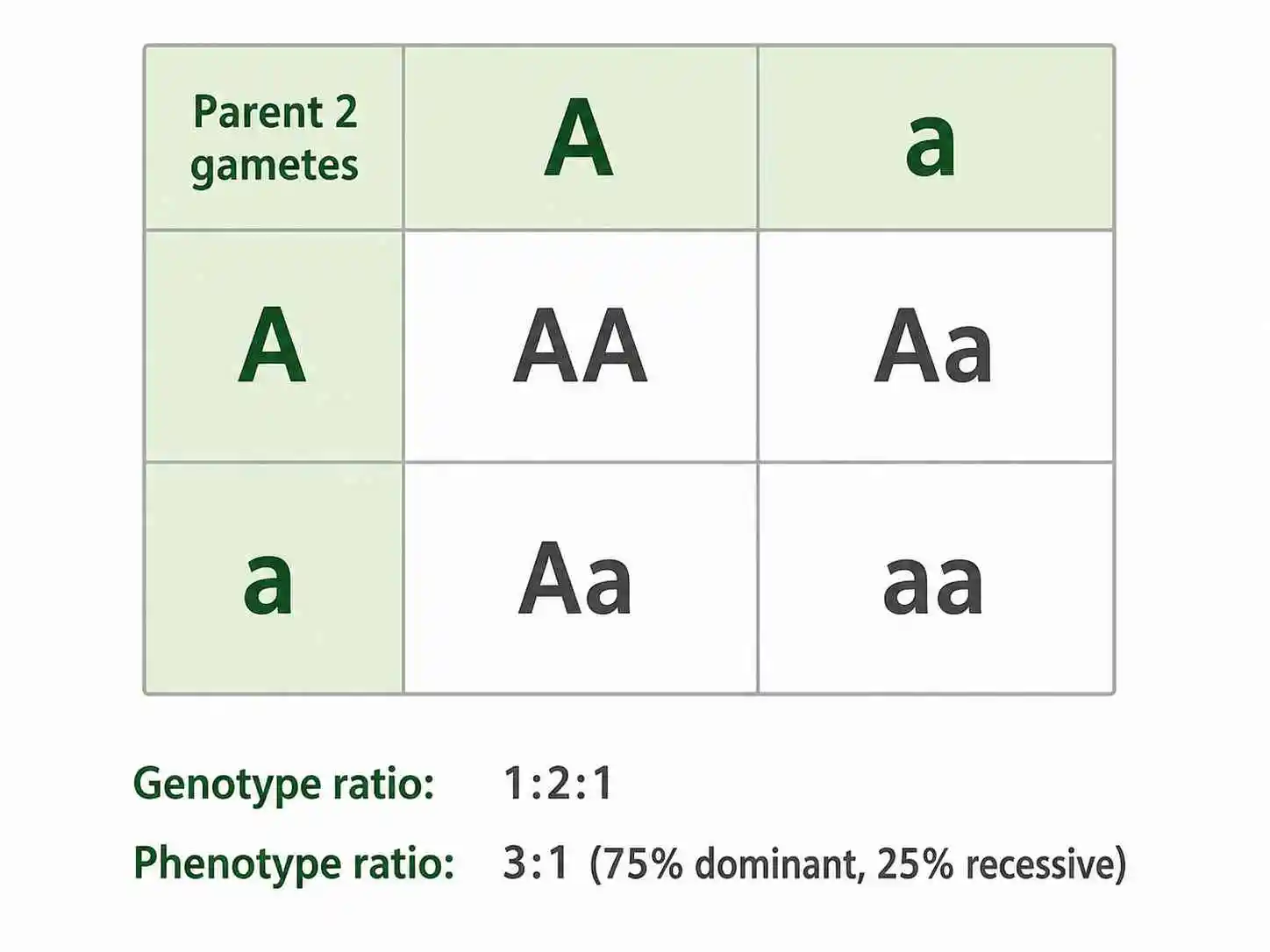
That gives a genotype ratio of 1:2:1. Because both AA and Aa show the dominant trait, the phenotype ratio is 3:1. In percentages, three out of four offspring (75 percent) show the dominant trait, and one out of four (25 percent) shows the recessive one. To check whether your real-world results match a predicted ratio like this, run the numbers through a chi-square ratio calculator.
How Big Is a Punnett Square?
The size depends on how many traits you track. One trait gives a 2x2 grid. Two traits give a 4x4 grid with 16 boxes. The pattern follows a simple rule: a heterozygous parent makes 2 raised to the power of the number of traits in gametes.
So two traits produce 4 gamete types per parent, three traits produce 8, and the grid grows fast. A dihybrid cross already needs 16 boxes and the well-known 9:3:3:1 ratio. A trihybrid cross jumps to 64. By the time you reach four or five traits, drawing the square by hand stops being practical, which is exactly where a calculator earns its keep.
A Worked Example: Pea Plant Flower Color
Mendel studied pea plants, so they make a clean example. In peas, purple flowers (P) are dominant over white flowers (p). Cross a heterozygous purple plant (Pp) with a white plant (pp).
Parent one makes gametes P and p. Parent two makes only p. Here is the filled grid:
| P | p | |
|---|---|---|
| p | Pp | pp |
| p | Pp | pp |
You get two Pp and two pp. The genotype ratio is 1:1. Since Pp shows purple and pp shows white, the phenotype ratio is also 1:1. Half the offspring will likely have purple flowers, half white. This kind of cross, where one parent is homozygous recessive, doubles as a test cross for checking an unknown genotype.
Where You Will Use This
A Punnett square is not just a classroom exercise. It predicts the chance a child inherits a recessive disorder, which is why the carrier probability calculator builds on the same logic. It handles traits carried on the X chromosome through the sex-linked inheritance calculator. And it underpins breeding decisions in plants and animals every day. Mendel's original laws, explained well by Khan Academy, are still the foundation under all of it.
Common Questions
Why is it called a Punnett square? It is named after Reginald C. Punnett, the British geneticist who devised it in 1905 to predict inheritance patterns.
How many boxes does a Punnett square have? A one-trait square has four boxes. A two-trait square has sixteen. The count equals the gamete types from one parent multiplied by the gamete types from the other.
Is a Punnett square always 2x2? No. A 2x2 grid only fits a single trait. Tracking more traits makes the grid larger, following the 2 to the power of n rule.
What do the letters in a Punnett square mean? Letters stand for alleles. Capital letters mark dominant alleles, lowercase letters mark recessive ones. A pair of letters shows an offspring's genotype.