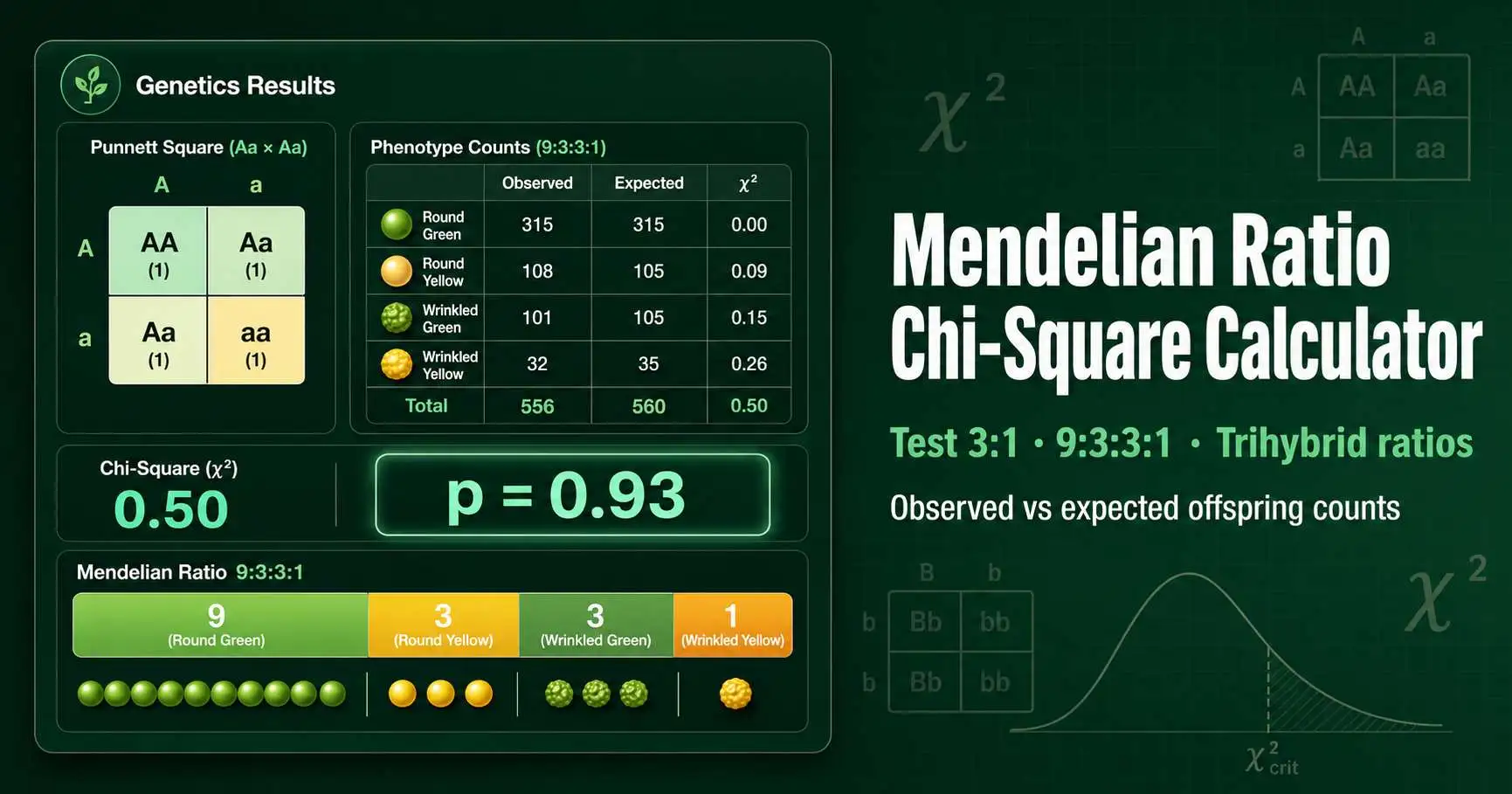
Biology students use chi-square tests to decide whether real offspring counts support a proposed cross. The method also helps breeders compare observed seed, coat, or flower phenotypes with a planned inheritance model. A rejected ratio can guide the next experiment, especially when two genes may show linkage or epistasis.
Molecular genetics gives those classical ratios a physical basis. Bhattacharyya, Smith, Ellis, Hedley, and Martin showed in 1990 that Mendel’s wrinkled pea seed phenotype traces to a transposon-like insertion in a gene encoding starch-branching enzyme. That discovery connected a visible 3:1 trait with starch biosynthesis in the developing seed. View the PubMed record.
For teaching statistics, the same workflow matches the general chi-square goodness-of-fit framework. OpenStax Statistics describes how observed and expected categorical counts drive the χ² statistic. Review the OpenStax goodness-of-fit method.