Trihybrid Cross Calculator for Three-Trait Genetics

Solve AaBbCc crosses without drawing a 64-box grid. This calculator builds parent gametes, combines them, and reports exact genotype and phenotype probabilities for three independently assorting genes.

Calculate trihybrid genotype and phenotype probabilities

Use Basic mode for the answer. Open Advanced mode when you need gamete frequencies, expected counts, genotype classes, and a downloadable table.

Set up a three-trait cross

Enter three allele pairs for each parent. The calculator builds gametes, combines them, and reports exact phenotype and genotype probabilities.

Parent 1 genotype

Example: AaBbCc means one heterozygous locus for each of A, B, and C.

Normalized: AaBbCc

Parent 2 genotype

Example: aabbcc is the triple-recessive tester used in a trihybrid test cross.

Normalized: AaBbCc

Selected result

A_B_C_

Probability: 42.19%

Expected count from 640 offspring: 270

Most likely class

A_B_C_

42.19%

This class has the largest probability under the current genotype model.

Trihybrid cross probability summaryAaBbBbCcCcCcCcPhenotype probabilitiesA_B_C_42.19%A_B_cc14.06%A_bbC_14.06%aaB_C_14.06%A_bbcc4.69%aaB_cc4.69%aabbC_4.69%aabbcc1.56%

Parent 1 gametes

abc

12.50%

abC

12.50%

aBc

12.50%

aBC

12.50%

Abc

12.50%

AbC

12.50%

ABc

12.50%

ABC

12.50%

Parent 2 gametes

abc

12.50%

abC

12.50%

aBc

12.50%

aBC

12.50%

Abc

12.50%

AbC

12.50%

ABc

12.50%

ABC

12.50%

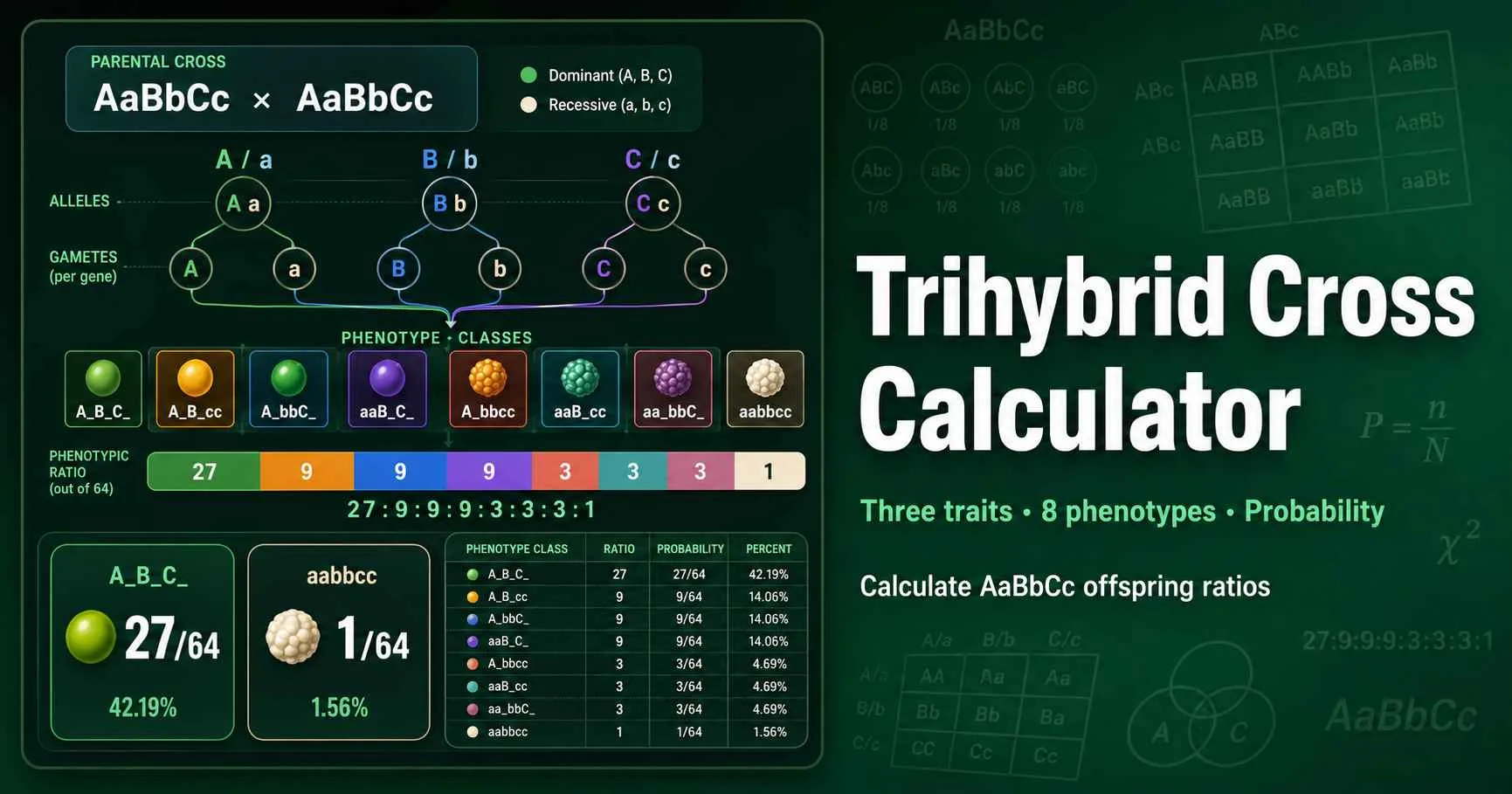
Trihybrid cross diagram showing AaBbCc gametes, three-trait phenotype classes, and the 27 to 9 to 9 to 9 to 3 to 3 to 3 to 1 Mendelian ratio
Figure 1. A trihybrid cross tracks three loci, such as A/a, B/b, and C/c, through gamete formation and fertilisation. The diagram shows how independent assortment creates eight gamete types and eight complete-dominance phenotype classes.

Trihybrid cross quick answer

A standard AaBbCc × AaBbCc cross gives the phenotype ratio 27:9:9:9:3:3:3:1 when all three genes assort independently and each dominant allele masks its recessive partner. The most common class is A_B_C_ at 27/64, or 42.19%. The rarest class is aabbcc at 1/64, or 1.56%.

The fast method multiplies single-gene probabilities. For A_B_C_, use 3/4 × 3/4 × 3/4. For aabbcc, use 1/4 × 1/4 × 1/4. This is the same logic used by the forked-line method, but the calculator also handles custom parent genotypes.

How three genes create 64 zygote combinations

Each heterozygous locus gives a parent two possible alleles in gametes. AaBbCc has three heterozygous loci, so it makes 2³ = 8 gamete types. Two parents with eight gamete types each create 8 × 8 = 64 fertilisation combinations.

Mendel’s law of independent assortment states that alleles at different genes sort into gametes independently when those genes are unlinked. OpenStax explains independent assortment through dihybrid crosses, and the same probability rule extends to three loci. Nature Education also describes independent assortment as the separation of different genes during gamete formation.

Real data can depart from this model. Linked loci, epistasis, reduced viability, incomplete dominance, and small sample size can change offspring ratios. If your observed class counts deviate from 27:9:9:9:3:3:3:1, test the numbers with a Mendelian ratio chi-square calculator before changing your genetic model.

Sources: OpenStax Biology 2e and Nature Education.
What each control does

The tool separates inputs, genetic assumptions, and outputs so students can see each step instead of copying a final ratio.

Parent genotypes

Controls
Three allele pairs, such as AaBbCc or AABbCc
Purpose
They determine which gametes each parent can make.

Target phenotype

Controls
The class you want to solve, such as A_B_C_
Purpose
It gives a direct answer for homework and lab questions.

Expected offspring count

Controls
A sample size, such as 640 offspring
Purpose
It converts probabilities into expected counts for experiments.

Trihybrid probability examples students actually need

AaBbCc × AaBbCc: chance of A_B_C_

Each single-gene heterozygote cross gives a 3/4 chance of the dominant phenotype. Multiply the three independent probabilities: 3/4 × 3/4 × 3/4 = 27/64. The answer is 42.19%.

If the class counted 640 offspring, the expected number of A_B_C_ offspring equals 640 × 27/64 = 270. This count gives a clear target for lab data.

AaBbCc × aabbcc: test cross classes

The heterozygous parent makes eight gamete types. The triple-recessive parent makes only abc gametes. Each heterozygote gamete therefore creates one matching offspring class.

If the genes assort independently, each phenotype appears at 1/8, or 12.5%. Large excesses of parental classes can point toward linkage, so compare this result with a genetic linkage calculator when your data show unequal test-cross classes.

When a three-trait ratio does not fit

Linked genes

Genes close together on the same chromosome produce too many parental gametes.

Epistasis

One gene can mask or modify another gene, so 27:9:9:9:3:3:3:1 no longer applies.

Small sample size

Rare classes such as aabbcc can disappear by chance when offspring numbers stay low.

Scoring error

Similar phenotypes can make counts drift away from the expected classes.

Trihybrid cross FAQ

What is a trihybrid cross?

A trihybrid cross tracks three genes at the same time. A standard example uses AaBbCc × AaBbCc. Each heterozygous parent can make eight gamete types, so the cross has 64 possible zygote combinations before identical classes merge. The calculator uses segregation and independent assortment to calculate each genotype and phenotype probability.

What is the trihybrid phenotypic ratio for AaBbCc × AaBbCc?

The classic complete-dominance ratio is 27:9:9:9:3:3:3:1. The largest class, A_B_C_, appears in 27 of 64 expected offspring. The triple-recessive class, aabbcc, appears in 1 of 64 expected offspring. This ratio assumes independent assortment and no epistasis, linkage, viability bias, or scoring error.

How many gametes does a trihybrid parent make?

A parent that is heterozygous at all three loci makes eight gamete types. The formula is 2ⁿ, where n equals the number of heterozygous loci. AaBbCc produces ABc, AbC, Abc, aBC, aBc, abC, abc, and ABC at equal frequency. A parent with a homozygous locus makes fewer gamete types because that locus contributes only one allele.

Why should I use probability instead of a 64-box Punnett square?

A 64-box grid works, but it wastes time and hides the pattern. Probability multiplication gives the same answer faster. For example, the chance of A_B_C_ in AaBbCc × AaBbCc equals 3/4 × 3/4 × 3/4 = 27/64. This method scales better when you move from two traits to three traits.

Can this calculator handle a trihybrid test cross?

Yes. Enter AaBbCc for one parent and aabbcc for the tester parent. If all three genes assort independently, the eight phenotype classes each appear at 12.5%. Strong departures from that pattern can suggest linkage, selection, small sample noise, or phenotype scoring problems.

Does this calculator model linked genes?

No. This calculator assumes that the three loci assort independently. Linked genes do not follow the standard trihybrid ratios because parental gametes appear more often than recombinant gametes. Use a linkage-specific calculator when loci sit close together on the same chromosome.

Can I use custom allele letters?

Yes. Use three matched allele pairs, such as RrYyTt or AaBbCc. Each pair must contain the same gene letter in uppercase and lowercase form. The calculator treats uppercase letters as dominant alleles and lowercase letters as recessive alleles for phenotype grouping.