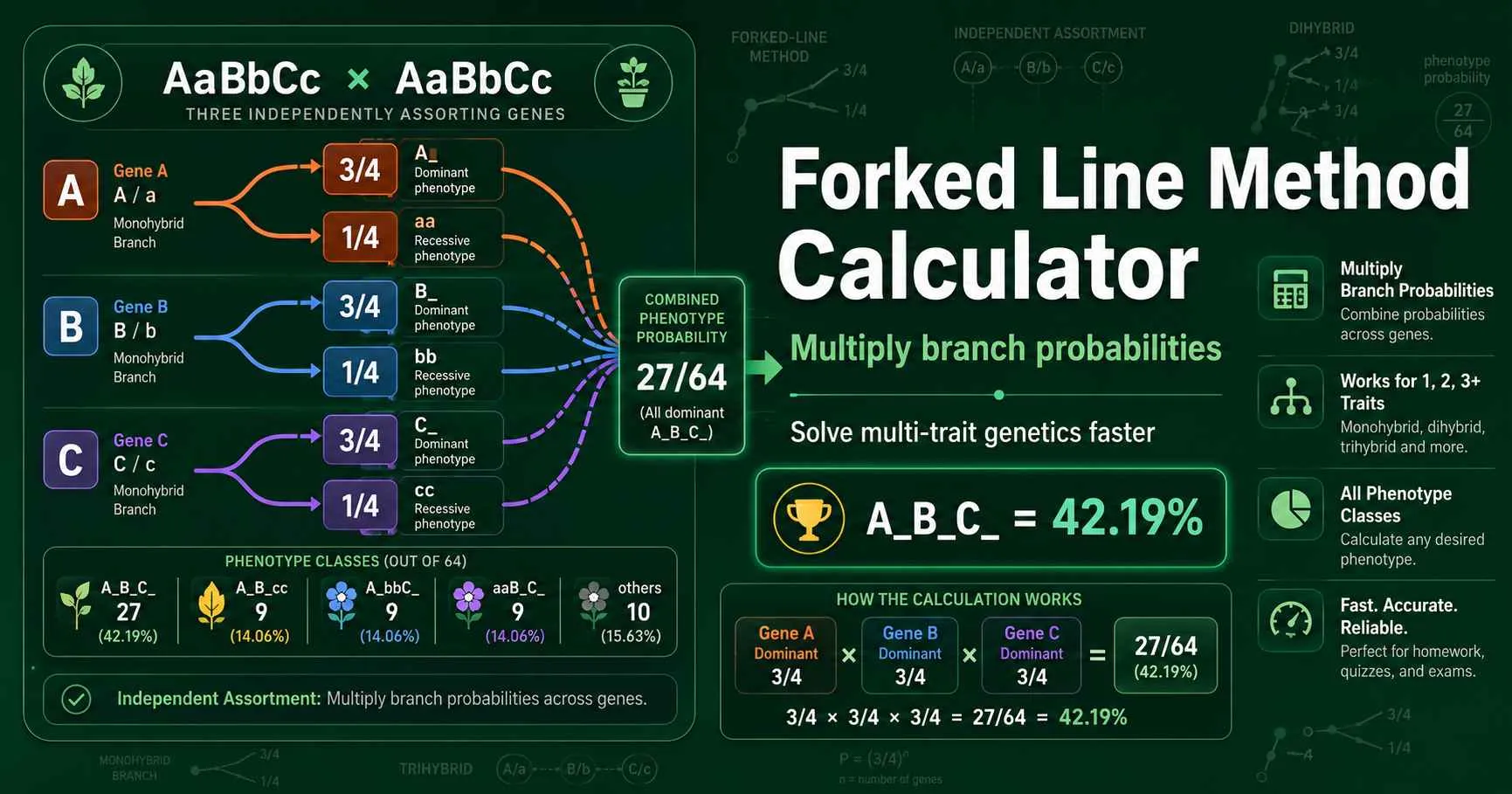
The forked line method answers one common question: what is the probability of a specific multi-trait offspring phenotype? It treats each locus as a separate monohybrid cross. Then it multiplies the branch probabilities because independent events combine through the product rule.
Mendel’s law of independent assortment says allele sorting at one gene does not control allele sorting at another unlinked gene. OpenStax explains this principle with dihybrid crosses, where gamete combinations occur independently when genes are unlinked or effectively unlinked. Read the inheritance background.
Students often use this method after they understand a single-gene Punnett square. It gives the same result as a large grid when the traits assort independently, but it keeps the work readable.