Eye Color Punnett Square: Brown-Eyed Parents, Blue Child?
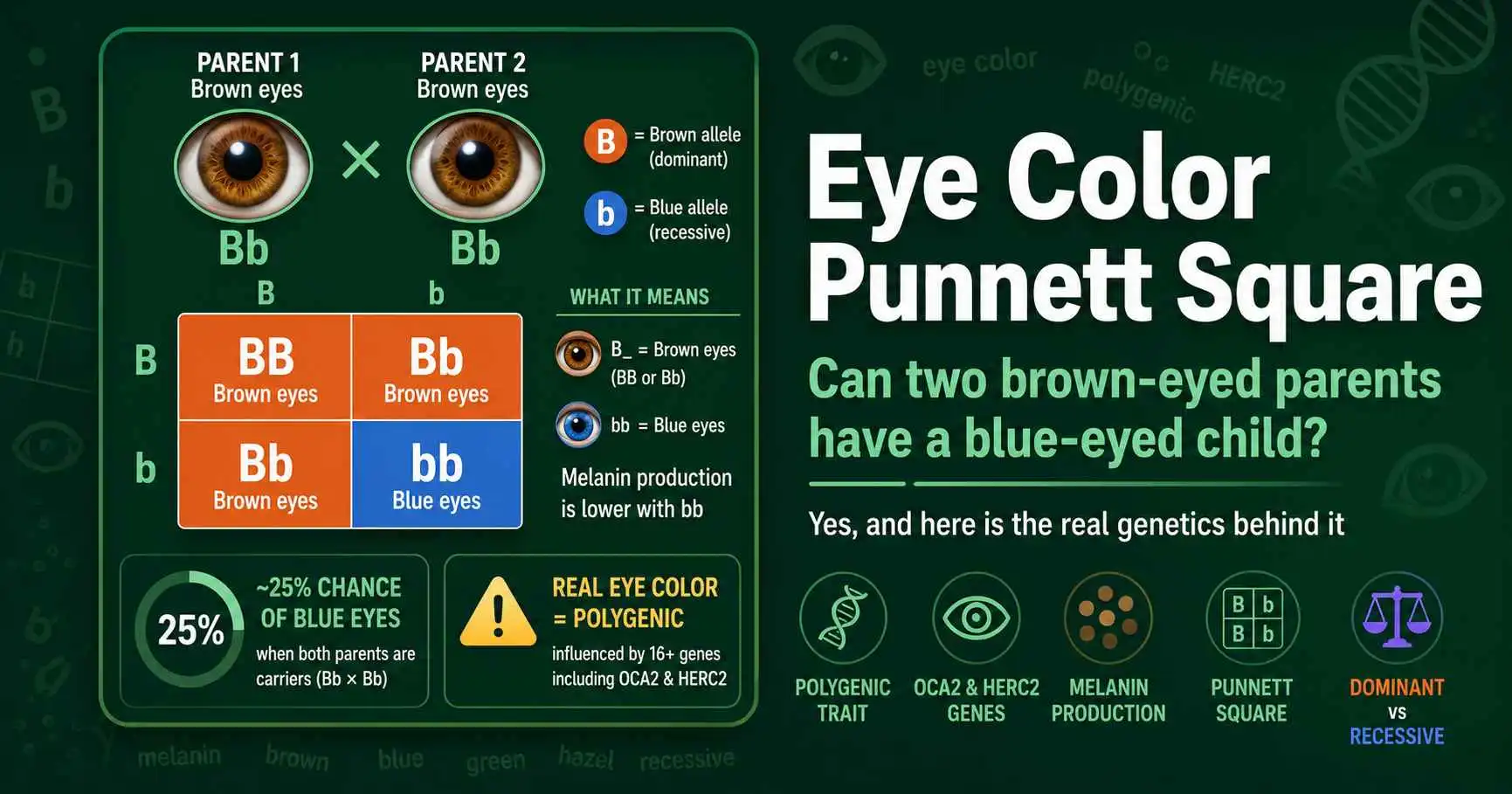
Yes, two brown-eyed parents can have a blue-eyed child. It happens when both parents carry a hidden recessive allele for lighter eyes and each passes it on. Under the simplified genetics taught in most classrooms, this is the textbook outcome of two heterozygous brown-eyed parents, with roughly a one in four chance of a blue-eyed child. The reality is a little more involved, because eye color is shaped by many genes, but the short answer to the famous question is a clear yes.
This question is one of the most searched in all of genetics, and for good reason. Eye color is the first trait many people think about when they wonder what a child will look like. This guide answers the headline question directly, shows you the Punnett square that explains it, and then tells you the honest truth that most pages skip: eye color is polygenic, so the simple brown-over-blue model is an oversimplification. Understanding both the simple model and its limits is what separates a real understanding from a half-truth. For the basics of reading any cross, our guide on how a Punnett square works covers the foundation.
The Short Answer: Yes, and Here Is Why
Two brown-eyed parents can absolutely have a blue-eyed child, and the simplified model explains the most common way it happens. In this model, brown eyes come from a dominant allele, often written B, and blue eyes come from a recessive allele, written b. A person shows brown eyes if they carry at least one B, so both the BB and Bb genotypes look brown.
Here is the key. A brown-eyed parent with the genotype Bb carries a hidden blue allele even though their own eyes are brown. If both parents are Bb, each can pass the recessive b to their child. A child who inherits b from both parents ends up with the genotype bb, which gives blue eyes. So two brown-eyed parents, both carrying a hidden blue allele, can produce a blue-eyed child whose eyes match neither parent.
This is exactly the same logic behind any recessive trait appearing from two carrier parents. The brown-eyed parents are carriers of the blue allele, much like carriers of a recessive condition who show no signs themselves. The blue eyes were always genetically possible; they were just masked in the parents by the dominant brown allele. The difference between what a parent shows and what they carry is the heart of why this surprises people, and it is the same gap between genotype and phenotype that runs through all of genetics.
The Eye Color Punnett Square (Simple Model)
Setting up the eye color Punnett square in the simple model works like any monohybrid cross. You take each parent's genotype, find their gametes, and combine them in a grid. The classic case is two heterozygous brown-eyed parents, both Bb.
Each Bb parent produces two kinds of gamete, one carrying B and one carrying b. Place one parent's gametes across the top and the other's down the side, then fill the four boxes. The result is one BB, two Bb, and one bb. Reading by eye color, the three boxes with at least one B are brown, and the single bb box is blue.
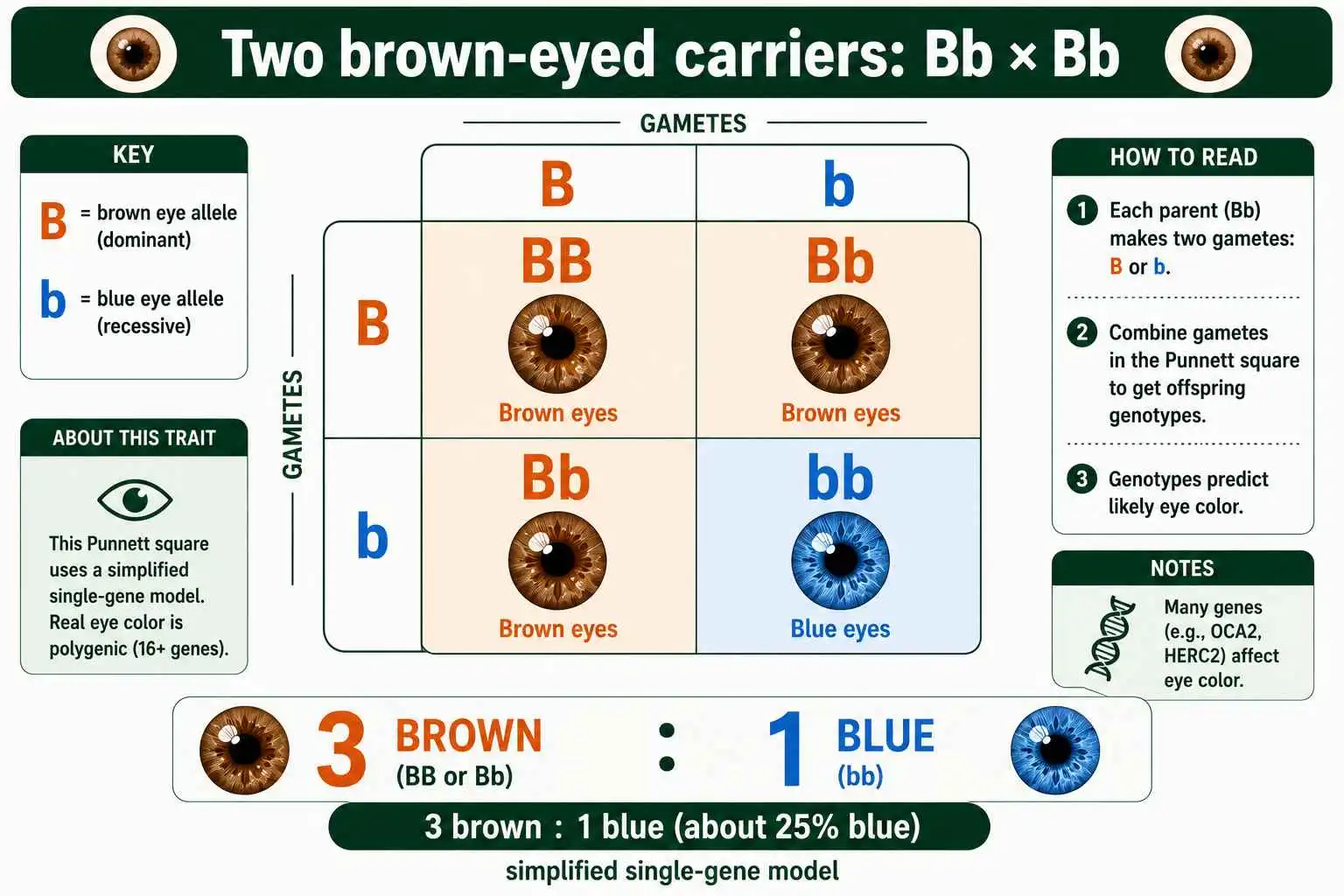
So this cross gives a 3:1 ratio, three brown-eyed children to one blue-eyed child, meaning roughly a 25 percent chance of blue eyes in any given child. That is the number behind the headline. If only one parent is a carrier, say Bb crossed with BB, no child can have blue eyes, because every child receives at least one B. And if both parents are blue-eyed (bb in this model), all their children would be blue-eyed, since neither parent has a brown allele to pass on. This last prediction is where the simple model starts to break down in the real world, as we will see. The same 3:1 pattern appears in many traits, and you can explore it further in our guide to the monohybrid cross and the 3:1 ratio.
Why the Simple Model Is Actually Wrong
Here is the truth most eye color pages leave out: the simple one-gene model is genetically incorrect. Eye color is not controlled by a single gene with a clean dominant brown allele and recessive blue allele. That model, first proposed by Charles and Gertrude Davenport in 1907 and taught for a century, is an oversimplification that fails to match reality.
Eye color is a polygenic trait, meaning it is influenced by many genes working together. Researchers estimate that up to 16 genes contribute to human eye color. The most important are two neighboring genes on chromosome 15, called OCA2 and HERC2. The OCA2 gene helps produce and store melanin, the pigment that darkens the iris, while HERC2 acts as a control switch that turns OCA2 activity up or down. Together these two genes account for roughly three-quarters of the blue-to-brown variation, but the remaining genes shift the outcome in ways a single-gene model cannot capture.
It is worth understanding where the wrong model came from, because it has proven remarkably hard to dislodge. In 1907, Charles and Gertrude Davenport proposed that brown eye color is always dominant over blue, which implied that two blue-eyed parents could never have a brown-eyed child. The idea was simple, memorable, and easy to teach, so it spread into classrooms worldwide and stayed there for most of a century. The problem is that it was built on observation alone, long before anyone could read the genes themselves. Modern sequencing has shown the Davenport model to be far too simple, yet it persists in textbooks precisely because the simplicity that makes it wrong also makes it easy to remember.
This polygenic reality has real consequences for prediction. Because so many genes contribute, the clean Mendelian predictions of the simple model often fail. The classic claim that two blue-eyed parents can never have a brown-eyed child turns out to be false. It is uncommon, but it does happen, precisely because the minor genes can boost melanin enough to override the expectation. As the Myths of Human Genetics project at the University of Delaware explains, blue eyes are simply not determined by a single recessive allele, and eye color should not be used as a textbook example of simple inheritance at all.
How Eye Color Genetics Really Works
To understand eye color properly, you have to start with melanin, the pigment that colors the iris. There is no blue or green pigment in human eyes. The amount and distribution of brown-black melanin, called eumelanin, determines the color you see. More melanin gives brown eyes, less gives green or hazel, and very little gives blue.
The blue color itself is not a pigment at all. Eyes with little melanin appear blue for the same reason the sky looks blue, through the way light scatters in the structure of the iris. This is why blue eyes are described as a structural color rather than a pigmented one. The genes do not paint the eye blue; they simply reduce the melanin, and the optical properties of the low-pigment iris produce the blue appearance. This single fact explains why eye color sits on a continuous spectrum rather than in neat categories.
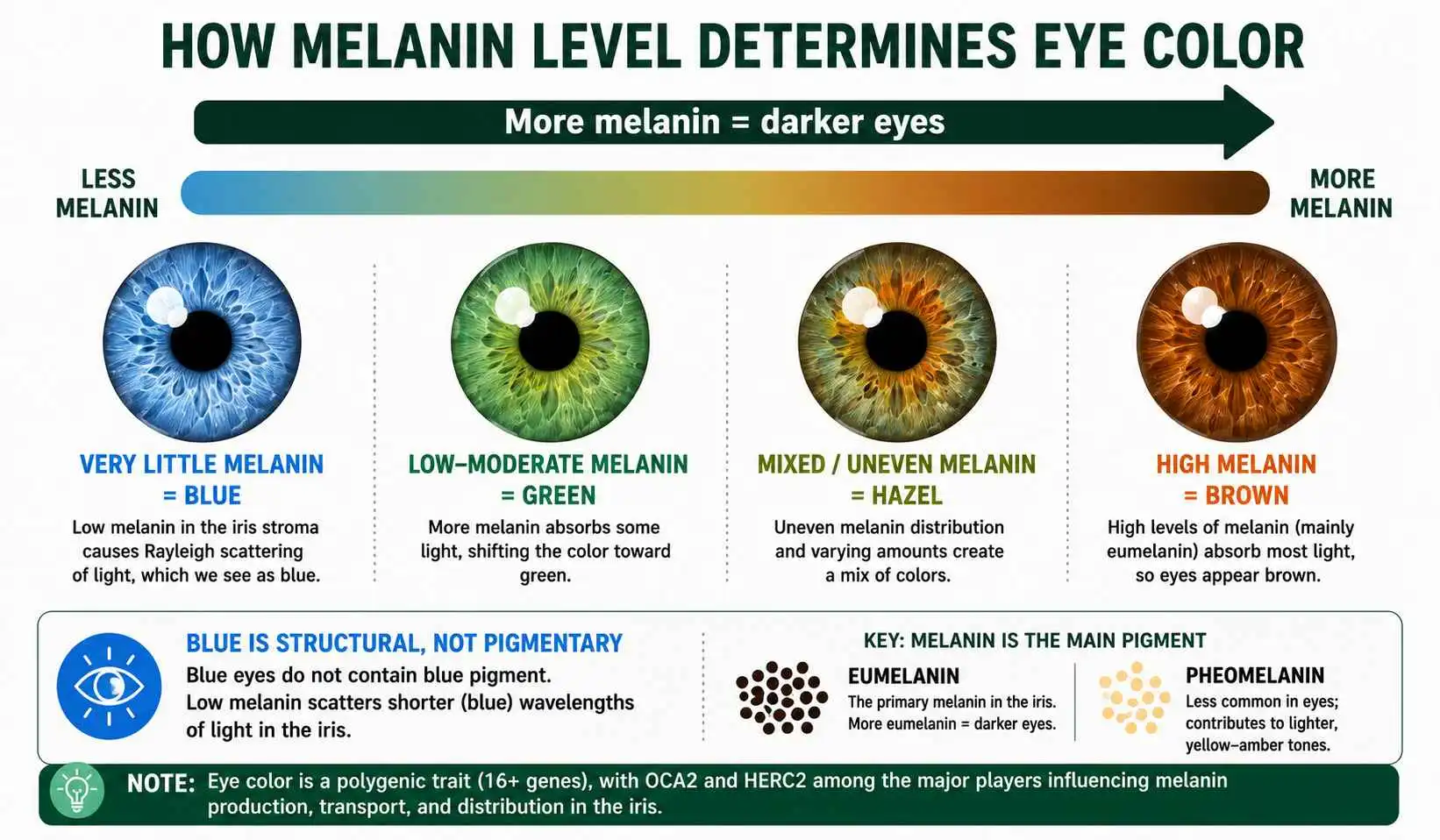
The genes control eye color by regulating this melanin. OCA2 governs how much melanin gets produced and stored in the iris, and HERC2 contains a switch that can dial OCA2 up or down.
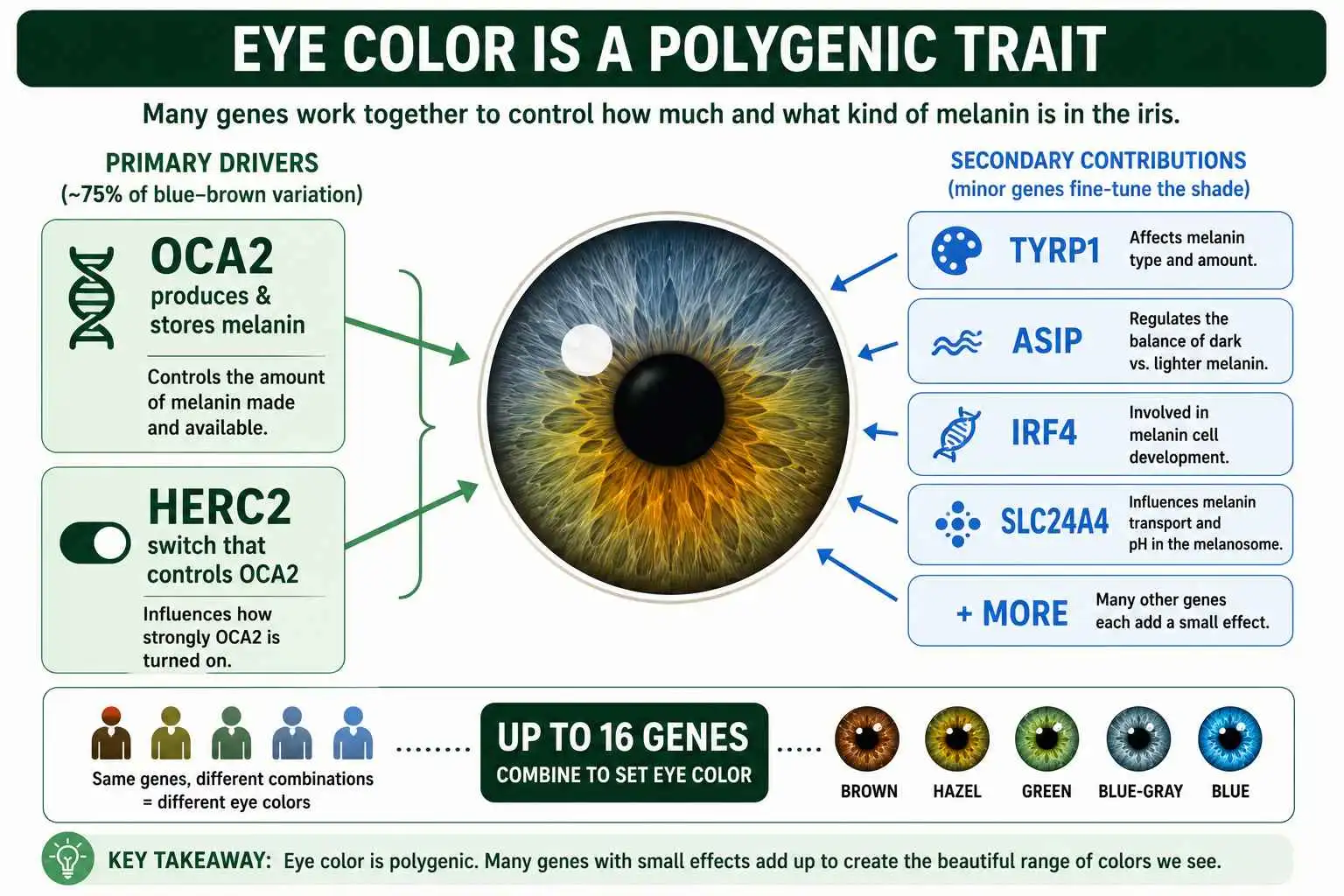
A common variant in HERC2 reduces OCA2 activity, lowering melanin and tending toward blue eyes. But other genes, including TYRP1, ASIP, and several melanin-transport genes, each nudge the total melanin level. The final eye color is the combined result of all these genes, which is why siblings can have noticeably different eye colors and why prediction is probabilistic rather than certain. This layered control, where one gene modifies another, is a form of gene interaction that appears throughout genetics.
Green and Hazel: The Colors the Simple Model Ignores
One of the biggest failures of the single-gene model is that it cannot explain green or hazel eyes at all. A model with only brown and blue alleles has no way to produce the intermediate colors that millions of people have. Yet green and hazel are common, which is strong evidence on its own that eye color needs more than one gene.
Green and hazel eyes come from intermediate amounts of melanin combined with the way that pigment is distributed in the iris. Green eyes, the rarest of the common colors at roughly two percent of people worldwide, have a moderate level of melanin, less than brown but more than blue, along with a particular scattering of light. Hazel eyes typically have melanin concentrated in different parts of the iris, often appearing to shift between brown, green, and gold depending on the light. Neither color fits anywhere in a two-allele scheme.
The existence of this full spectrum is why geneticists treat eye color as a continuous, polygenic trait rather than a set of discrete categories. The minor genes that the simple model ignores are exactly the ones that fine-tune melanin to produce green, hazel, amber, and every shade in between. A trait with such smooth variation almost always involves many genes, each contributing a small effect, which is the defining signature of polygenic inheritance and the clearest reason the textbook eye color model deserves retirement. The contrast is instructive: a true single-gene trait sorts people into a few sharp categories, the way pea plants are either tall or short, while eye color blends seamlessly from the darkest brown through hazel and green to the palest blue. That seamless gradient is something a two-allele model can never reproduce, no matter how the dominance is arranged.
When the Punnett Square Still Helps
Given all this complexity, you might wonder whether the eye color Punnett square is useless. It is not, as long as you treat it as a rough guide rather than a precise prediction. The simple model captures a real and dominant trend, even if it misses the details.
The honest framing is that brown alleles do tend to behave dominantly and blue tends to behave recessively for the major OCA2 and HERC2 genes. So the simple Punnett square gives a reasonable first approximation of the odds, especially for the broad question of brown versus blue. If both parents have brown eyes and a family history of blue, a blue-eyed child is plausible, and the one-in-four figure is a fair ballpark. The model breaks down at the edges, with green and hazel and the rare exceptions, but it is not worthless for a quick estimate.
The key is to state the caveat. A Punnett square for eye color predicts a tendency, not a guarantee, because the minor genes can shift the result. Used this way, with honesty about its limits, the simple cross is a useful teaching tool and a reasonable rough estimate. It becomes misleading only when someone treats its predictions as certain or uses it to make confident claims, such as insisting a brown-eyed child is impossible from two blue-eyed parents. To get probability estimates for traits that do follow cleaner inheritance, a phenotype probability calculator works well, with the reminder that eye color is an approximation.
Can a DNA Test Predict Eye Color?
Because eye color is polygenic, scientists have developed DNA tests that read many of the relevant genes at once, and these are far more accurate than any Punnett square. Forensic and ancestry labs use them, and they reveal both the power and the limits of eye color prediction.
The best-known tool is a forensic system that reads several eye color variants, including the key HERC2 marker, to predict whether a person has blue or brown eyes. For the two extremes, blue and brown, these tests are quite accurate, often above 90 percent, because the major OCA2 and HERC2 genes dominate those outcomes. This is why DNA-based eye color prediction has become useful in forensic investigations, where a sample can suggest a likely eye color for an unknown person.
The limits are just as telling. The same tests struggle with intermediate colors, especially green and hazel, precisely because those depend on the many minor genes whose effects are harder to read and combine. A test might confidently call blue or brown yet hesitate between green and hazel for the same reasons the simple model fails. This pattern, strong prediction at the extremes and weakness in the middle, is the clearest real-world confirmation that eye color is genuinely polygenic. It also shows that even sophisticated genetic testing inherits the same fundamental uncertainty that makes a single Punnett square inadequate, just to a much smaller degree.
Does Eye Color Change Over Time?
Eye color is not always fixed for life, which adds another layer the simple genetic model never addresses. Many people experience real changes in eye color, especially in infancy, and understanding this helps set realistic expectations about what genetics predicts.
The most common change happens in babies. Many infants of European descent are born with blue or blue-gray eyes because their irises have not yet accumulated melanin. Over the first six months to three years, melanin-producing cells gradually deposit pigment, and the eyes often darken toward their genetically determined color. A baby born with blue eyes may end up brown, green, or hazel as this process unfolds. This is why a newborn's eye color is an unreliable guide to their final color, and why the genes set a destination the iris reaches only gradually.
Smaller changes can continue beyond childhood. Some people notice subtle shifts in eye color with age, lighting, or even certain medications and medical conditions. These changes are usually minor compared to the dramatic darkening of infancy, but they reinforce a key point: eye color is the visible result of melanin in a living tissue, not a fixed label stamped at birth. Genetics sets the underlying tendency, but the phenotype you actually see can drift over time, which is one more reason any eye color prediction should be treated as an estimate rather than a certainty.
What This Means for Predicting a Baby's Eye Color
For expectant parents, the practical takeaway is that eye color can be estimated but not guaranteed. Family history gives useful clues, and the general dominance of brown over blue holds as a tendency, but the polygenic nature of the trait means surprises are entirely normal and not a cause for concern.
A few realistic patterns help set expectations. Two brown-eyed parents most often have brown-eyed children, but a blue-eyed or green-eyed child is quite possible if both carry lighter-eye alleles. Two blue-eyed parents usually have blue-eyed children, but a green or even brown-eyed child can occur in a small percentage of cases, around one to two percent by some estimates, due to the minor genes. A mixed pairing, one brown and one blue, can produce any of the common colors depending on what alleles the brown-eyed parent carries.
There is also a developmental wrinkle worth knowing. Many babies are born with blue or blue-gray eyes that darken over the first months or years as melanin accumulates in the iris. Eye color often does not stabilize until a child is several years old, so a newborn's eye color is not always their final one. Between the polygenic genetics and this gradual darkening, predicting a baby's exact eye color is genuinely uncertain, and any tool that claims precise certainty is overstating what the science allows. The most honest prediction is a range of likely colors with rough probabilities, not a definite answer.
Frequently Asked Questions
Can two brown-eyed parents have a blue-eyed child?
Yes. If both brown-eyed parents carry a hidden recessive allele for blue eyes, each can pass it on, giving the child two blue-eye alleles and blue eyes. In the simplified model this happens about 25 percent of the time when both parents are carriers.
Can two blue-eyed parents have a brown-eyed child?
Rarely, yes. Although the simple model says it is impossible, eye color is polygenic, and minor genes can occasionally boost melanin enough to produce brown or green eyes in a child of two blue-eyed parents. It occurs in roughly one to two percent of such cases.
Is eye color determined by one gene?
No. Eye color is polygenic, influenced by up to 16 genes. The OCA2 and HERC2 genes on chromosome 15 are the main drivers, accounting for about three-quarters of blue-to-brown variation, but many other genes fine-tune the final color.
Why can't a Punnett square reliably predict eye color?
Because eye color depends on many genes, not one. A Punnett square models a single gene, so it captures only the broad brown-versus-blue tendency and cannot account for green, hazel, or the gene interactions that produce unexpected colors.
The Honest Takeaway
So, can two brown-eyed parents have a blue-eyed child? Yes, and the simple Punnett square shows why: two carrier parents can each pass a hidden blue allele, giving a roughly one in four chance of blue eyes. That part of the classroom model holds up as a useful approximation. The deeper truth is that eye color is polygenic, shaped by OCA2, HERC2, and around a dozen more genes that together explain green, hazel, and the rare exceptions the simple model cannot.
The right way to use an eye color Punnett square is as a rough guide with an honest caveat, not a precise predictor. It captures the broad brown-over-blue tendency while leaving room for the surprises that polygenic genetics regularly produces. You can experiment with single-gene crosses using the Punnett Square Calculator to see the underlying logic, keeping in mind that a trait this complex always carries real uncertainty. For a deeper, research-based look at how eye color truly works, this article from HudsonAlpha is an excellent place to continue reading.