Baby Eye Color Prediction: How Genetics Decides
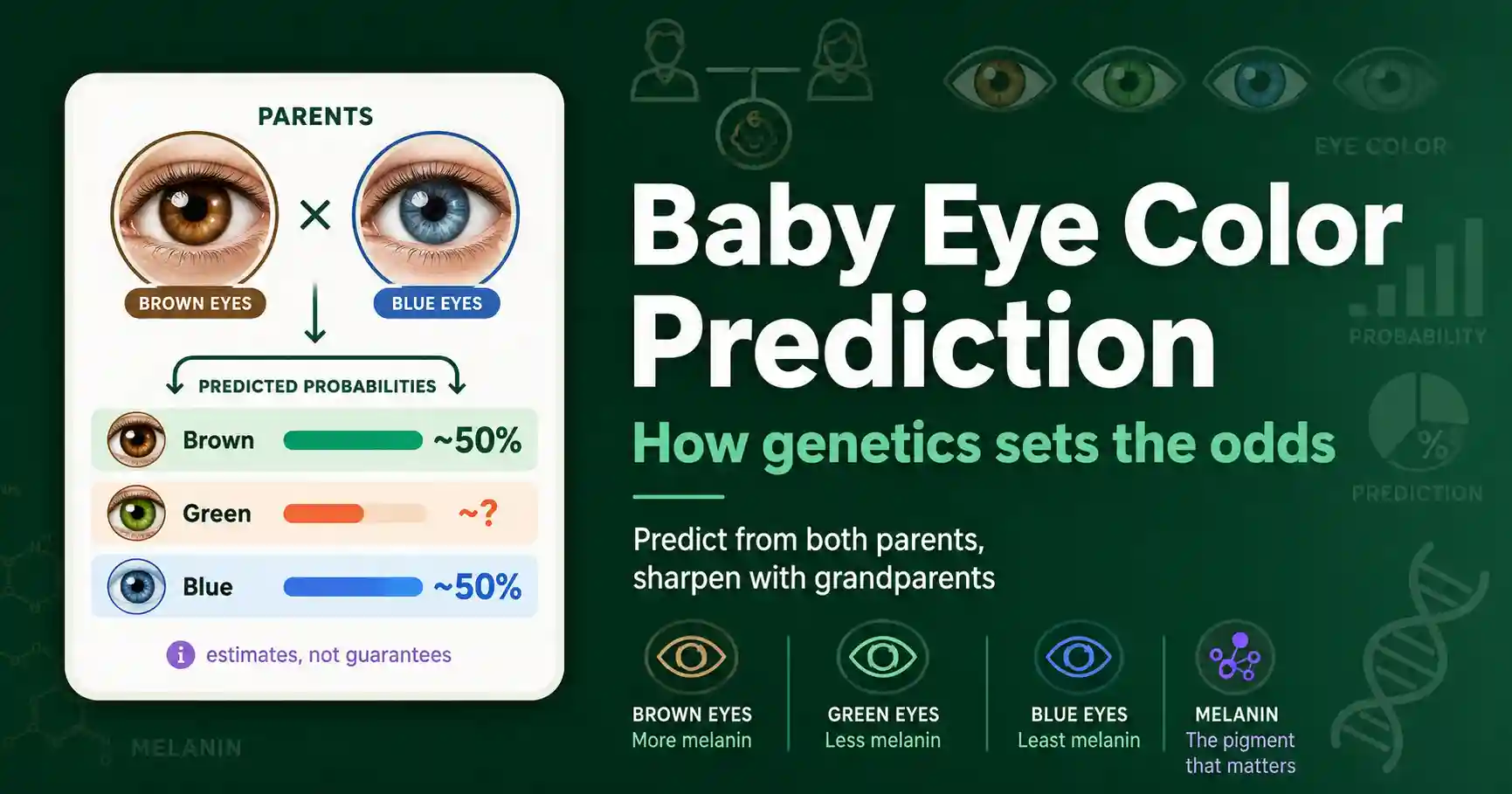
You can predict your baby's likely eye color from both parents' eye colors, but only as a probability, not a certainty. If both parents have brown eyes, brown is most likely, with a smaller chance of green or blue. If both have blue eyes, blue is almost certain. If one parent has brown and the other blue, the odds are roughly even. Eye color is shaped by many genes, so every prediction is an educated estimate.
This guide shows how to read those odds, gives a parent-by-parent probability chart, explains how grandparents sharpen the prediction, and is honest about the limits. For the science of why surprises happen, see our guide on whether brown-eyed parents can have a blue-eyed child. To compare eye colour with hair colour and blood type, use the baby genetics calculator.
How Eye Color Prediction Works
Predicting eye color means estimating probabilities from the parents' eye colors. It works because eye color is inherited, so the parents' colors carry real information about what the child is likely to get.
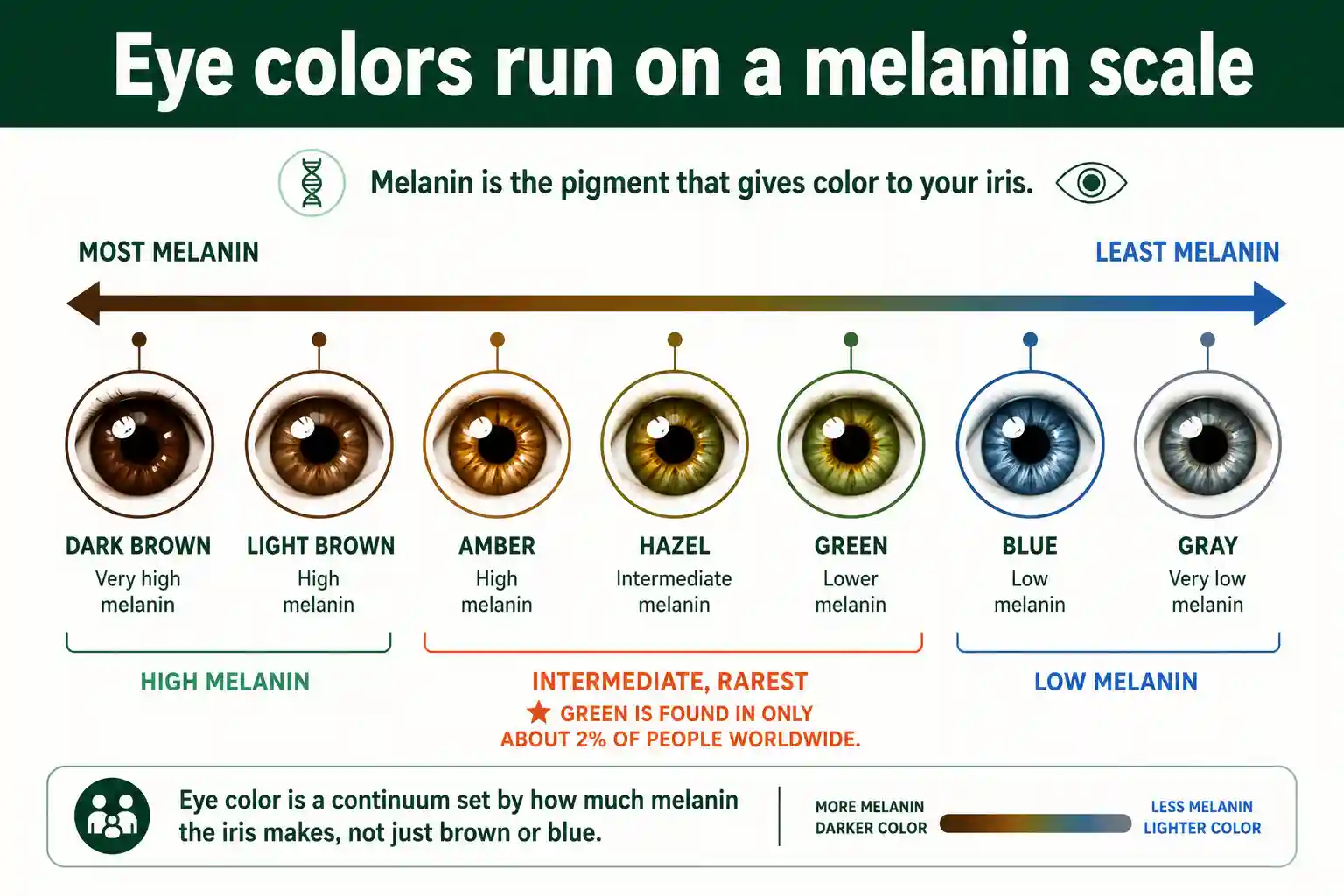
The logic rests on melanin, the pigment in the iris. Brown eyes have the most melanin, blue eyes the least, and green and hazel fall in between. Parents pass on gene variants that set how much melanin their child's irises will make, so darker-eyed parents tend toward darker-eyed children and lighter-eyed parents toward lighter. But because lighter colors can hide behind darker ones, the parents' visible eye color only narrows the odds rather than fixing the result.
That is why prediction is about probability, not certainty. A predictor takes the parents' colors, applies the known inheritance patterns, and returns a percentage chance for each possible color. The numbers come from studies of large families and twins, so they reflect real outcomes, but they remain averages across many families rather than a guarantee for yours.
It helps to think of each parent as carrying two "votes" for eye color, one on each copy of their genes, and only the stronger vote shows in their own eyes. A brown-eyed parent might be carrying brown-and-brown, or brown-and-blue, or brown-and-green, and you cannot tell which from looking at them. When they have a child, they pass along just one of their two votes at random. This is why two brown-eyed parents can produce a range of outcomes: the child receives one hidden vote from each, and the combination decides the result. The prediction percentages are really just a tally of how those random combinations tend to fall across many families.
The Eye Color Probability Chart
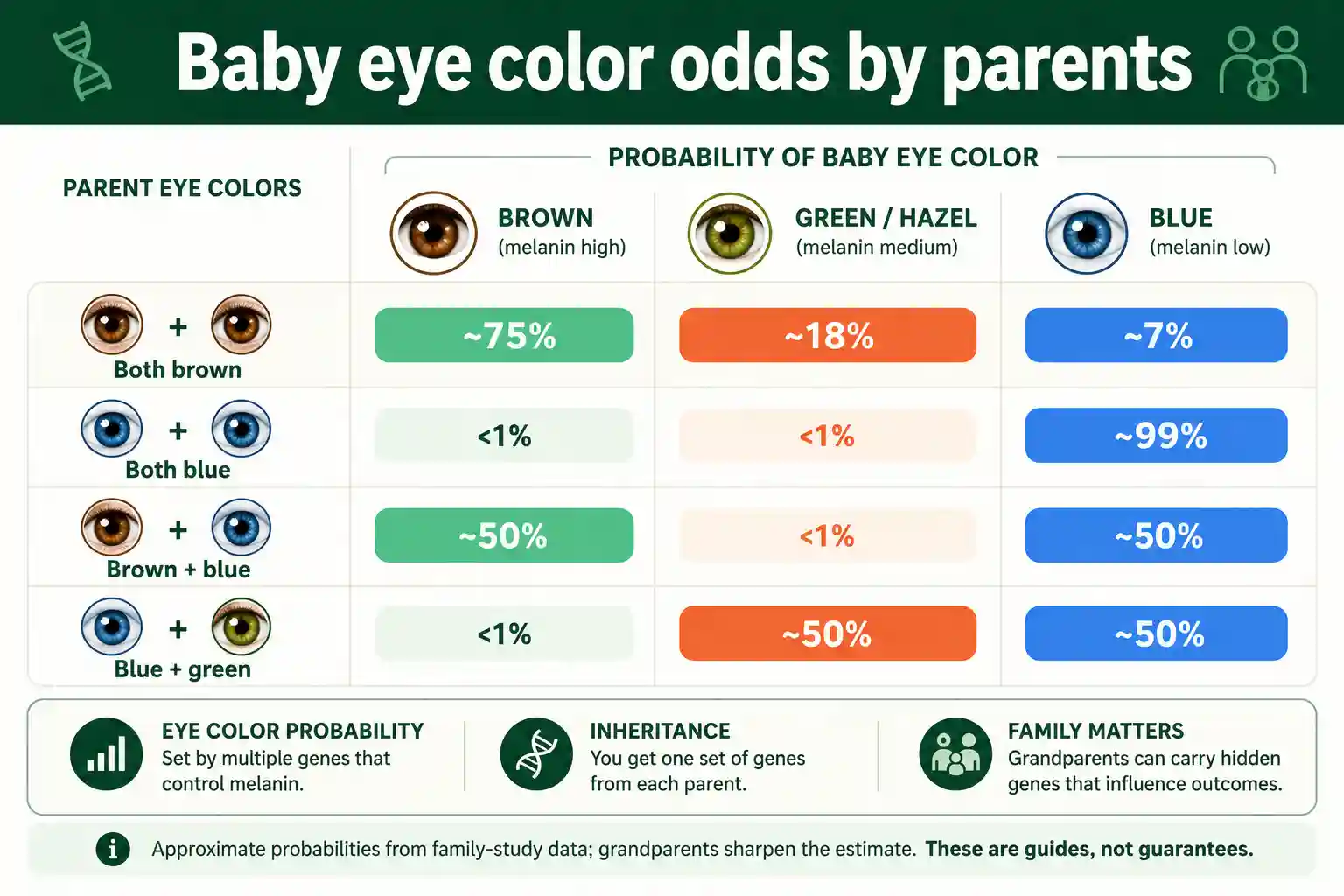
The most useful tool is a chart of likely outcomes for each parent combination. The table below shows approximate probabilities, drawn from family-study data.
| Parents' eye colors | Brown | Green/Hazel | Blue |
|---|---|---|---|
| Both brown | ~75% | ~18% | ~7% |
| Both blue | ~1% | ~0% | ~99% |
| Both green | ~0% | ~99% | ~1% |
| Brown + blue | ~50% | ~?% | ~50% |
| Brown + green | ~50% | ~38% | ~12% |
| Blue + green | ~0% | ~50% | ~50% |
A few patterns stand out. Two brown-eyed parents most often have a brown-eyed child, but roughly a quarter of the time the child has green or blue eyes, because brown-eyed parents frequently carry hidden lighter variants. Two blue-eyed parents almost always have a blue-eyed child. And mixed pairings, like brown and blue, split fairly evenly. These figures are approximate, and the green and hazel numbers are the least certain, because those colors come from complex gene combinations. The AllAboutVision overview of eye color genetics presents similar parent-by-parent estimates.
How Grandparents Change the Odds
Adding grandparents' eye colors makes a prediction sharper, especially when the parents have brown eyes. Grandparents reveal which hidden variants a brown-eyed parent might carry.
The reason is carrier status. A brown-eyed parent could carry only brown variants, or could carry a hidden blue or green one. You cannot tell from their eyes alone. But if that parent has a blue-eyed mother or father, it shows the parent likely carries a blue variant passed down from that grandparent, which raises the chance of a lighter-eyed grandchild. So a brown-eyed couple with blue-eyed grandparents in the mix has a higher chance of a blue-eyed baby than the chart's baseline suggests. A simple way to picture it: a blue-eyed grandparent is proof that the blue variant runs in the family and could surface again in the grandchild.
Grandparents matter most when parents are brown-eyed, because that is where the hidden variants are hardest to see. When a parent already has blue eyes, their lighter variants are not hidden, so the grandparents add little. This is why the more detailed predictors ask for grandparents' colors: each one entered narrows the estimate and raises confidence. To factor in the whole family, our eye color calculator lets you enter parents and grandparents for a sharper estimate, and if you want to predict eye color together with other features, you can run a full baby trait estimate in one place.
Why Predictions Are Only Estimates
No eye color prediction is a guarantee, and the reason is built into the genetics. Eye color is polygenic, shaped by at least 16 genes, so the simple charts capture the main pattern but miss the finer combinations.
The two biggest genes, OCA2 and HERC2, set most of the blue-to-brown range, but the supporting genes shift the result toward green, hazel, amber, or gray in ways a parent's visible color does not reveal. Two couples with identical eye colors can carry different genetic recipes and have differently-eyed children. That hidden variation is why even a good predictor gives probabilities rather than answers, and why occasional surprises, like a brown-eyed child from two blue-eyed parents, are genuinely possible. The Cleveland Clinic explainer on eye color describes how this polygenic inheritance produces a spectrum rather than fixed categories.
Ethnic background matters too, because eye color gene frequencies differ between populations, so the same chart can be more or less accurate depending on ancestry. And multi-racial families often see outcomes the simple two-gene model predicts poorly, because more variants are in play. Treat any prediction as a fun, informed guess, and hold it loosely.
The Rarer Eye Colors
Beyond brown, blue, and green, a few eye colors show up rarely, and parents often wonder about their odds. These are the hardest to predict, because they come from unusual gene combinations.
Green is the rarest common eye color, found in only about 2 percent of people worldwide. It needs a specific middle range of melanin plus light scattering in the iris, which is why no simple chart predicts it reliably. Hazel, a shifting mix of brown and green often with a ring of one color around another, is similarly hard to pin down, and it can even appear to change with lighting and clothing. Amber, a solid golden-brown, and gray, a very low-melanin variant of blue, are rarer still. The American Academy of Ophthalmology overview of eye color describes how these shades arise from melanin amount and light interaction.
Then there is heterochromia, where a person has two different-colored eyes or patches of different color within one iris. It is uncommon and usually harmless, sometimes inherited and sometimes arising on its own during development. No predictor estimates heterochromia, since it does not follow the simple parent-color patterns. If a baby is born with noticeably mismatched eye colors, it is worth mentioning to a pediatrician, who can confirm it is the harmless kind, though in most cases it is simply a striking and benign trait.
When Eye Color Becomes Final
A practical wrinkle for new parents: the eye color a baby is born with is often not the final one, so predictions describe the eventual adult color. Many babies' eyes change over the first months.
Lots of babies, especially those of European descent, are born with blue or gray eyes because their irises have not yet made much melanin. Over the first six to twelve months, the pigment cells respond to light and may add melanin, shifting the eyes toward green, hazel, or brown. By around nine to twelve months many babies show their likely permanent color, though subtle changes can continue to about age three. Babies with more melanin at birth, common in many populations, usually start and stay brown. So if your prediction said brown but your newborn's eyes look blue, give it a year before deciding the prediction was wrong. The change is gradual and one-directional: eyes generally darken with added melanin, they rarely lighten, so a brown-eyed newborn almost never turns blue later.
Frequently Asked Questions
What is the most accurate way to predict a baby's eye color?
The most accurate simple method uses both parents' eye colors plus all four grandparents' colors. Parents' colors set the baseline probability, and grandparents reveal hidden variants a brown-eyed parent may carry, which sharpens the estimate. Even so, the result is a probability, not a guarantee, because eye color is influenced by many genes.
If both parents have brown eyes, what color will the baby have?
Most likely brown, around a 75 percent chance, but there is roughly an 18 percent chance of green or hazel and about a 7 percent chance of blue. Two brown-eyed parents often carry hidden lighter variants, so a lighter-eyed child is entirely possible, especially if there are blue or green eyes among the grandparents.
Can a baby's eye color change after birth?
Yes. Many babies are born with blue or gray eyes that darken over the first six to twelve months as the iris produces more melanin. Most reach their likely permanent color by around one year, with minor changes possible until about age three. This is why predictions describe the expected adult eye color rather than the color at birth.
Reading the Odds
Predicting a baby's eye color is a matter of probability. Both parents' colors set the baseline, two brown parents lean brown but often carry hidden lighter variants, two blue parents almost always have blue-eyed children, and mixed pairs split more evenly. Adding grandparents sharpens the estimate, especially for brown-eyed couples whose carried variants are otherwise invisible.
The honest bottom line is that eye color is polygenic, so every prediction is an educated guess rather than a certainty, and a baby's eyes may keep changing through the first year. Enjoy the guessing, and treat the percentages as a fun guide. To predict another trait the same way, our guide on baby blood type shows how blood type inheritance works, which is more predictable than eye color.