Can Brown-Eyed Parents Have a Blue-Eyed Child?
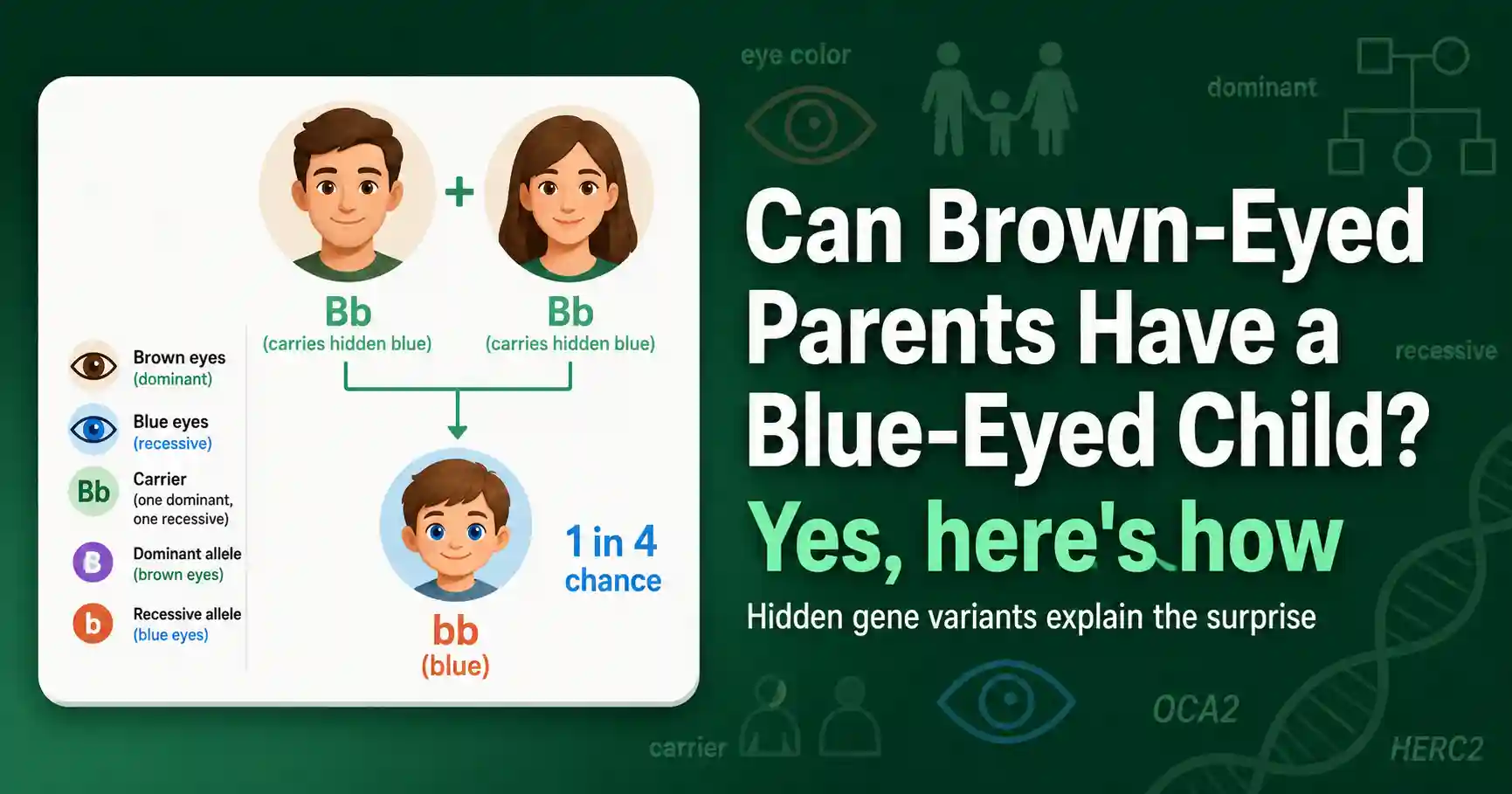
Yes, two brown-eyed parents can have a blue-eyed child. It happens when both parents carry a hidden blue-eye gene variant behind their brown eyes, and each passes that variant to the child. Brown eyes are usually dominant, so a parent can have brown eyes while still carrying a recessive blue variant that does not show. When a child inherits the blue variant from both parents, blue eyes can appear.
This is one of the most common questions about baby traits, and the short answer surprises people. This guide explains how it works, why eye color is more complicated than the simple version taught in school, and what that means for predicting your own child's eyes. There are even quick tools that estimate the odds for common baby traits from both parents, which we get to below.
The Short Answer
Two brown-eyed parents absolutely can have a blue-eyed baby. The key is that having brown eyes does not mean carrying only brown-eye genes.
Eye color genes come in versions called alleles, and the brown version tends to dominate the blue version. That means a person can carry one brown allele and one blue allele, show brown eyes because brown wins out, and still pass the blue allele to their children. Geneticists call such a person a carrier: they carry the blue variant without showing it.
When two brown-eyed carriers have a child, each has a chance of passing on their hidden blue allele instead of the brown one. If the child happens to receive a blue allele from both parents, with no brown allele to mask it, blue eyes can result. This is why blue eyes sometimes appear in a family where both parents, and maybe even the grandparents, have brown eyes.
Why It Happens: Hidden Variants
The reason this surprises people is that we carry genes we cannot see. Every person has two copies of each eye-color gene, one from each parent, and the two copies can be different.
Think of the brown allele as a dimmer switch turned up, producing lots of the brown pigment melanin in the iris, and the blue allele as the switch turned down. When someone has one of each, the turned-up brown allele dominates, so their eyes look brown. But the turned-down blue allele is still there, hidden, ready to be passed on. Two brown-eyed parents who each carry a hidden blue allele can each pass it down, and a child who gets both shows the trait neither parent displays.
This hidden-carrier idea is the heart of recessive inheritance, and it explains many "where did that come from" family traits, not just eye color. The same logic appears in our explainer on eye color Punnett squares, which shows how to map out the possibilities on paper.
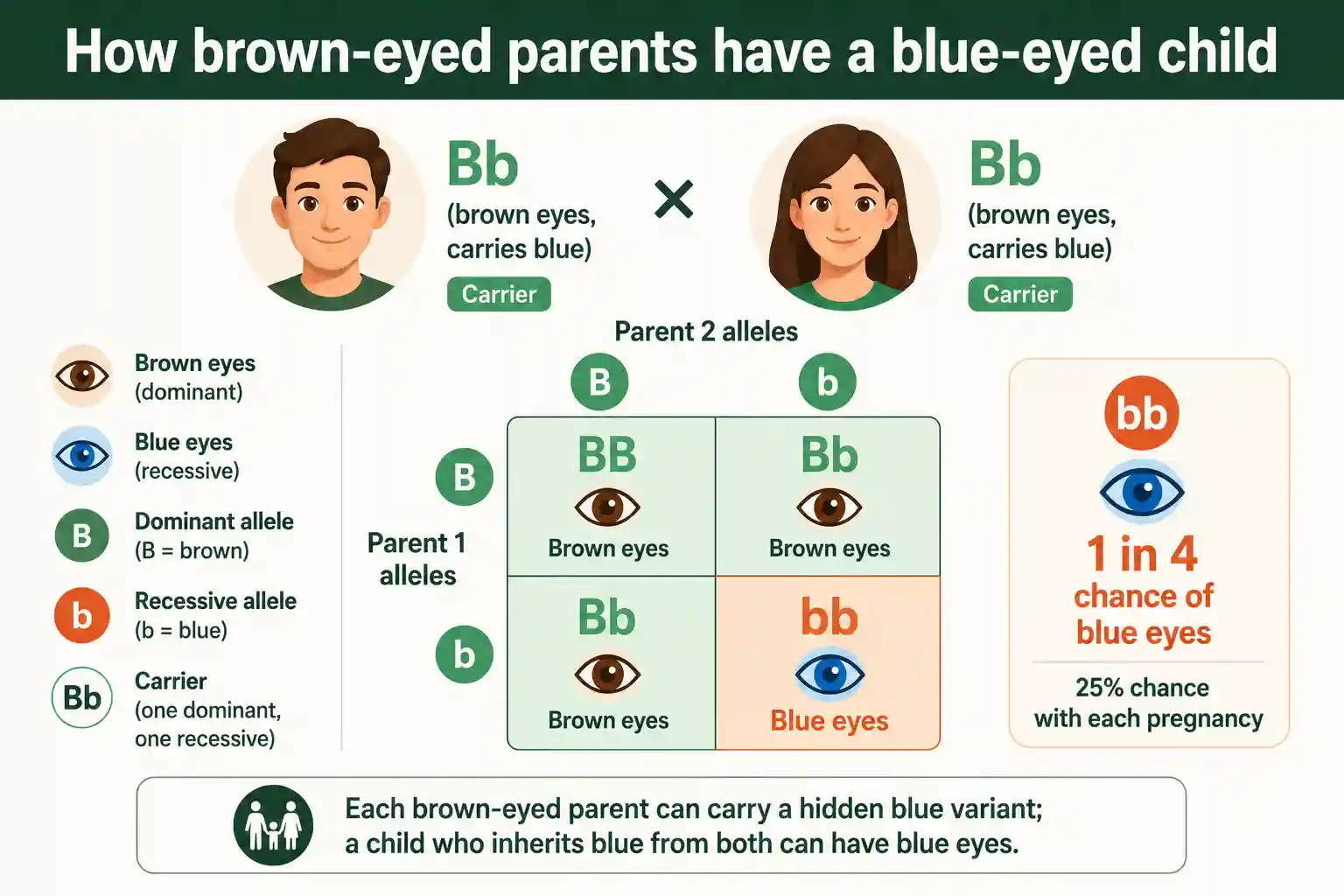
The Simple Model, and Why It Is Incomplete
For decades, eye color was taught with a simple model: one gene, brown dominant, blue recessive. That model is a useful starting point, but it is not the full story, and it gets some cases wrong.
In the simple version, brown-eyed parents who are both carriers have about a one in four chance of a blue-eyed child, the classic recessive ratio. That number is a reasonable rough guide, and it captures the basic idea that two brown-eyed parents can have a blue-eyed baby. For a first estimate, it works.
But real eye color is polygenic, meaning many genes shape it, not one. Scientists have found that up to 16 genes influence eye color, which is why human eyes come in a continuous range, blue, gray, green, hazel, amber, light brown, dark brown, rather than just two options. The one-gene model cannot explain green or hazel eyes at all, and it occasionally predicts impossible outcomes. So treat the simple model as a helpful approximation, not a law.
Green and hazel eyes are the clearest sign that more than one gene is at work. They sit between blue and brown on the melanin scale: more pigment than blue, less than brown, often with extra warmth from a pigment called lipochrome. A single brown-or-blue gene could never produce these in-between shades, which is why a child of two brown-eyed parents might turn out green or hazel rather than strictly brown or blue. The same goes for the difference between light and dark brown, or gray and blue, all of it the product of many genes nudging melanin up or down.
The Genes Behind Eye Color
Two genes do most of the work in setting eye color, and knowing their names helps make sense of it. They sit next to each other on chromosome 15.
The first is OCA2, which carries the instructions for making a protein that helps produce and store melanin in the iris. More melanin means darker eyes; less means lighter. The second is HERC2, which sits right beside OCA2 and acts like a control switch, turning OCA2's activity up or down. A common variant in HERC2 turns OCA2 down, reducing melanin and producing blue eyes. Together, OCA2 and HERC2 account for most of the difference between blue and brown eyes. The MedlinePlus overview of eye color genetics from the U.S. National Library of Medicine explains how these genes work in plain language, and the geneticists at The Tech Interactive describe these genes as dimmer switches rather than simple on-off controls.
Several other genes fine-tune the result, including ones with names like ASIP, IRF4, and TYR. These minor players adjust the exact amount and distribution of melanin, which is what produces green, hazel, and the many shades in between. Because so many genes combine, two people with the same eye color can carry very different genetic recipes, which is exactly why predictions are estimates rather than certainties.
What About Two Blue-Eyed Parents?
The flip side question comes up just as often: can two blue-eyed parents have a brown-eyed child? Under the simple model, the answer would be no, but real genetics says it is possible, though uncommon.
In the one-gene model, two blue-eyed parents carry only blue alleles, so they could only pass blue to a child, making brown impossible. That is why the simple model says two blue-eyed parents always have blue-eyed children. For most families, that holds true.
But because eye color is polygenic, a blue-eyed parent can carry other melanin-promoting gene variants that did not affect their own eyes much but can combine in a child to produce brown. It is rare, and it points back to the same lesson: eye color is governed by many genes interacting, so unusual combinations occasionally produce a surprise. The genetics is real, even when the outcome is uncommon.
Predicting Your Baby's Eye Color
So what does this mean for guessing your own child's eyes? You can estimate the odds, but you cannot know for sure, and that uncertainty is built into the biology.
The practical approach is probability. If both parents have brown eyes, brown is the most likely outcome for the child, but blue or green is possible if hidden variants line up. If both parents have blue eyes, blue is most likely, with darker shades much less likely but not impossible. Family history helps: a blue-eyed grandparent raises the chance that a brown-eyed parent carries a hidden blue variant, and a long line of brown-eyed relatives on both sides lowers it. To turn parental eye colors into rough odds, our eye color calculator estimates the likelihood of each color, and you can estimate several of your baby's traits at once when you want more than eye color.
Treat any prediction as a fun, educated guess rather than a guarantee. Because so many genes contribute, even a good estimate carries real uncertainty, and the only way to know a baby's eye color is to wait and see, keeping in mind that many babies' eyes change color over the first year of life.
A Note on Newborn Eye Color
One thing trips up new parents: a baby's eye color at birth is often not their final color. Many babies' eyes change over the first year, which adds another layer to any prediction.
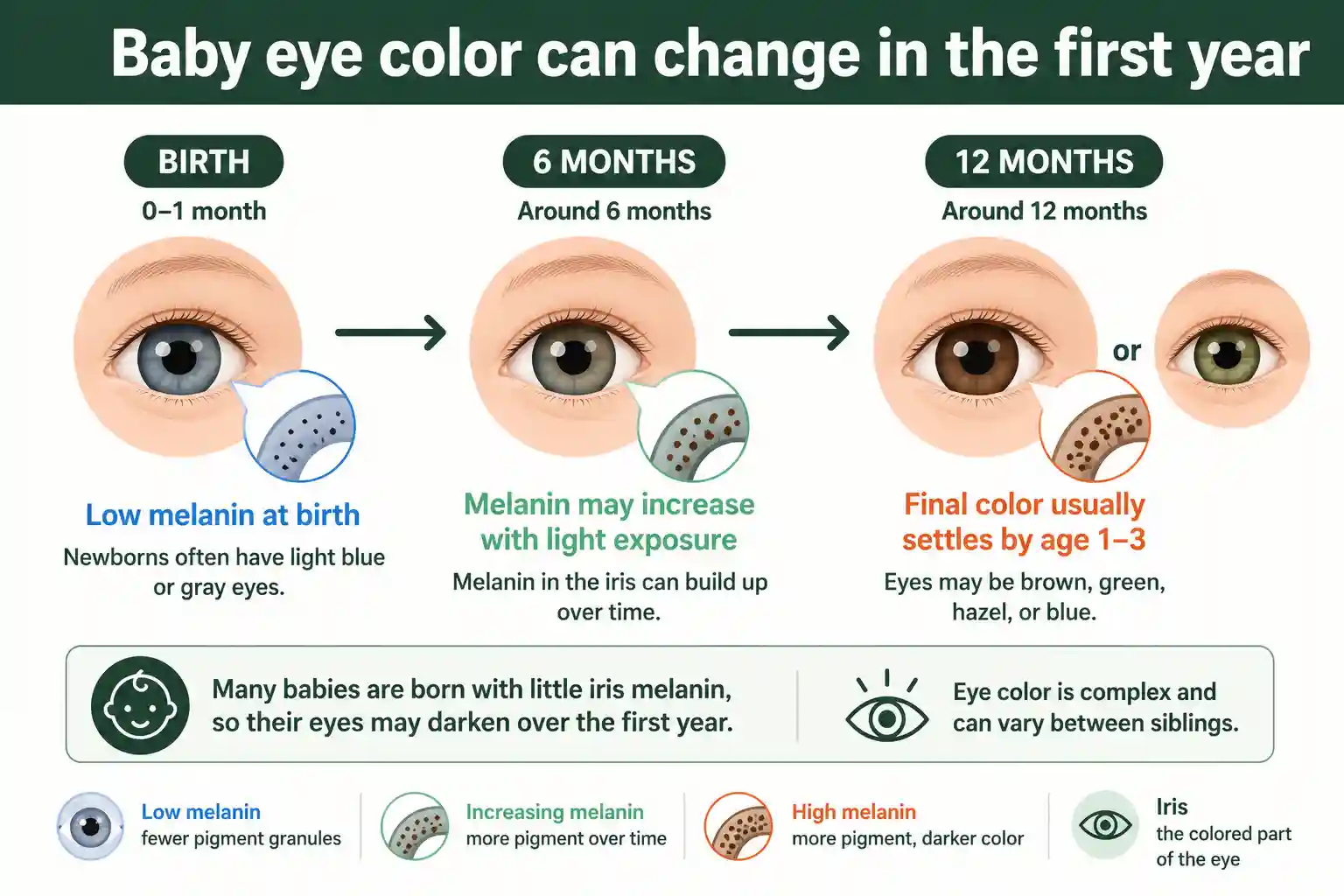
The reason is melanin again. Many babies, especially those of European ancestry, are born with little melanin in the iris, so their eyes look blue or gray at first. Over the first six to twelve months, melanin-producing cells respond to light and may add pigment, gradually shifting the eyes toward green, hazel, or brown. Babies with more melanin at birth, common in many populations worldwide, tend to start and stay brown. So a blue-eyed newborn may end up brown-eyed by their first birthday, while a brown-eyed newborn almost always stays brown.
This is why predictions describe the likely adult eye color, not the color at birth. If your baby's eyes seem to be changing through their first year, that is completely normal, and it usually settles by around age one to three. It is one more reason to hold any prediction loosely and enjoy the surprise.
Frequently Asked Questions
Can two brown-eyed parents have a blue-eyed baby?
Yes. If both brown-eyed parents carry a hidden recessive blue-eye variant, each can pass it to the child, and a child who inherits the blue variant from both parents can have blue eyes. Brown is usually dominant, so the parents show brown while silently carrying blue. This is a common and well-understood outcome.
What are the odds of two brown-eyed parents having a blue-eyed child?
Under the simple model, two brown-eyed carriers have about a 25 percent chance of a blue-eyed child. But because eye color is influenced by many genes, this is only an approximation. The actual odds depend on which hidden variants each parent carries, which is why family history, such as a blue-eyed grandparent, shifts the likelihood.
Can two blue-eyed parents have a brown-eyed child?
It is possible but uncommon. The simple one-gene model says no, but eye color is polygenic, so two blue-eyed parents can carry other melanin-promoting variants that combine in a child to produce brown eyes. It is rare, and it reflects the genuine genetic complexity behind eye color.
The Takeaway
Two brown-eyed parents can absolutely have a blue-eyed child, because brown-eyed people can carry a hidden blue variant and pass it on. When a child inherits the blue variant from both parents, with no dominant brown allele to mask it, blue eyes can appear, even in a family that looks brown-eyed across generations.
The deeper lesson is that eye color is polygenic, shaped by OCA2, HERC2, and many supporting genes, so the simple brown-dominant, blue-recessive model is a helpful starting point but not the whole truth. That complexity is why predictions are estimates, not certainties. To explore the odds for your own family across eye color and more, our guide on baby eye color prediction goes deeper into how the genetics plays out.