Hairpin Calculator for DNA and RNA Oligos

Check whether a primer, probe, or synthetic oligo can fold into a hairpin before you order it. The calculator scans for complementary stems, loop size, GC-rich pairing, stem melting temperature, and approximate stability. Use it before PCR, qPCR, cloning primer design, or oligo probe design.

Hairpin Calculator for primer secondary structure screening

Paste a sequence and get an immediate risk call. Basic mode handles routine PCR primers. Advanced mode lets you tune stem and loop rules for longer oligos, probes, or cloning tails.

Hairpin Calculator settings

Enter an oligo sequence and scan for intramolecular stem-loop structures that can reduce PCR or qPCR performance.

Oligo sequence input

Paste DNA or RNA bases only. The calculator normalizes spaces and line breaks automatically.

Sequence quality preview

Length

19

bases

GC content

52.6%

G + C bases

Normalized sequence

GCGTACGTTAAACGTACGC

Live hairpin risk

High hairpin risk

The strongest predicted hairpin may compete with primer binding at your use temperature.

Stem

8

Loop

3

ΔG*

-14.3

*Approximate screening score, not a full nearest-neighbor thermodynamic prediction.

Predicted hairpin diagram

Predicted hairpin stem-loop structureStrongest predicted DNA hairpinloop 3 ntTAAGCGTACGTCGCATGCAStem 8 bp · GC pairs 5 · approx ΔG -14.3 kcal/mol

Top stem-loop candidates

The strongest structures rank by stem length, GC pairing, loop size, and approximate stability.

#1 · 8 bp stem

Loop 3 nt · GC pairs 5 · Tm 26.0°C · ΔG -14.30

#2 · 7 bp stem

Loop 5 nt · GC pairs 5 · Tm 24.0°C · ΔG -13.05

#3 · 7 bp stem

Loop 3 nt · GC pairs 4 · Tm 22.0°C · ΔG -12.10

#4 · 6 bp stem

Loop 5 nt · GC pairs 4 · Tm 20.0°C · ΔG -10.85

#5 · 6 bp stem

Loop 7 nt · GC pairs 4 · Tm 20.0°C · ΔG -10.55

#6 · 6 bp stem

Loop 3 nt · GC pairs 3 · Tm 18.0°C · ΔG -9.90

Low risk

No strong stem-loop appears. Continue checking primer dimer and target specificity.

Moderate risk

Review the structure. A small 5′ shift can often break the stem without changing the target.

High risk

Redesign the oligo when the stem is GC-rich, long, or stable near the reaction temperature.

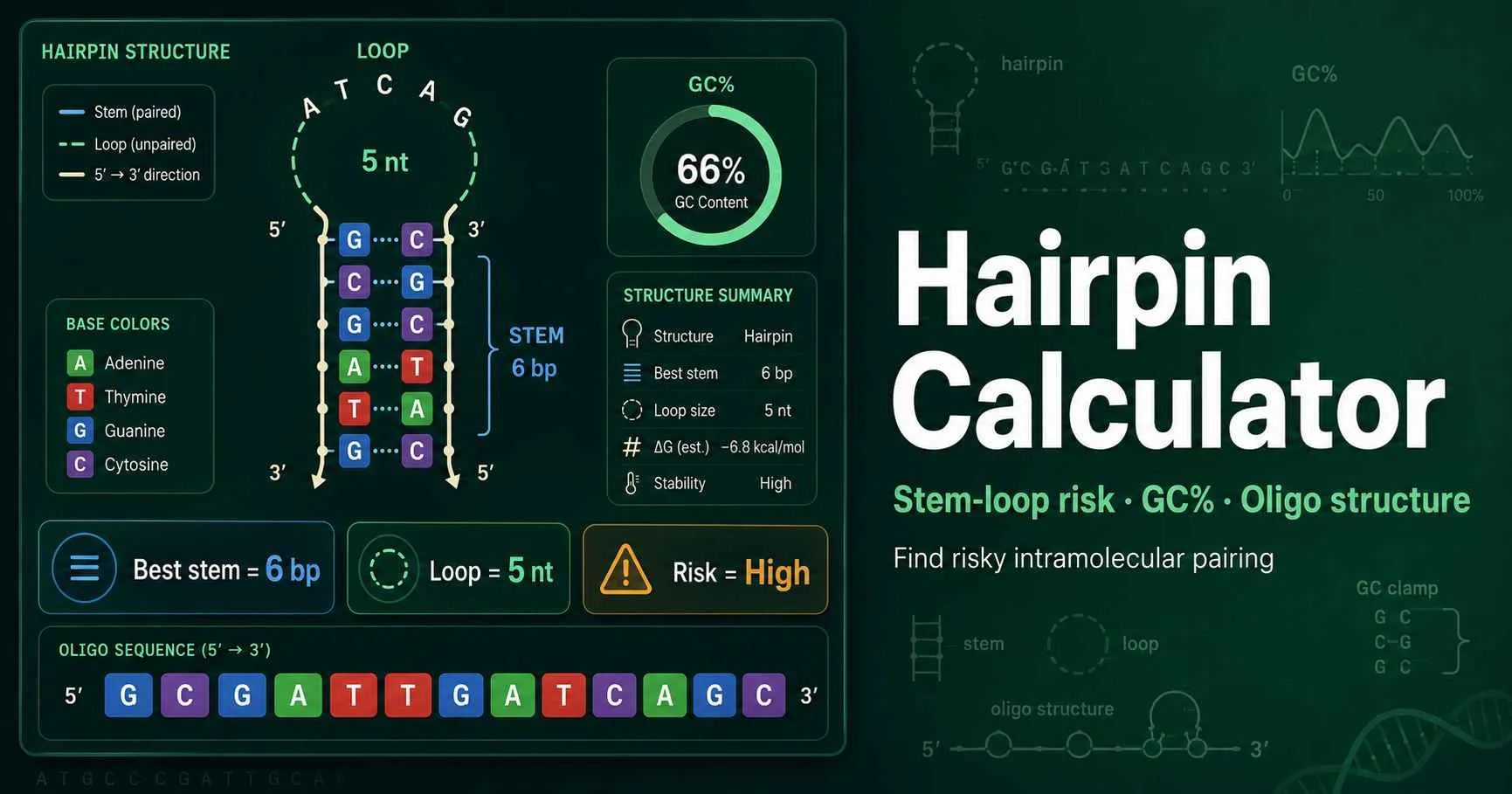
DNA oligo hairpin diagram showing a complementary stem, loop region, GC-rich base pairs, and primer secondary structure risk output
Figure 1. A hairpin forms when one region of a DNA or RNA oligo folds back and base-pairs with another region of the same strand. The stem contains Watson-Crick pairs such as A·T, A·U, and G·C, while the loop remains unpaired. Strong GC-rich stems can reduce primer availability during PCR and qPCR.

Hairpin Calculator answer: what the result means

A low-risk result means the oligo has no strong predicted stem-loop under your settings. A moderate result means the sequence contains a structure worth reviewing. A high-risk result means the predicted hairpin may compete with target binding at your chosen reaction temperature.

Primer hairpins matter because folded primers cannot bind template DNA efficiently. A strong 3′ or internal stem can also reduce amplification yield, raise Cq values, or create inconsistent replicate behavior. IDT describes hairpin, self-dimer, and hetero-dimer checks as standard oligo analysis steps before ordering primers or probes. See IDT OligoAnalyzer.
Hairpin Calculator components and what each input does

Oligo sequence

The calculator uses this DNA or RNA strand to search for internal complementary regions. Paste only the sequence you plan to order or test.

Molecule type

DNA mode pairs A with T. RNA mode pairs A with U. Both modes pair G with C.

Use temperature

This value represents PCR annealing temperature, qPCR annealing temperature, or probe-use temperature. Hairpin stem Tm near this value raises concern.

Minimum stem

This advanced input sets the shortest paired stem that counts as a candidate. Four base pairs work for routine primer screening.

Loop size range

The loop range controls how far apart complementary regions can sit. Short loops can form compact structures. Longer loops can matter in probes and tailed primers.

CSV report

The export lists ranked hairpins with stem length, loop length, GC pairs, stem Tm, and approximate stability score.

Hairpin Calculator formula and scoring logic

This tool uses a screening model, not a full nearest-neighbor thermodynamic engine. It identifies perfectly complementary stems separated by a loop, then ranks each candidate by stem length, GC-pair count, loop size, stem Tm, and approximate ΔG-style stability.

Stem Tm estimate

Tm ≈ 4(GC pairs) + 2(AT or AU pairs)

This Wallace-style value estimates how stable the paired stem may be.

Approximate stability

ΔG* ≈ pair energy + loop penalty

More negative values suggest a more stable folded structure.

Risk decision

risk = stem strength near use temperature

The calculator raises risk when stem Tm approaches the reaction temperature.

Hairpin Calculator examples for PCR and qPCR primers

Hairpin example: a clean PCR primer

A primer such as ATGACCATGATTACGCCAAG has balanced GC content and no long internal reverse-complement region. The calculator usually reports low hairpin risk. You can continue by checking primer pair interaction with the Primer Dimer Calculator.

Hairpin example: a GC-rich stem-loop primer

A sequence such as GCGTACGTTAAACGTACGC carries complementary G/C-rich ends. The oligo can fold into a stem-loop, leaving the middle bases as the loop. Shift the primer position or change the target-binding region before you finalize PCR setup.

Hairpin Calculator interpretation table

Low risk

Cause: No long stable complementary stem appears.

Action: Check Tm, GC content, specificity, and primer dimer risk.

Moderate risk

Cause: The oligo contains a possible stem-loop, but it may melt below reaction temperature.

Action: Compare alternative primer positions and check the structure with a thermodynamic tool.

High risk

Cause: The stem is long, GC-rich, or stable near the use temperature.

Action: Redesign the primer, especially when the folded region includes the 3′ target-binding end.

Hairpin Calculator workflow for better primer design

Start with sequence length, GC content, and melting temperature. A typical PCR primer often sits near 18 to 30 bases, with balanced GC content and no strong secondary structure. IDT primer design guidance highlights Tm, target binding, and avoidance of strong self-complementarity as key design checks. Read IDT primer design guidance.

Check the hairpin before finalizing a primer pair. Then compare forward and reverse primers with a dimer check. If you need reaction-temperature guidance after redesign, use the DNA melting temperature calculator before building the reaction setup.

Related primer and oligo tools

Use these calculators to finish the primer-design workflow after hairpin screening.

Hairpin Calculator FAQs

What does a hairpin calculator check in a primer?

A hairpin calculator checks whether one part of an oligo can fold back and pair with another part of the same oligo. It looks for complementary stem bases, the loop between them, GC-rich pairing, and the likely stability of the stem-loop. PCR primers with strong hairpins can bind themselves instead of binding the template. That lowers available primer concentration and can reduce amplification yield.

What hairpin result should I avoid before ordering a primer?

Avoid long GC-rich stems that remain stable near your annealing or reaction temperature. IDT advises that hairpin melting temperature should sit below the temperature at which the oligo will be used. A short weak stem often causes little trouble, but a 5 to 7 bp GC-rich stem deserves attention. This calculator flags those cases as moderate or high risk.

Why do GC-rich stems create stronger hairpins?

G·C pairs form three hydrogen bonds and stack strongly in nucleic acid duplexes. A stem with several G·C pairs usually melts at a higher temperature than an A·T-rich stem of the same length. That means the oligo can spend more time folded during primer annealing. A folded primer cannot bind the intended target efficiently.

Is this calculator a full thermodynamic hairpin predictor?

No. This calculator provides a fast screening model for primer and oligo design. It uses stem length, loop size, GC pairs, stem Tm, and an approximate stability score to rank likely structures. Dedicated tools such as IDT OligoAnalyzer use deeper thermodynamic models. Use this page to catch obvious design problems before you run a more detailed final check.

Can I use this calculator for qPCR primers?

Yes. qPCR primers need extra care because primer secondary structures can compete with template amplification and distort Cq values. Check both primers for hairpins, then check the pair with a primer dimer calculator. A good qPCR primer usually keeps strong secondary structures away from the reaction temperature and avoids risky 3′ complementarity.

How can I fix a primer with a high hairpin risk?

Move the primer a few bases upstream or downstream, then recheck the new sequence. Try to break the complementary stem while keeping length, GC content, and target specificity within acceptable ranges. Avoid adding long G/C runs near both ends of the primer. For cloning primers with 5′ tails, check the full oligo and the target-binding region separately.

Should I check hairpins or primer dimers first?

Check hairpins first when you design a single oligo, because hairpins come from self-folding within one sequence. Check primer dimers next when you pair forward and reverse primers. A primer can pass the hairpin screen but fail the hetero-dimer screen. PCR design works best when both checks look clean.