Inbreeding Coefficient in Conservation and Breeding
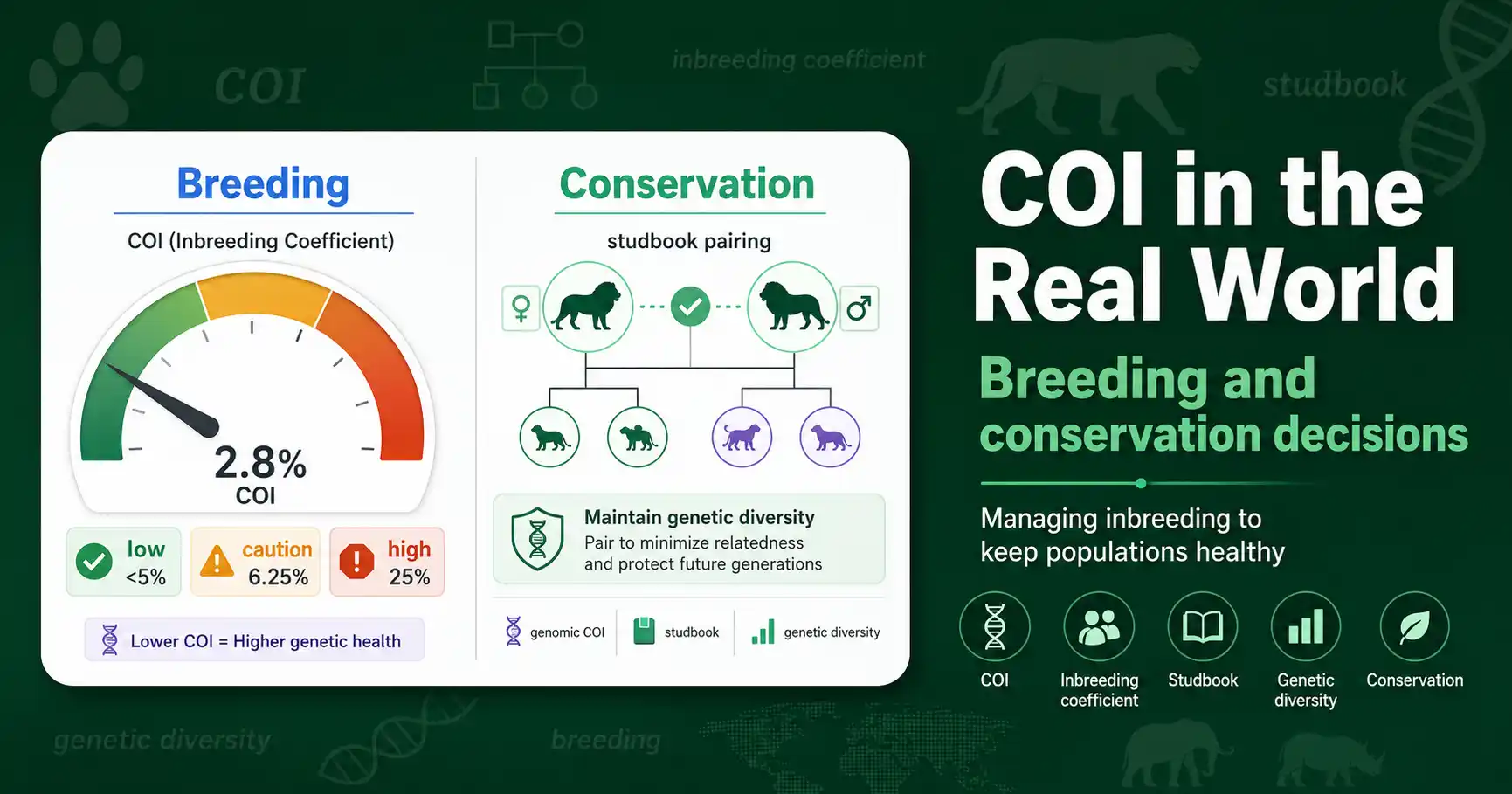
The inbreeding coefficient earns its keep in the real world. Breeders use it to decide which animals to mate. Conservationists use it to keep endangered species from collapsing. In both fields, the same number, often called the COI in breeding circles, predicts the risk of inbreeding depression and guides decisions worth real money and, for endangered species, survival itself.
This guide covers those applications. It walks through how breeders read and use the COI, the threshold values they aim for, how conservation programs manage inbreeding in small populations, and why genomic measures are replacing pedigree estimates. For the underlying concept, our explainer on what the inbreeding coefficient is sets it up.
COI: The Breeder's Tool
In animal breeding, the inbreeding coefficient is usually called the coefficient of inbreeding, or COI, and it is given as a percentage. A COI of 6.25 percent means a 6.25 percent probability that any given gene pair in the animal is identical by descent. It is the same F that Sewall Wright defined, expressed as a percentage and applied to breeding stock.
Breeders care about COI because it predicts the problems inbreeding causes. A higher COI means more homozygosity, which surfaces breed-specific genetic disorders, shrinks litter sizes, weakens immune function, and reduces fertility and longevity. These are the symptoms of inbreeding depression, and they cost breeders healthy animals and money.
The trade-off is that some inbreeding is how breeds are made. Mating relatives fixes the consistent traits that define a breed, its size, coat, and temperament. So breeders walk a line: enough relatedness to hold the breed's type, not so much that health collapses. The COI is the instrument they use to walk that line, turning a vague worry about "too much inbreeding" into a number they can target.
There is a hard truth underneath this. Every closed breeding population, one that admits no new animals, accumulates inbreeding over time, because the supply of unrelated mates steadily runs out. No amount of clever pairing can stop this entirely in a truly closed group; it can only slow it. This is why the most forward-looking breed communities debate opening their studbooks to limited outcrossing, and why conservation programs treat the closed nature of a captive population as a problem to be actively managed rather than ignored. The inbreeding coefficient is the gauge that tells them how fast the clock is ticking.
The Threshold Numbers
Breeders work to specific COI thresholds, and a few numbers come up repeatedly. They are guidelines, not hard laws, but they reflect real experience.
A COI below about 5 percent is generally considered low and desirable. Around 6.25 percent, the level of a first-cousin mating, is often cited as a caution line above which risks start to climb noticeably. Many breed advisors warn against routinely exceeding it. As COI rises toward 25 percent, the level of full-sibling or parent-offspring mating, the risks become serious, with documented effects on health and lifespan.
The rate of increase matters as much as the absolute value. Guide-dog and working-dog programs often aim to keep the rise in COI below about 2 percent per generation, because a slow accumulation lets selection weed out problems while a rapid spike from overusing one popular animal can flood a population with hidden defects. The table summarizes the common reference points.
| COI level | Interpretation |
|---|---|
| Below 5% | Low, generally desirable |
| ~6.25% (first cousins) | Caution line, risks begin to climb |
| 10% to 25% | Elevated, increasing health concerns |
| 25%+ (full sib, parent-offspring) | High, serious inbreeding depression risk |
| Rise over 2% per generation | Too fast, regardless of absolute level |
A sobering benchmark puts these in context: the average COI across dog breeds has been estimated at around 25 percent, meaning many purebred dogs are as inbred as the offspring of full siblings. This is the legacy of closed studbooks and the heavy use of popular sires over decades.
The health stakes are concrete. A study of Standard Poodles found that dogs with a COI below 6.25 percent lived on average about four years longer than those with a COI above 25 percent. Longevity, litter size, and disease resistance all tend to decline as inbreeding rises, which is why these thresholds are not arbitrary. They mark the points where breeders have repeatedly seen health begin to suffer.
How Breeders Use It in Practice
In practice, COI shapes the actual choice of which animals to breed. Two rules of thumb guide most responsible programs.
First, choose pairings with the lowest expected COI that still meet the breeding goals. Before committing a mating, a breeder can calculate the COI the offspring would have, and prefer the cross that adds the least inbreeding. Running candidate pairings through a tool that computes the offspring's COI before breeding is now a standard step, turning the decision into a comparison of numbers rather than a guess.
Second, spread the breeding around to avoid the popular sire effect. When one champion male is bred to many females, his genes saturate the next generation, and a few generations later his descendants are all related to each other, spiking the breed's inbreeding. Using a wider range of breeding animals, even at some cost to short-term type, protects the breed's long-term genetic health. This is the single most important lever a breed community has, because the popular sire effect is the fastest way to lose diversity.
The COI also flags specific danger pairings. Two animals that look unrelated on a short pedigree may share a common ancestor a few generations back, and the COI catches that hidden relatedness when a casual glance would miss it. This is why breeders calculate rather than eyeball.
Linebreeding Versus Inbreeding
Breeders often distinguish linebreeding from inbreeding, and the difference is one of degree, captured by the COI. Both mate relatives; the line is where you draw the COI.
Inbreeding, strictly, means mating close relatives, parent to offspring or sibling to sibling, producing a high COI around 25 percent. Linebreeding means mating more distant relatives, such as a dog to its grandparent or to a cousin, to keep a prized ancestor's influence in the line while holding the COI lower. The two shade into each other, and the COI is what tells a breeder which side of the line a given pairing falls on.
The appeal of linebreeding is concentrating the genes of an outstanding ancestor without the steep risks of close inbreeding. The danger is that repeated linebreeding to the same ancestor, generation after generation, quietly accumulates COI until the population is as inbred as if close matings had been used. This slow creep is why breeders track COI over generations, not just for a single litter. A pairing that looks like mild linebreeding can still push a breed's average inbreeding upward if everyone does it to the same celebrated bloodline.
Inbreeding in Livestock
Beyond companion animals, the inbreeding coefficient is central to livestock breeding, where the economic stakes are large and the management is sophisticated. Dairy cattle, pigs, sheep, and poultry are all bred with careful attention to F.
Livestock breeders face the same tension as dog breeders, sharper for the money involved. Intensive selection for production traits, milk yield, growth rate, egg numbers, concentrates a few elite bloodlines, which raises inbreeding and risks inbreeding depression in fertility and health. Modern dairy cattle breeding, built around a small number of elite artificial-insemination sires, has driven inbreeding upward fast enough that the industry actively monitors and manages it. A pedigree study of one gun-dog breed found a mean inbreeding coefficient of about 0.042, with breeders working to keep the per-generation rise low, illustrating the same careful bookkeeping applied across managed populations.
The tools are increasingly genomic. Rather than relying on pedigrees alone, livestock programs now use genomic estimates of inbreeding and of relatedness between candidates, choosing matings with software that balances genetic gain against inbreeding accumulation. This optimal-contribution selection deliberately limits the rate of inbreeding while still pushing production forward, the formal version of the breeder's instinct to spread the matings around. It is the inbreeding coefficient operating at industrial scale.
Pedigree COI Versus Genomic COI
Traditionally, COI came from pedigrees, but genomic measurement is now more accurate and increasingly standard. Knowing the difference matters for anyone using these numbers today.
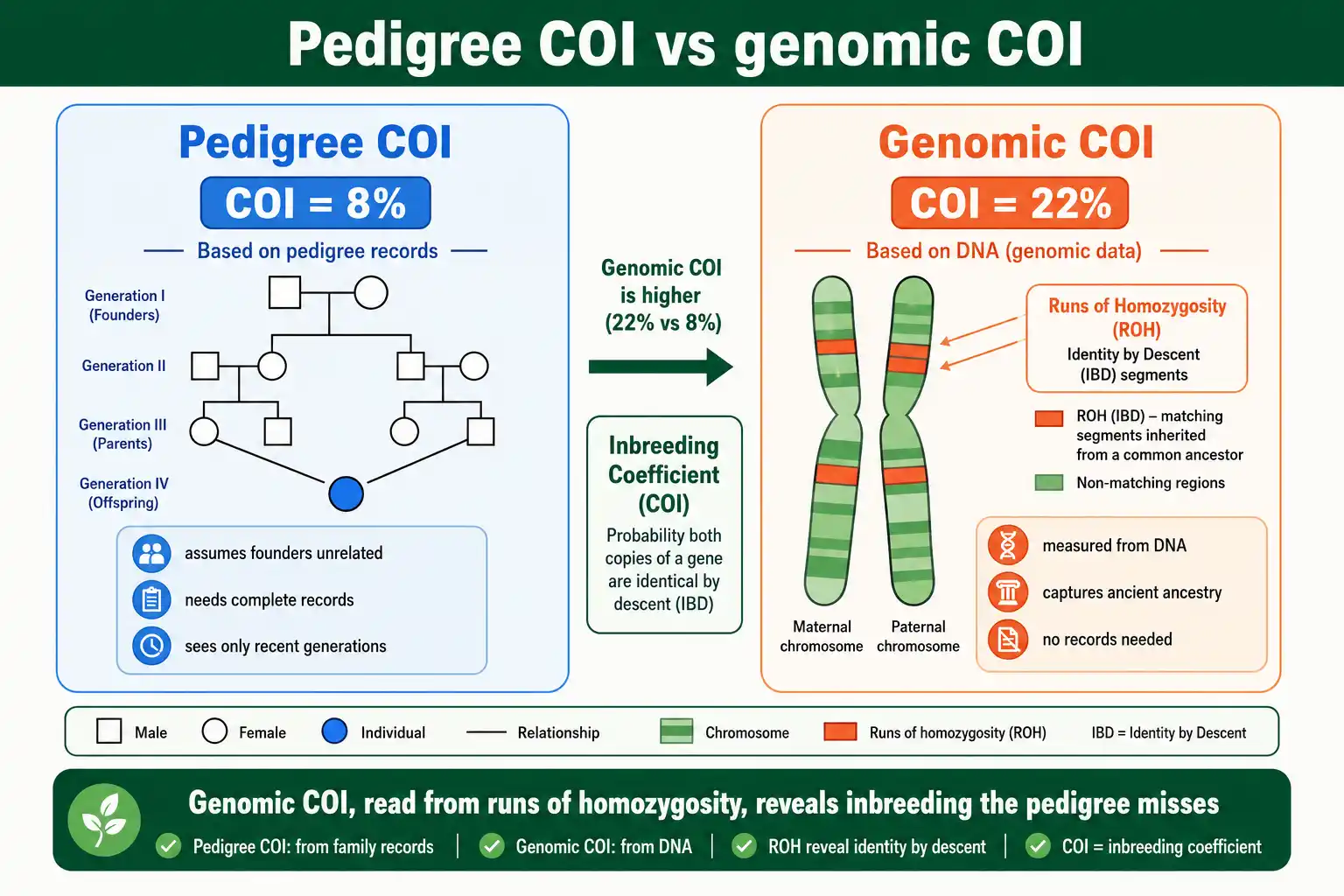
Pedigree COI is calculated from a family tree, predicting inbreeding from recorded ancestry. It has two weaknesses. It assumes the founders of the pedigree were unrelated, which breed histories show is rarely true, and it depends on complete, accurate records across many generations, which often do not exist. Both flaws make pedigree COI underestimate the real inbreeding, sometimes badly.
Genomic COI measures inbreeding directly from an animal's DNA, usually through runs of homozygosity, long stretches where both chromosomes carry identical alleles, the genetic footprint of shared ancestry. Because it reads the actual genome rather than predicting from records, it captures inbreeding from ancestors far beyond any pedigree and does not depend on record-keeping. Companies offering dog DNA tests now report genomic COI directly, and breed organizations use it to assess whole-population diversity. These tests also screen for the specific recessive mutations behind many breed-linked genetic disorders, letting breeders avoid pairing two carriers even when the overall COI looks acceptable. The figures can be striking: in the Doberman Pinscher, genetic COI ranges from about 25 to 60 percent across individuals, with a breed median near 40 percent, while breeds like the Siberian Husky or Poodle sit lower, around a median of 20 percent. The genomic version is becoming the gold standard precisely because it shows the inbreeding that pedigrees miss.
Inbreeding Management in Conservation
In conservation, managing the inbreeding coefficient can be the difference between a species recovering and going extinct. Small, endangered populations face unavoidable inbreeding, and programs are built specifically to slow it.
The core problem is forced relatedness. When a population drops to a few dozen individuals, every animal is related to every other, so inbreeding rises whether or not mating is random. Rising F brings inbreeding depression, which lowers survival and fertility, which shrinks the population further, the extinction vortex. Conservation breeding programs exist to break this cycle by managing which animals reproduce. The pace of inbreeding is governed by the effective population size, the subject of our guide on effective population size, and keeping that effective size high is the central goal.
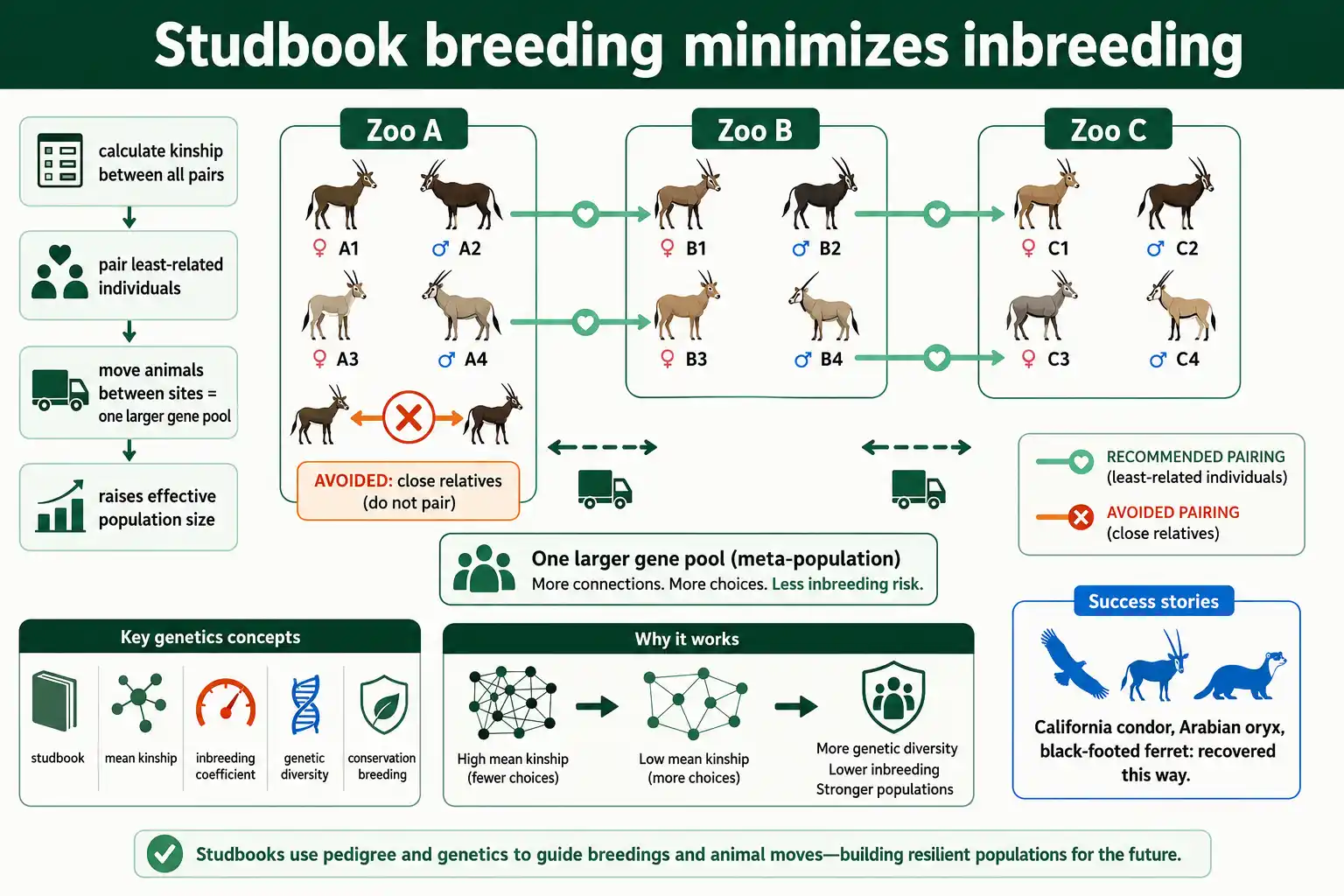
Zoos and recovery programs use studbooks, detailed pedigree records of every individual in a managed population, to do this. Studbook keepers calculate the kinship between all potential breeding pairs and recommend matings that minimize inbreeding and preserve genetic diversity, often pairing the least-related individuals. They also use mean kinship, a measure of how related each individual is to the whole population, to prioritize breeding the most genetically valuable, least-represented animals. This is conservation genetics applied animal by animal, with the inbreeding coefficient at its center.
Many programs go further and manage several institutions' animals as one metapopulation. By moving individuals between zoos according to studbook recommendations, managers treat scattered captive groups as a single larger gene pool, which raises the effective population size and slows inbreeding far better than any one collection could alone. The California condor, Arabian oryx, and black-footed ferret recoveries all relied on this kind of coordinated, pedigree-driven breeding, pulling species back from the brink by managing inbreeding deliberately rather than letting small numbers take their course.
When Inbreeding Gets Too High
Both fields share a last resort when inbreeding climbs too high: bringing in new genetic material from outside the population. The principle is identical even though the labels differ.
In conservation, this is genetic rescue, introducing individuals from another population to add new alleles, raise heterozygosity, and reverse inbreeding depression. The Florida panther recovery is the famous case, where a few pumas from Texas restored the population's genetic health. In breeding, the parallel is an outcross, introducing an unrelated animal, sometimes from a different line or even, in regulated cases, a different breed, to lower COI and refresh diversity.
Both carry the same small risk and the same large benefit. The benefit is relief from inbreeding depression, which is usually substantial and reliable. The risk is outbreeding depression, where mixing very divergent populations breaks up locally adapted gene combinations, though this is rarer and usually outweighed when inbreeding is already severe. The judgment in both fields is the same: when the inbreeding coefficient climbs into dangerous territory, the cure is fresh genes, applied carefully.
Frequently Asked Questions
What COI is too high for breeding?
A COI above about 5 percent is generally watched, and above 6.25 percent, the first-cousin level, many advisors caution against routine breeding. Values approaching 25 percent, the level of full-sibling matings, carry serious risks of inbreeding depression. The rate of increase also matters, with a rise above roughly 2 percent per generation considered too fast.
Why is genomic COI better than pedigree COI?
Genomic COI measures inbreeding directly from an animal's DNA through runs of homozygosity, so it captures shared ancestry from far beyond any written pedigree and does not depend on record-keeping. Pedigree COI assumes founders were unrelated and needs complete records, both of which often fail, causing it to underestimate true inbreeding.
Managing the Number That Matters
The inbreeding coefficient moves from theory to consequence in conservation and breeding. Breeders read it as the COI, aim to keep it low, below 5 percent where possible and rising no faster than about 2 percent per generation, and use it to pick pairings and avoid the popular sire effect that has pushed many breeds to an average COI near 25 percent. Conservation programs track it through studbooks and mean kinship to keep endangered populations off the path to the extinction vortex.
In both worlds the same logic holds: a higher inbreeding coefficient means more homozygosity, more inbreeding depression, and less of the diversity a population needs to stay healthy and adaptable. Genomic measurement through runs of homozygosity is sharpening the picture, revealing inbreeding that pedigrees hide, and when the number climbs too high, the answer in both fields is fresh genetic material applied with care. To see how any pairing's number is built from the family tree behind it, our guide on the inbreeding coefficient from a pedigree traces it back to the chart.