Population Bottleneck and Genetic Diversity Loss
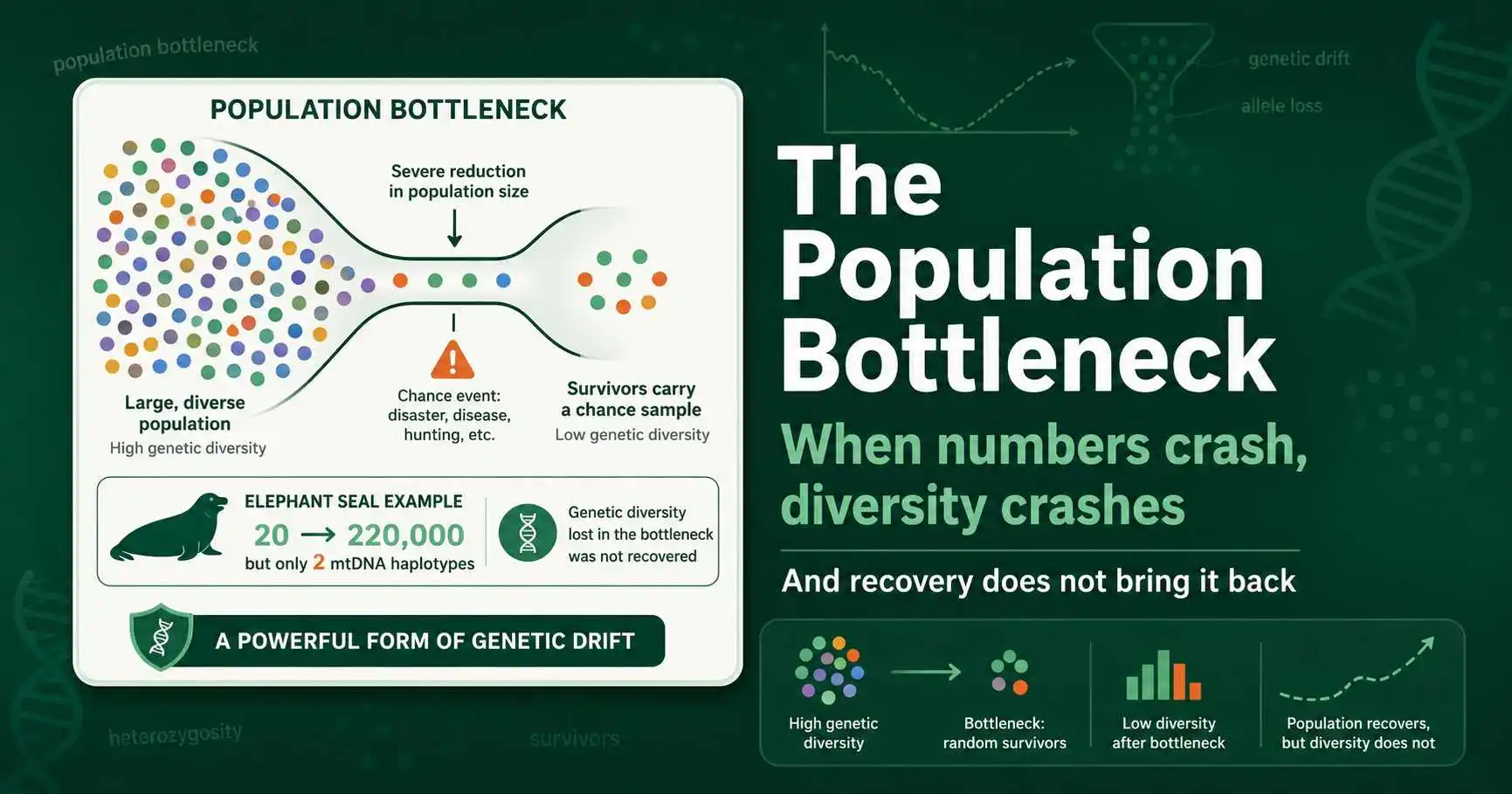
A population bottleneck is a sharp, sudden reduction in the size of a population, which dramatically slashes its genetic diversity. The survivors carry only a small, random sample of the original gene pool, so many alleles are lost purely by chance during the crash. A population bottleneck is a powerful form of genetic drift, and its effects can last for thousands of years even after the population recovers fully in number. The northern elephant seal, reduced to about 20 animals in 1892 and now numbering over 220,000, is the textbook example of a bottleneck's lasting genetic scar, a species that recovered its numbers completely yet never recovered its lost diversity.
This guide explains what a population bottleneck is, how it destroys genetic variation, and what the most studied real cases reveal, backed by hard numbers drawn from modern genome sequencing studies. It also covers why a population can recover its headcount while staying genetically impoverished, and why that matters for conservation. A simulator can show how a sudden population crash collapses allele diversity, with variation disappearing in real time. The data below show just how deep and durable the damage can be.
What Is a Population Bottleneck?
A population bottleneck is a dramatic reduction in the number of individuals in a population, usually caused by a catastrophic event. The name comes from the vivid image of pouring liquid through a narrow bottleneck: only a little gets through, and what passes is a small, unrepresentative sample of what was there before.
The cause is typically a sudden disaster. Natural events like earthquakes, floods, fires, droughts, and disease outbreaks can wipe out a large fraction of a population in a short time. Human activities are now the leading cause worldwide, through overhunting, habitat destruction, and the fragmentation of once-continuous habitats. Whatever the trigger, the result is the same: a population that was once large is suddenly reduced to a small number of survivors who simply happened to make it through.
The crucial genetic point is that the survivors are a random sample, not a fit one. A bottleneck does not select for the best-adapted individuals; it kills indiscriminately, so the survivors carry a chance subset of the original genetic variation. Alleles that were common may be lost if their carriers happened to die, and rare alleles may suddenly become common if their carriers happened to survive. This random sampling is why a bottleneck is a form of genetic drift, the change in allele frequencies by chance rather than by fitness. The broader process is explained in our guide on what genetic drift is.
How a Bottleneck Destroys Genetic Diversity
A bottleneck destroys genetic diversity because a small group of survivors simply cannot carry all the alleles that existed in the large original population. Genetic diversity is the variety of different alleles present in a population, and that variety depends on having many individuals. Cut the numbers sharply, and much of the variety vanishes with the individuals who die.
The loss happens in two stages. First, the immediate crash eliminates whatever alleles were carried only by the individuals who died, an instant loss of variation. Second, the population remains small for a time, and during that period ongoing genetic drift continues to erode diversity each generation, because small populations lose alleles rapidly by chance. The rate of this ongoing loss is tied to population size: a population loses heterozygosity, a key measure of diversity, at a rate of roughly 1 divided by twice the effective population size per generation. The smaller the surviving group, the faster the remaining diversity drains away.
This is why the timing and depth of a bottleneck both matter. A brief, shallow dip removes relatively little variation, because few alleles are lost and the population quickly returns to a buffering size. A deep, prolonged bottleneck is devastating, because it both eliminates many alleles at once and then keeps drift strong for many generations. The deepest bottlenecks can strip a population of most of its genetic variation, leaving it with a fraction of what it once had. This lost diversity is not easily recovered, since only mutation, a very slow process, can introduce genuinely new variation.
Real Population Bottleneck Examples: The Data
The most informative way to understand bottlenecks is through real cases with hard data. The table below summarizes several of the best-documented examples, showing how far each population crashed and what happened to its genetic diversity.
| Species | Lowest population | Cause | Recovery | Genetic outcome |
|---|---|---|---|---|
| Northern elephant seal | ~20 (1892) | Commercial hunting | 220,000+ today | Only 2 mtDNA haplotypes; profoundly low diversity |
| Cheetah | Crash ~10,000-12,000 years ago | Ancient climate or other event | ~7,100 wild today | ~90% less nucleotide variation than other mammals |
| European bison (wisent) | 12 founders | Hunting, habitat loss | A few thousand today | Extremely low variation affecting bull fertility |
| American bison | Near extinction ~1890 | Mass overhunting | ~500,000 today | Reduced diversity; some cattle-gene introgression |
| Humans | ~1,280 breeders (~900,000 years ago) | Climate stress (proposed) | 8 billion today | Detected in genome-wide diversity patterns |
Each row tells a story of chance shaping a species' genetics. The northern elephant seal is the clearest case, and the next section examines it in detail. The cheetah shows the deepest documented loss in a mammal. The European bison demonstrates how a tiny founding remnant, just 12 animals, can leave a species with lasting fertility problems. Every wisent alive today, numbering several thousand after intensive conservation breeding, descends from those 12 individuals who survived into the early twentieth century, and the resulting inbreeding has been linked to reduced fertility in bulls and greater susceptibility to disease. The American bison tells a parallel story: once numbering in the tens of millions across North America, the species was hunted to near extinction by around 1890, with only a few hundred wild animals remaining, and although it has recovered to roughly half a million today, its genetic diversity was permanently reduced, with some herds also carrying introgressed cattle genes from historical interbreeding. Even our own species carries the signature of an ancient bottleneck, recently estimated from genome data. The numbers vary, but the pattern is universal: when a population crashes, genetic diversity crashes with it, and the recovery of numbers does not restore the lost variation.
The Northern Elephant Seal: A Bottleneck in Detail
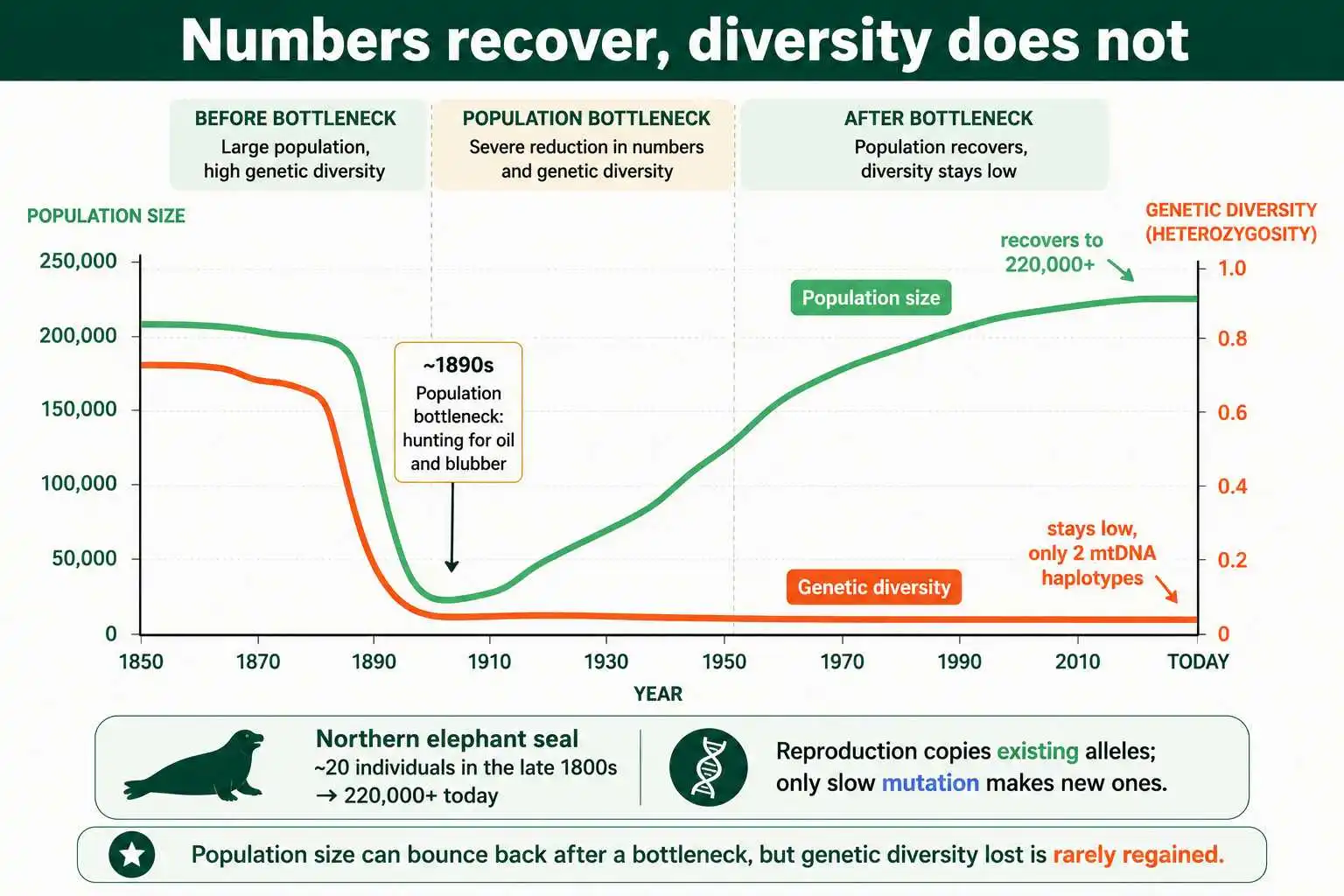
The northern elephant seal is the most thoroughly studied population bottleneck, and its numbers are striking. Commercial sealers hunted the species for its blubber oil throughout the 1800s, reducing it to roughly 20 individuals by 1892. The species was nearly declared extinct.
Then it recovered spectacularly in numbers. Protected from hunting, the population rebounded almost exponentially, passing 15,000 by 1960 and exceeding 220,000 today. By the measure of headcount alone, this is a conservation triumph, one of the great recoveries from the brink of extinction. But the genetic story is very different, and far more sobering.
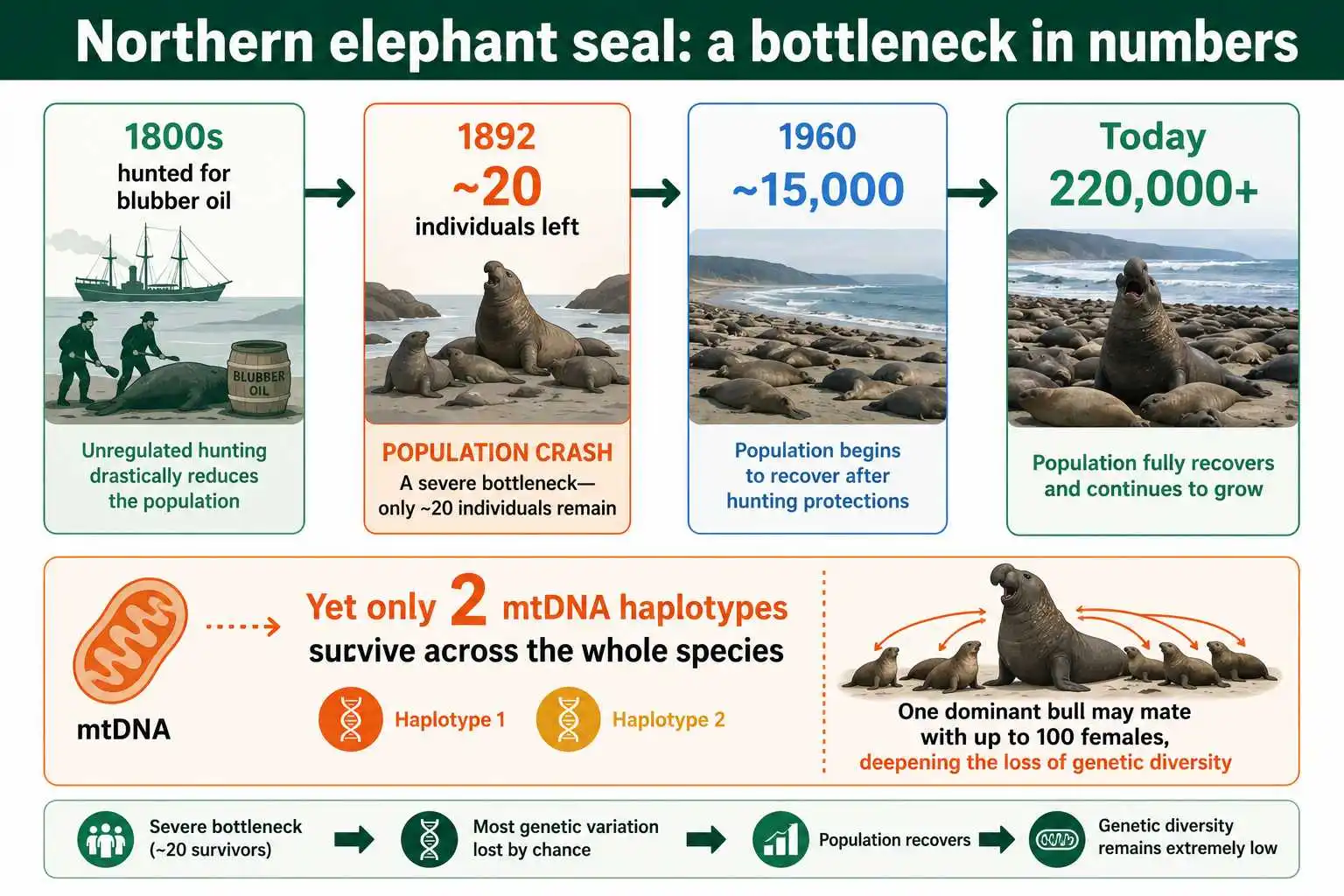
Despite the enormous population recovery, the northern elephant seal's genetic diversity remains profoundly reduced. Genetic studies find only two mitochondrial DNA haplotypes across the entire species, an extraordinarily low number that reflects the tiny pool of survivors. Whole-genome sequencing of 260 modern and 8 historical seals confirmed that the rapid demographic recovery did not undo the genetic damage. The diversity lost in the 1890s crash is simply gone, because the survivors never carried it through. The species' breeding system makes matters worse: a single dominant bull may mate with up to 100 females, so a huge share of each generation descends from very few males, intensifying the loss. The northern elephant seal proves a critical lesson: a population can recover its numbers completely while remaining genetically impoverished indefinitely.
The Cheetah: The Deepest Mammal Bottleneck
The cheetah is famous among biologists for having the lowest genetic diversity of almost any wild mammal, the legacy of severe ancient bottlenecks. Genetic evidence points to two crashes, one around 100,000 years ago and a more recent one around 10,000 to 12,000 years ago, that reduced the species to very few individuals.
The numbers documenting the cheetah's genetic uniformity are remarkable. Cheetahs show roughly 90 percent less nucleotide variation than other mammals. Their stretches of identical DNA run 10 to 15 times longer than those in domestic cats, and variation in protein-coding genes is about 98 percent lower than in domestic cats or European wildcats. The most vivid demonstration came from a classic experiment: skin grafts between unrelated cheetahs are not rejected, because the animals are so genetically similar that their immune systems cannot tell self from non-self. In most species, such grafts between strangers would be rejected immediately.
This extreme genetic uniformity has real consequences for the cheetah's survival. Low diversity leaves the species highly vulnerable to infectious disease, since a pathogen that can infect one cheetah can likely infect them all, with little genetic resistance in reserve. It also raises concerns about reproductive problems and reduced adaptability to environmental change. With only around 7,100 cheetahs left in the wild, the genetic legacy of those ancient bottlenecks compounds the modern threats of habitat loss and human conflict. Conservation breeding programs for cheetahs have historically struggled with low cub survival and high rates of disease, problems that researchers link in part to this depleted genetic diversity and the inbreeding it reflects. The cheetah shows how a bottleneck's effects can persist for ten thousand years and still shape a species' prospects today.
Why Recovering Numbers Does Not Restore Diversity
A population can recover its size while its genetic diversity stays low, because numbers and diversity are restored by completely different processes. Population size can rebound quickly through reproduction, but lost alleles can only be replaced by mutation, which is extraordinarily slow.
The reason is simple arithmetic of inheritance. When a population grows from a small group of survivors, every new individual descends from those survivors and can only inherit the alleles they carried. Reproduction copies existing alleles; it does not create new ones. So a population that bounced back from 20 to 220,000, like the northern elephant seal, has 220,000 individuals all drawing from the limited genetic toolkit of those 20 survivors. The headcount is huge, but the underlying variety is still tiny.
Restoring genuinely new genetic variation requires mutation, and mutation rates are so low that rebuilding diversity takes thousands to millions of generations. This is why conservationists emphasize that population recovery alone is not enough. A species that rebounds in number may still carry the genetic scars of its bottleneck indefinitely, leaving it vulnerable to disease and less able to adapt. Managing genetic diversity, through strategies like connecting fragmented habitats and sometimes moving individuals between populations to add variation, is as important as growing the raw numbers. This insight is central to conservation genetics, a topic explored in our guide on genetic drift in conservation.
Bottleneck Versus Founder Effect
A population bottleneck and a founder effect are both forms of genetic drift that shrink a population's gene pool, but they differ in how the small population forms. A bottleneck reduces an existing population in place through a disaster. A founder effect creates a new population when a few individuals colonize a new area.
The mechanisms are distinct even though the genetic outcome is similar. In a bottleneck, the original population stays in the same location but crashes in size, so the survivors are a remnant of the original group. In a founder effect, a small group migrates away to establish a fresh population somewhere else, so the founders start something new rather than surviving a catastrophe. Both leave a small, non-representative gene pool, which is why both intensify drift and reduce diversity.
The two can also blend together, as the island of Pingelap shows: a typhoon there caused a bottleneck, and the few survivors then acted as founders for the modern population. In practice, the line can blur, but the core distinction is useful. A bottleneck is about a population surviving a crash, while a founder effect is about a population being born from a few colonizers. Both demonstrate the same fundamental principle that small numbers let chance dominate a population's genetics. The founder side of this pairing is covered in our guide on the founder effect.
Did Humans Go Through a Bottleneck?
Humans appear to have passed through at least one severe population bottleneck in our deep past, detectable in the genome diversity of people today. Our species carries less genetic variation than many would expect, a signature of past crashes in population size.
A 2023 study published in the journal Science proposed a dramatic example. Using a genome-analysis method called FitCoal applied to over 3,000 modern human genomes, the researchers estimated that human ancestors may have crashed to roughly 1,280 breeding individuals around 900,000 years ago, and stayed at that low level for over 100,000 years. If correct, our entire species would have teetered near extinction for a long stretch of prehistory. The finding is still being tested against other evidence, as is appropriate for such a striking claim, but it illustrates how genetic data can reveal ancient demographic events.
More broadly, the modern human population shows relatively low genetic diversity for a species of our size, consistent with bottlenecks during our evolutionary history, including the migrations out of Africa that founded populations across the rest of the world. Each major migration carried only a sample of African genetic diversity, layering founder effects on top of older bottlenecks. This is why African populations today retain the highest genetic diversity, while populations farther along the migration routes carry progressively less. The human genome, in other words, records the bottlenecks and founder events of our past, just as the genomes of elephant seals and cheetahs record theirs.
How Scientists Measure a Bottleneck
Scientists detect and measure past bottlenecks by reading the signatures they leave in a population's DNA. A bottleneck leaves distinctive patterns of reduced and unusual genetic variation that persist for many generations, allowing researchers to reconstruct crashes that happened long ago.
Several genomic clues reveal a bottleneck. Reduced overall heterozygosity, the proportion of gene loci where an individual carries two different alleles, is a primary sign, since bottlenecks strip away allelic variety. Long runs of homozygosity, stretches where the two chromosomes carry identical DNA, indicate descent from few ancestors, exactly as seen in the cheetah's unusually long identical stretches. The site frequency spectrum, which describes how common different variants are across the genome, also shifts in a characteristic way after a crash. By fitting models to these patterns, researchers can estimate both how small a population became and how long ago.
Comparing a population to a close relative that did not crash sharpens the picture. The northern elephant seal, for instance, shows markedly less variation than the southern elephant seal, which was never hunted as intensively, isolating the effect of the bottleneck. Historical DNA from museum specimens adds another dimension, letting scientists compare genetic diversity directly before and after a known crash. These methods turn the genome into a historical record, one that preserves the demographic shocks a species has endured. The same diversity measures, especially heterozygosity, are central to assessing the genetic health of endangered species today.
Frequently Asked Questions
What is a population bottleneck in simple terms?
A population bottleneck is a sharp, sudden drop in the number of individuals in a population, usually from a disaster like disease, hunting, or habitat loss. The few survivors carry only a small, random sample of the original gene pool, so a lot of genetic diversity is lost by chance.
What is a real example of a population bottleneck?
The northern elephant seal is a classic example. Commercial hunting reduced it to about 20 individuals by 1892, and although the population has recovered to over 220,000 today, it retains profoundly low genetic diversity, with only two mitochondrial DNA haplotypes across the entire species.
Why does a bottleneck reduce genetic diversity?
Because a small group of survivors cannot carry all the alleles present in the large original population. Alleles carried only by individuals who died are lost instantly, and ongoing genetic drift in the small surviving population continues to erase variation generation after generation.
Can a population recover its genetic diversity after a bottleneck?
Recovering numbers does not restore lost diversity. Reproduction only copies the alleles the survivors carried, so new variation can come only from mutation, which is extremely slow. A species can rebound to huge numbers while remaining genetically impoverished for thousands of generations.
The Lasting Scar of a Crash
A population bottleneck is a sudden crash in population size that slashes genetic diversity, as the small group of survivors carries only a chance fraction of the original gene pool. It is a powerful form of genetic drift, and its effects endure long after the numbers recover, because lost alleles can be replaced only by slow mutation. The data make the point unmistakable: the northern elephant seal rebounded from 20 to over 220,000 yet has just two mtDNA haplotypes, and the cheetah still shows 90 percent less nucleotide variation than other mammals after 10,000 years.
The deeper lesson is that genetic health is not the same as population size. A species can look recovered on a census while carrying the permanent genetic legacy of a near-extinction, which leaves it vulnerable to disease and unable to adapt. This is why protecting genetic diversity matters as much as protecting numbers. You can watch a simulated population crash erase its allelic variation with the genetic drift simulator, seeing how quickly a bottleneck collapses diversity. For an authoritative, data-rich account of the northern elephant seal recovery, this genomics study in Nature Ecology and Evolution is a primary-source reference, and the ScienceInsights overview of bottlenecks summarizes the key cases and figures.