What Is Genetic Drift? Definition and Examples
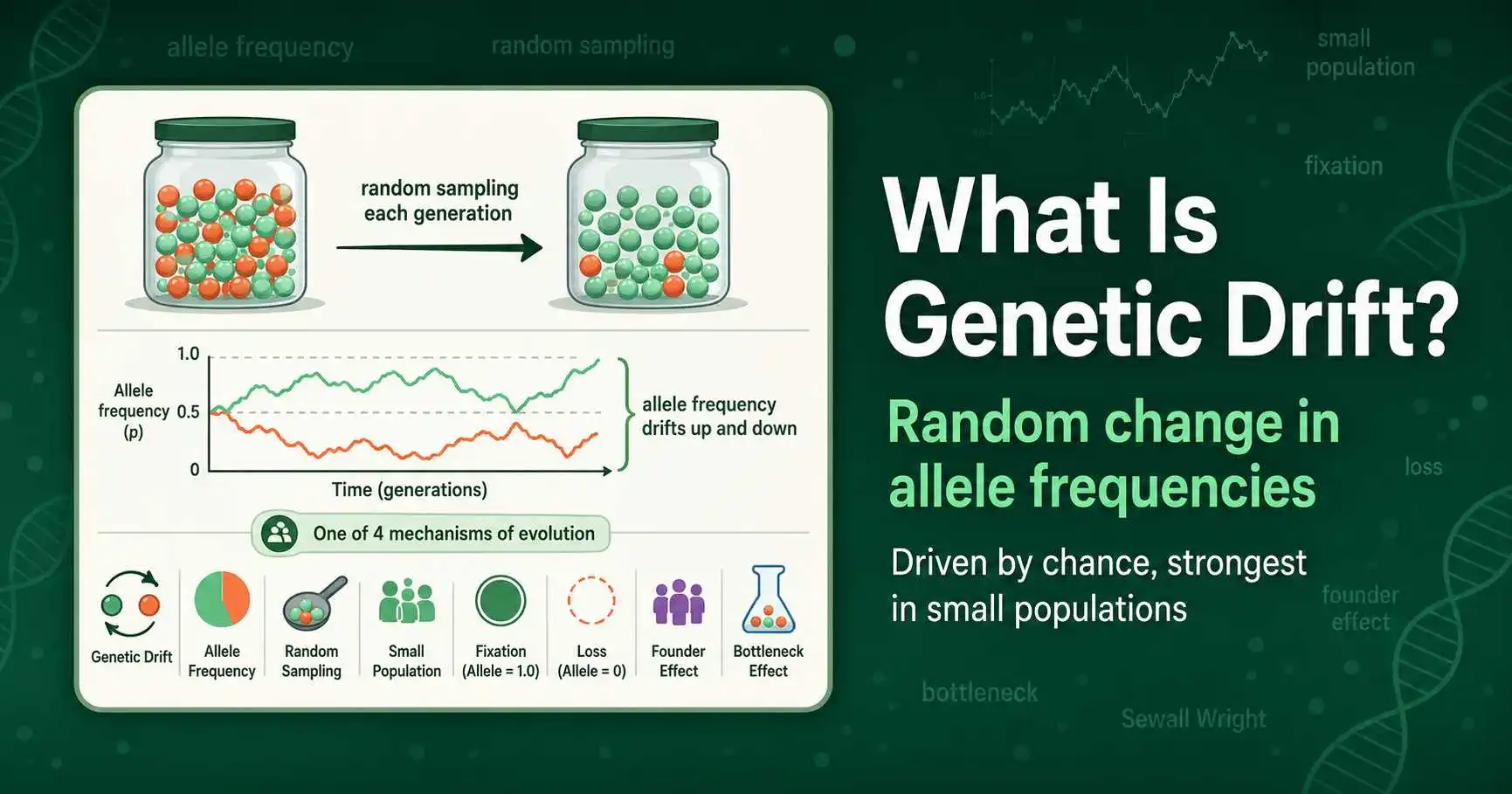
Genetic drift is the random change in the frequency of gene variants, called alleles, within a population from one generation to the next, occurring entirely by chance. It happens by pure chance, not because an allele is helpful or harmful in any way. The effect is strongest in small populations, where luck plays a much bigger role in deciding which alleles get passed on. Genetic drift is one of the four main mechanisms of evolution, alongside natural selection, mutation, and gene flow, and it can cause alleles to vanish completely or become universal entirely at random.
This guide explains genetic drift in plain terms, walks through its causes, and gives real-life examples that make the concept stick. It also answers the questions people most often ask: who coined the term, how drift differs from mutation, whether there is a formula, and whether drift is good or bad. Watching drift unfold across generations in a simulator makes the random nature of the process easy to see. By the end, you will understand why chance alone can reshape a population's genetics.
What Is Genetic Drift in Simple Terms?
Genetic drift is the change in how common an allele is in a population, caused purely by random chance. Think of it as the genetic version of luck. Some individuals happen to reproduce more than others, and the alleles they carry become more common in the next generation, regardless of whether those alleles are useful.
A simple analogy helps. Imagine a jar holding 50 red marbles and 50 blue marbles, where each marble is an allele. To make the next generation, you reach in and grab a handful at random. By chance, you might scoop more red than blue, so the next jar has a different color ratio. Repeat this sampling each generation, and the proportions wander up and down purely by luck. That wandering is genetic drift. Nothing about red being "better" drives the change; the shift comes from the randomness of the sample.
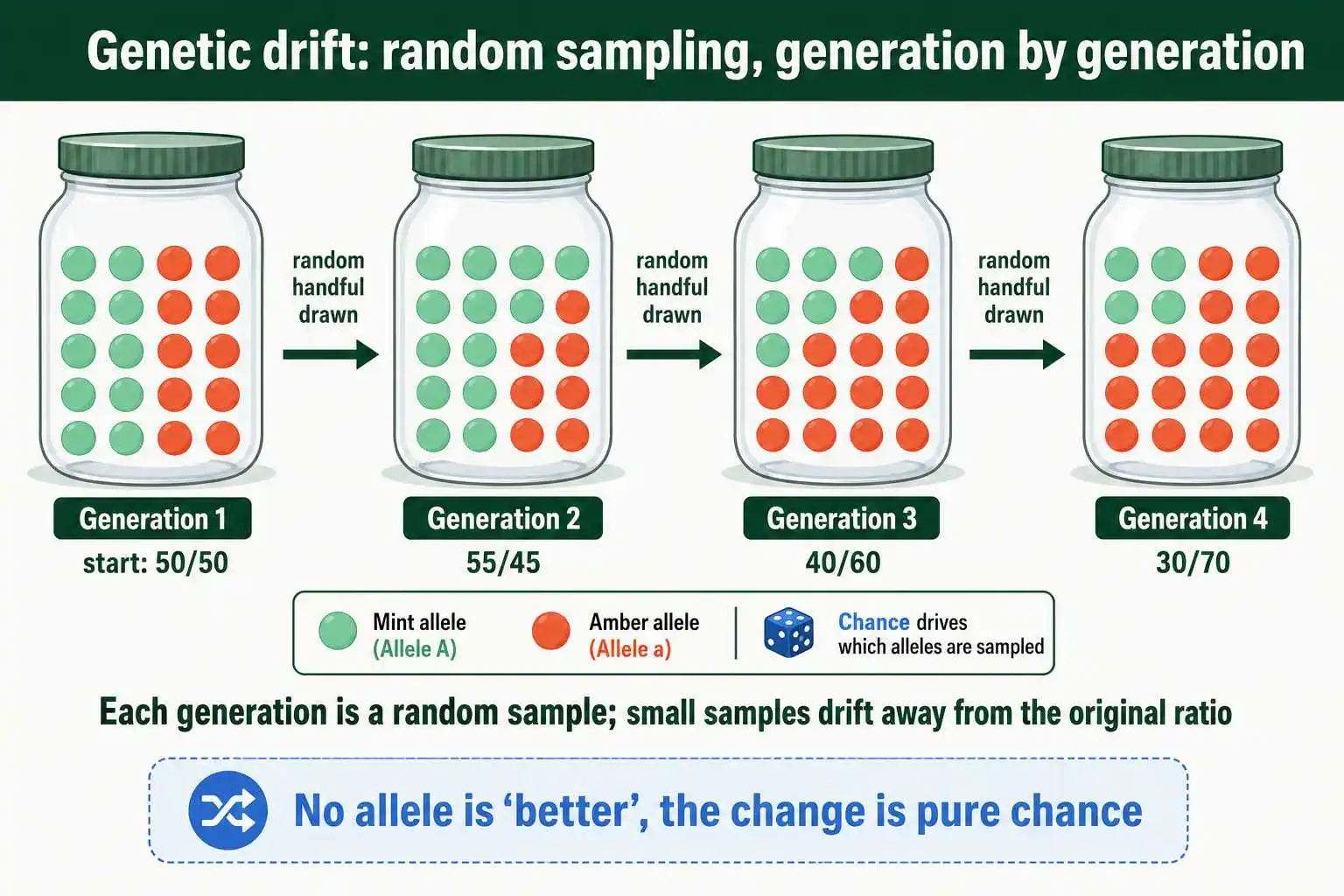
This is why drift is described as a non-directional force. Natural selection pushes allele frequencies in a consistent direction, toward better-adapted variants. Genetic drift has no direction at all. It can increase or decrease any allele's frequency in any generation, with no relationship to fitness. Over many generations, this random walk can carry an allele all the way to a frequency of 100 percent, called fixation, or all the way to zero, called loss. The genetic makeup of the population changes, but evolution here is driven by chance rather than adaptation.
Which Best Describes Genetic Drift?
Genetic drift is best described as random sampling error in the transmission of alleles from one generation to the next. That single phrase captures the whole idea. Each generation is a sample drawn from the parent generation's gene pool, and small samples rarely match the original proportions exactly.
The key word is random. Unlike natural selection, which is a sorting process based on survival and reproduction advantages, drift is undirected noise. It does not "try" to do anything. The alleles that increase or decrease are simply the ones that, by chance, ended up in the individuals who reproduced. This is why two identical populations, left to drift independently, will diverge genetically over time even in the exact same environment.
Sampling error is largest when the sample is small. A handful of marbles strays further from the true ratio than a bucketful does. In genetic terms, this means drift has a much stronger effect in small populations than in large ones. Large populations buffer against chance because their big sample sizes average out the random fluctuations. Small populations, by contrast, can swing dramatically from generation to generation, which is why drift is most powerful when numbers are low. This connection between population size and the strength of drift is the single most important property of the process.
What Causes Genetic Drift?
The cause of genetic drift is random sampling during reproduction. Not every individual passes on its alleles equally, and which ones happen to reproduce is partly a matter of luck rather than fitness. This sampling randomness is the root cause behind every instance of drift.
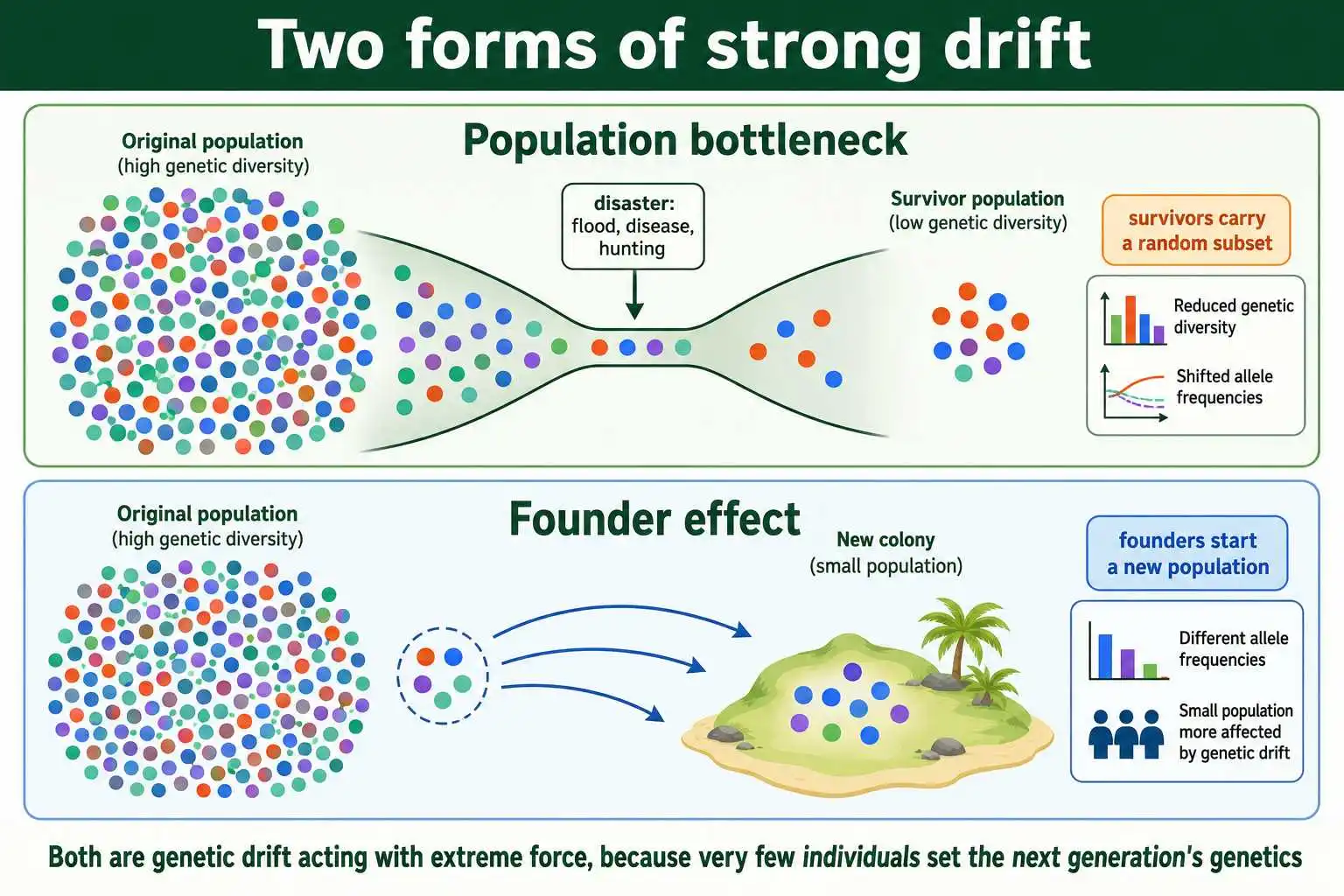
Several situations make this sampling error especially powerful, and two named scenarios stand out because they involve very few individuals determining the outcome. The first is the population bottleneck. A bottleneck happens when a population's size crashes suddenly, often due to a disaster like a flood, fire, disease, or intensive hunting. The survivors are a small, random sample of the original population, so their allele frequencies can differ sharply from the original, and a lot of genetic variation is lost in the crash.
The second named scenario is the founder effect. The founder effect happens when a small group breaks away to start a new population. The founders carry only a small, non-representative slice of the original gene pool, so the new population's allele frequencies reflect the founders rather than the source population. Both the bottleneck and the founder effect are simply genetic drift acting with extreme force, because both involve a very small number of individuals determining the next generation's genetics. Beyond these dramatic cases, ordinary drift operates quietly in every finite population, all the time, just more weakly when numbers are large.
Who Coined the Term Genetic Drift?
The term genetic drift and its underlying theory are attributed to Sewall Wright, an American geneticist who developed the concept in the 1930s. Drift is sometimes called the "Sewall Wright effect" in his honor. Wright was one of the founders of population genetics, alongside Ronald Fisher and J.B.S. Haldane.
Wright's key contribution was recognizing that chance, not just selection, shapes the genetics of populations. Before his work, many biologists assumed that evolution was driven almost entirely by natural selection. Wright showed mathematically that random fluctuations in allele frequencies, especially in small populations, are a genuine evolutionary force in their own right. His models explained how populations could change and even split into new species partly through chance.
Wright also introduced the concept of effective population size, the number that determines how strongly drift acts. He showed that the relevant population size for drift is not the raw headcount but the number of individuals actually contributing genes to the next generation, which is usually smaller. This insight remains central to conservation genetics today. Wright's recognition that drift and selection interact, sometimes reinforcing and sometimes opposing each other, reshaped evolutionary biology and earned drift its permanent place among the core mechanisms of evolution. The detailed workings of effective population size build directly on his ideas.
Real-Life Examples of Genetic Drift
A real-life example of genetic drift is the high rate of certain genetic conditions in the Amish population of the United States. The Amish descend from a small group of founders, so rare alleles those founders happened to carry became unusually common, a textbook founder effect. Real examples make the concept concrete, so here are several across different scenarios.
The northern elephant seal is a striking bottleneck example. Hunting in the 1890s reduced the species to perhaps 20 individuals before it recovered. Today's population of hundreds of thousands descends from those few survivors, so it carries very little genetic variation, a lasting signature of the bottleneck. The cheetah shows the same pattern from an ancient bottleneck, leaving the species with famously low genetic diversity. In both cases, the survivors carried only a fraction of the original variation, and that reduced diversity persists today even though the populations have grown large again.
The island of Tristan da Cunha offers a vivid founder example in humans. The settlement was founded by a handful of people, and the allele for retinitis pigmentosa, an eye disorder, reached a frequency far higher than in the British population the founders came from, simply because one or more founders carried it. Another clear case is the Afrikaner population of South Africa, where founder effects raised the frequency of conditions like Huntington's disease and a form of porphyria. In every example, the common thread is the same: a small number of individuals, by chance, set the genetic course for everyone who followed.
How Is Genetic Drift Different From Mutation?
Genetic drift and mutation are different processes, though both change a population's genetics. Mutation creates new alleles by altering the DNA sequence. Genetic drift changes the frequency of alleles that already exist, by random sampling. In short, mutation is the source of variation, while drift is one force that shuffles that variation around.
The distinction matters because the two play different roles in evolution. Mutation introduces brand-new genetic variants into a population, supplying the raw material that evolution works with. Without mutation, there would be no new alleles for any other process to act on. But mutation by itself changes allele frequencies very slowly, because mutation rates are low. Drift, on the other hand, does not create anything new. It takes the existing pool of alleles and changes their proportions by chance, sometimes dramatically and quickly in small populations.
The two forces also interact. A new allele created by mutation starts at a very low frequency, present in just one individual. Its early fate is often decided by drift rather than selection, because at such low numbers chance dominates. Many new mutations are lost within a few generations purely by drift, before selection ever gets a chance to act on them. So mutation and drift work together: mutation proposes new variants, and drift, along with selection, disposes of them. Keeping the roles straight, mutation makes alleles, drift moves their frequencies, prevents a common point of confusion.
Is There a Formula for Genetic Drift?
There is no single formula for genetic drift, because it is a random process, but its effects are described by several equations from population genetics. The most useful ones capture how drift depends on population size. Drift is quantified through probabilities and variances rather than a single deterministic equation.
One important result concerns fixation. The probability that a given allele will eventually become fixed, reaching a frequency of 100 percent, by drift alone equals its current frequency. So an allele at a frequency of 0.3 has a 30 percent chance of eventually drifting to fixation, and a 70 percent chance of being lost. This elegantly simple result holds in the absence of selection. Another key equation describes the loss of genetic variation: a population loses heterozygosity, a measure of genetic diversity, at a rate of about 1 divided by 2 times the effective population size, per generation. Smaller populations lose diversity faster.
The variance of allele frequency change is also tied to population size, being larger in smaller populations. This is the mathematical expression of the core idea that drift acts more strongly when numbers are low. These formulas are why population size sits at the heart of any quantitative treatment of drift. Rather than memorizing them, the key takeaway is that every quantitative measure of drift points back to effective population size as the controlling factor. These relationships play out visually when smaller populations are shown to drift faster and fix alleles sooner.
Why Population Size Controls the Strength of Drift
Population size is the single biggest factor determining how strongly genetic drift acts. Drift is powerful in small populations and weak in large ones. This relationship is the most important quantitative fact about the entire process.
The reason traces back to sampling. In a large population, each generation is a big sample of the gene pool, so random fluctuations average out and allele frequencies stay fairly stable. In a small population, each generation is a tiny sample, so chance can swing the frequencies sharply from one generation to the next. A population of ten individuals can lose an allele in a single unlucky generation, while a population of a million is far more stable. Size buffers a population against the randomness of drift.
The relevant number is not always the raw headcount, though. The effective population size, written Ne, is the number of individuals actually contributing genes to the next generation, and it is usually smaller than the total count because not everyone breeds. Drift acts according to Ne, not the census size. A herd of 500 animals where only 50 breed drifts as if it were a population of roughly 50. This is why effective population size is so central to predicting drift and to conservation planning, a topic covered in our guide on effective population size.
Can Genetic Drift Be Good or Bad?
Genetic drift can be both good and bad, because it is random and has no regard for what is beneficial. It can fix a harmful allele in a population or eliminate a beneficial one, both of which are bad for the population's fitness. But it can also remove harmful alleles or spread useful ones, simply by chance.
The mostly negative consequence is the loss of genetic diversity. Because drift tends to push alleles toward fixation or loss, it reduces the variety of alleles in a population over time. Low genetic diversity is generally harmful, because it leaves a population less able to adapt to new challenges like disease or environmental change. This is why drift is a major concern in conservation: small, endangered populations lose diversity quickly and can spiral toward extinction, a problem sometimes called the extinction vortex.
Yet drift is not purely destructive. It is a genuine engine of evolutionary change and can contribute to the formation of new species when populations are isolated and drift apart genetically. It can also, by luck, increase the frequency of a beneficial allele or purge a harmful one. The honest answer is that drift is neither good nor bad by design; it is indifferent. Its outcomes depend entirely on chance and circumstance, which is exactly what makes it different from natural selection, the one evolutionary force that does consistently favor what works. This contrast between random drift and directional selection is explored in our guide on genetic drift versus natural selection.
How Do You Use Genetic Drift in a Sentence?
Genetic drift is used as a noun naming the random evolutionary process. A natural example sentence is: "The small island lizard population lost much of its genetic variation through genetic drift after a storm reduced its numbers." The phrase names the chance-driven change in allele frequencies.
In academic writing, you might see it used like this: "Genetic drift, rather than natural selection, best explains the divergence between the two isolated populations." Here the term contrasts the random force with the directional one. Students in class 12 biology and A-level biology often encounter it in this comparative context, where the task is to distinguish drift from selection and from gene flow. Genetic drift is a standard topic in advanced school biology because it is one of the core mechanisms of evolution.
For these curricula, the essential points to remember are short and clear. Genetic drift is random. It is strongest in small populations. It reduces genetic diversity. And it acts without regard to fitness. A common exam phrasing completes the stem "when genetic drift occurs" with an answer like "allele frequencies change randomly from one generation to the next, independent of natural selection." Mastering that one-sentence summary, plus a real example like the founder effect, covers most of what school-level questions ask about the topic.
Frequently Asked Questions
What is genetic drift in simple terms?
Genetic drift is the random change in how common an allele is in a population over time, caused by chance rather than by an allele being helpful or harmful. It is strongest in small populations, where luck has a bigger effect on which alleles get passed on to the next generation.
What is genetic drift for class 12 and A-level biology?
For class 12 and A-level biology, genetic drift is defined as the random change in allele frequency in a population due to chance, one of the factors that disturbs Hardy-Weinberg equilibrium and drives evolution. It is most significant in small populations and is contrasted with natural selection, which is directional.
When genetic drift occurs, what happens?
When genetic drift occurs, allele frequencies change randomly from one generation to the next, independent of natural selection. Over time this can fix some alleles at 100 percent and eliminate others entirely, reducing the population's overall genetic diversity by chance alone.
What is genetic drift versus mutation?
Mutation creates new alleles by changing the DNA sequence, while genetic drift changes the frequencies of alleles that already exist through random sampling. Mutation is the source of new variation; drift is a force that shuffles existing variation, especially powerfully in small populations.
Why Chance Shapes the Gene Pool
Genetic drift is the random change in allele frequencies within a population, driven by chance rather than fitness. It is one of the four mechanisms of evolution, it acts most strongly in small populations, and it tends to reduce genetic diversity by pushing alleles toward fixation or loss. The two dramatic forms, the population bottleneck and the founder effect, are simply drift acting with extreme force when very few individuals determine the next generation. Sewall Wright established the concept, showing that chance is a real evolutionary force alongside selection, and that insight reshaped how biologists understand the way populations change over time.
The lasting lesson is that evolution is not driven by adaptation alone. In every finite population, chance is quietly reshaping the gene pool, and in small populations that chance can dominate, fixing harmful alleles, losing beneficial ones, and eroding the diversity a population needs to adapt. You can watch this randomness unfold generation by generation with the genetic drift simulator, which makes the abstract idea tangible. For an authoritative academic treatment of the process, this overview from Biology LibreTexts is a clear and reliable reference, and the Nature Education article on genetic drift covers its link to population size in depth.