Dog Coat Color Calculator: Predict Puppy Colors
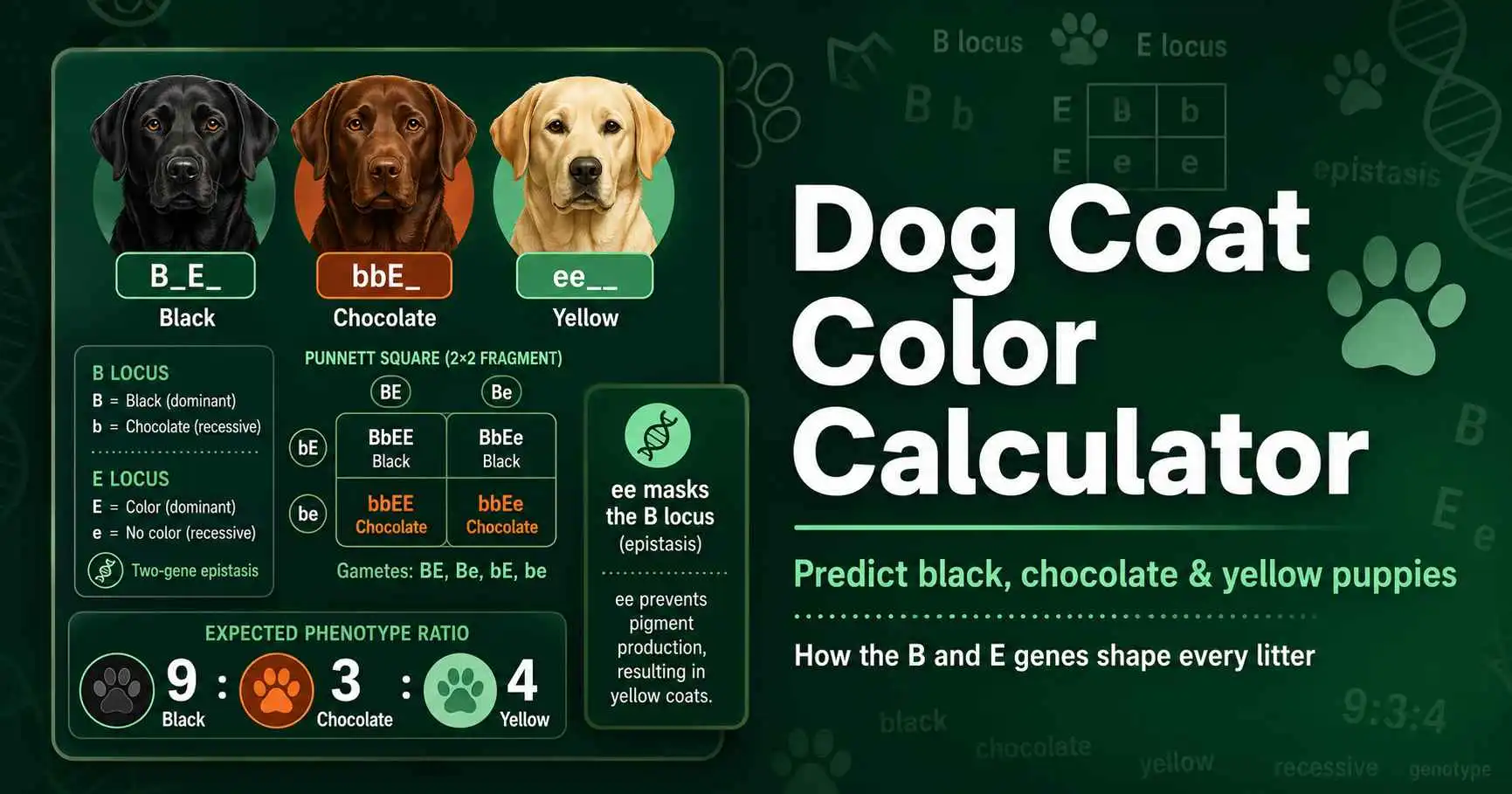
You can predict a puppy's coat color by knowing the parents' genotypes at the genes that control color, then using a Punnett square to map the outcomes. In Labradors, two genes do most of the work: the B locus, which sets black versus chocolate, and the E locus, which can switch the coat to yellow regardless of the B genes. Get the parents' genotypes and you can predict the odds of black, chocolate, and yellow puppies in a litter.
Dog coat color looks complicated, but for the three classic Labrador colors it follows clear genetic rules. The twist that surprises most people is that one gene can completely override another, a pattern called epistasis, and it is why two black dogs can produce yellow puppies. This guide explains the genes behind dog coat color, shows how to set up the cross, and works through real examples you can apply to your own breeding plans. If you are new to the grid itself, the guide on how a Punnett square works covers the basics this article builds on.
The Two Genes Behind Dog Coat Color
Coat color in Labradors is controlled mainly by two genes, each at its own location, or locus, on a chromosome. The first is the B locus, which determines whether the dog's dark pigment is black or brown. The second is the E locus, which controls whether that dark pigment gets deposited in the coat at all, or whether the coat turns yellow instead.
The B locus is short for the brown gene, technically called TYRP1. It has two alleles: a dominant B that produces black pigment and a recessive b that produces brown, often called chocolate or liver. A dog needs two copies of the recessive allele, the genotype bb, to be chocolate. A single dominant B, in either BB or Bb, makes the dog's dark pigment black, because B masks b in the usual dominant-recessive way.
The E locus is short for the extension gene, also called MC1R. It too has two main alleles: a dominant E that allows dark pigment to show in the coat, and a recessive e that blocks it. Here is the crucial part. A dog with two copies of the recessive e allele, the genotype ee, will be yellow no matter what its B locus says. The ee genotype shuts off the deposition of black or brown pigment in the coat, letting the underlying yellow pigment show through instead. This interaction between the two genes is the key to everything that follows.
How the Genes Combine: Black, Chocolate, and Yellow
The three classic Labrador colors come from how the B and E loci combine. Because each dog carries two alleles at each locus, you read the two genes together to find the coat color. The rule has a clear order: check the E locus first, because it can override the B locus entirely.
A black Labrador has at least one dominant allele at both loci. Its genotype is written as B_E_, where the blank means any second allele. The E allele lets dark pigment show, and the B allele makes that pigment black. A chocolate Labrador has at least one E allele but is homozygous recessive at the B locus, written B_bb but more precisely bbE_. The E allele still lets pigment show, but with no dominant B present, the pigment is brown instead of black.
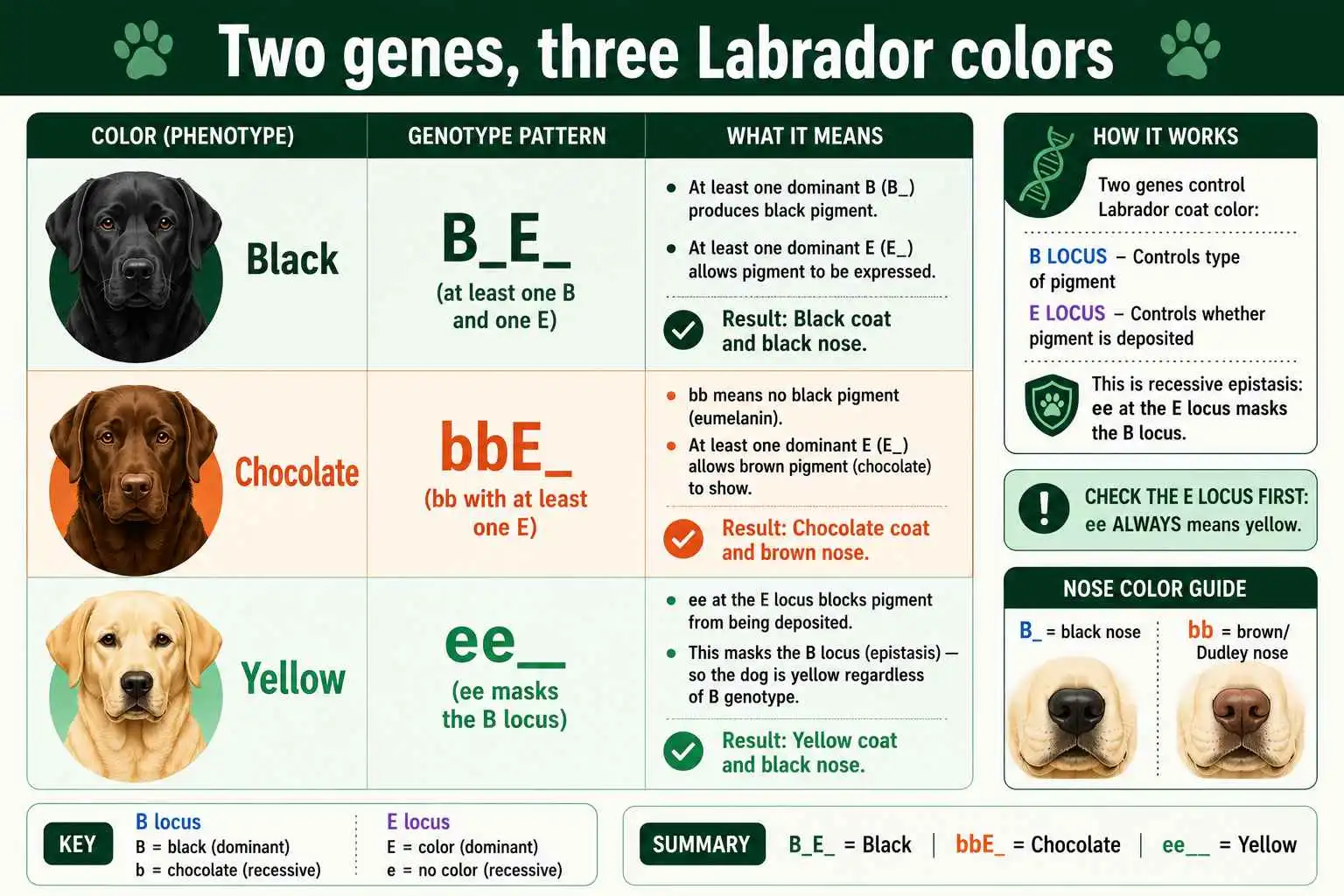
A yellow Labrador is homozygous recessive at the E locus, genotype ee, and its B locus is masked. Whether the dog is eeBB, eeBb, or eebb, it looks yellow, because the ee genotype blocks dark pigment from the coat regardless of the B genes. There is a subtle tell, though. A yellow dog's B genotype still shows in its nose and paw pads. A yellow Lab with at least one B allele has a black nose, while a yellow Lab that is eebb has a brown or pinkish nose, sometimes called a Dudley. So the hidden B locus is not entirely invisible; it just moves from the coat to the features.
Recessive Epistasis: Why One Gene Masks Another
The reason the E locus can override the B locus is a phenomenon called epistasis, where one gene masks or modifies the effect of another gene at a different locus. Dog coat color is one of the clearest real-world examples, which is why genetics courses use it so often.
Specifically, this is recessive epistasis. The recessive ee genotype at the E locus is epistatic to the B locus, meaning it hides whatever the B genes would otherwise produce. Epistasis is different from simple dominance. Dominance is the relationship between two alleles of the same gene, like B masking b. Epistasis is the relationship between two different genes, like the E locus masking the B locus. Keeping that distinction clear is the single most important idea on this page.
Think of the genes as a two-step assembly line. The B locus decides which color of dark pigment to make, black or brown. The E locus decides whether that pigment gets used in the coat at all. If the E locus says no, with the ee genotype, it does not matter what color the B locus chose, because none of that pigment reaches the fur. The dog comes out yellow. This is why epistasis distorts the simple ratios you would expect from two independent genes, a point that becomes obvious the moment you run a real cross. As Biology LibreTexts explains, epistasis is a recognized extension of Mendel's laws that reshapes expected ratios. For a deeper look at how this masking changes Punnett square outcomes, the epistasis Punnett square calculator models these gene interactions directly.
How to Predict Puppy Colors With a Punnett Square
Predicting a litter's colors uses the same Punnett square method as any two-gene cross, with one extra step: you apply the epistasis rule when reading the phenotypes. The process has four parts, and it works for any pair of parent genotypes.
First, write out both parents' genotypes at both loci, such as BbEe for each. Second, work out the gametes each parent can make. A dog that is heterozygous at both loci, BbEe, produces four gamete types: BE, Be, bE, and be, found by taking one allele from each gene. Third, fill a 4x4 Punnett square by combining the gametes, exactly as in a dihybrid cross. Fourth, read each of the sixteen boxes by applying the color rules, checking the E locus first.
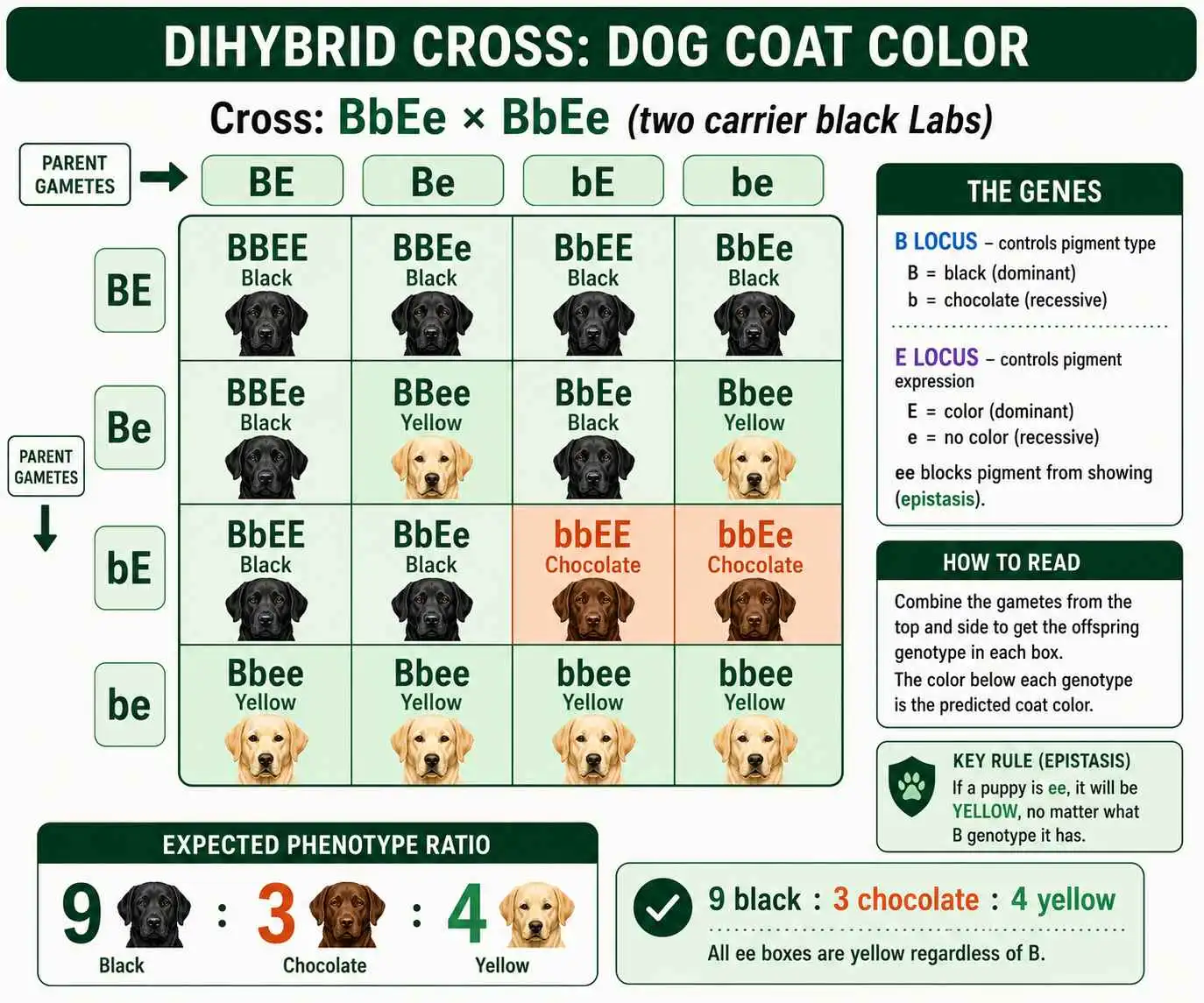
That last step is where epistasis comes in. Any box with the ee genotype is yellow, no matter what its B alleles are. Among the remaining boxes that have at least one E, those with at least one B are black and those that are bb are chocolate. When you sort a full BbEe by BbEe cross this way, you get a distinctive ratio that is not the textbook 9:3:3:1, precisely because the ee boxes all collapse into yellow. Working the grid by hand is instructive once, but a good calculator handles the gametes and the color sorting for you on every subsequent cross.
A Worked Example: Two Black Labs, Yellow Puppies
The most famous surprise in dog breeding is two black Labradors producing yellow puppies. It seems impossible until you see the genotypes, and then it makes perfect sense. The secret is that both black parents are hidden carriers.
Suppose both black parents have the genotype BbEe. Each one is black because it has at least one B and at least one E, but each also carries a hidden b and a hidden e. When two BbEe dogs are crossed, each parent can pass on the recessive e allele, so some puppies can end up ee, which makes them yellow. Running the cross, the ratio works out to 9 black, 3 chocolate, and 4 yellow puppies out of every 16.
That 9:3:4 ratio is the signature of recessive epistasis, and it differs from the standard 9:3:3:1 of a normal dihybrid cross.
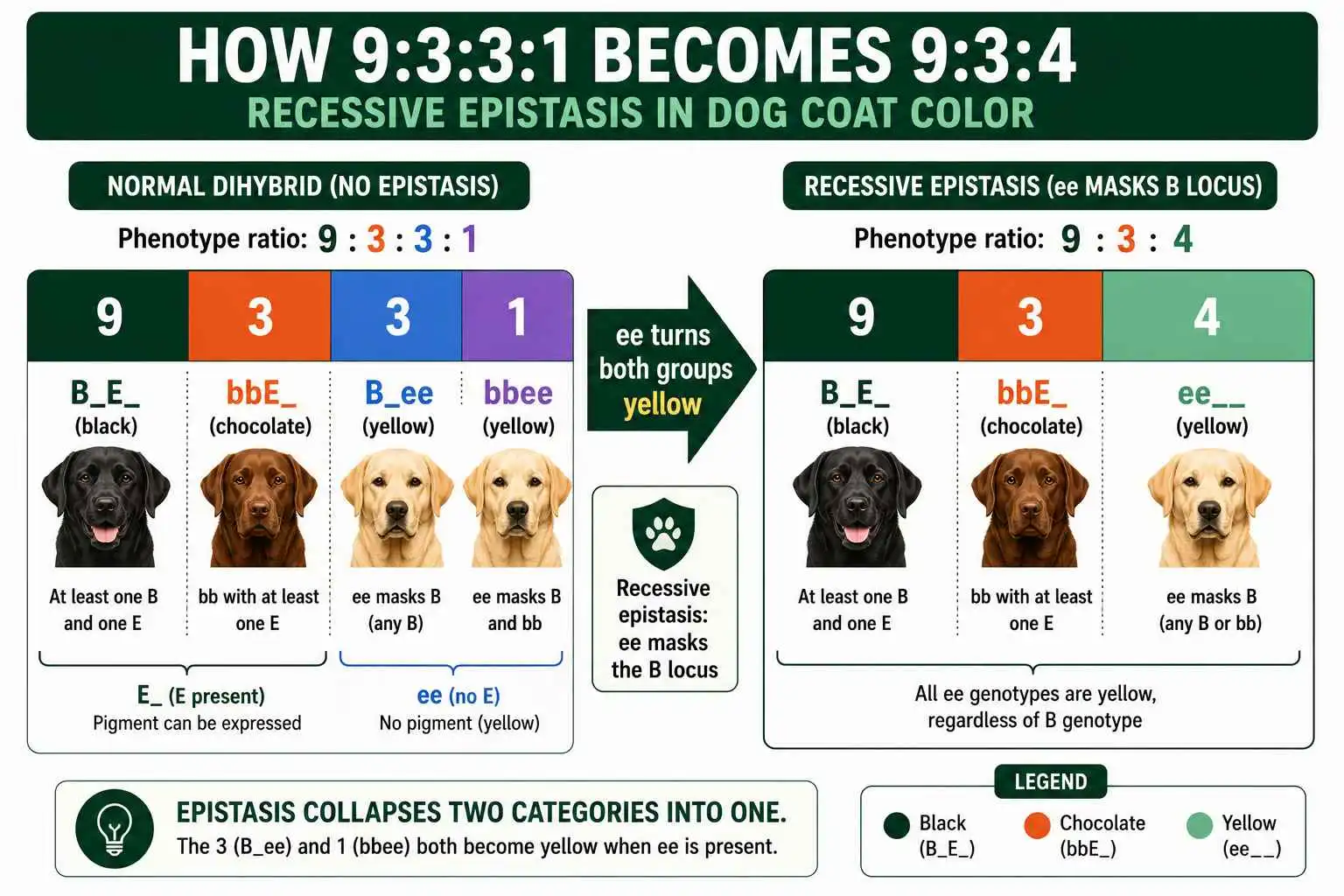
The two categories that would have been "chocolate with ee" and "black with ee" both turn yellow, so the 3 and the 1 from the bottom of the usual ratio merge into a single group of 4 yellow puppies. This is the clearest demonstration of how epistasis reshapes the expected numbers. It also explains the breeding rule that two yellow Labs (both ee) can only produce yellow puppies, since neither parent can contribute a dominant E allele. A black puppy from a yellow-by-yellow pairing would signal a misbreeding.
A Second Example: Black Carrier by Yellow
A different common pairing shows how the genes sort when one parent is yellow. Take a black Lab that carries chocolate and yellow, genotype BbEe, bred to a yellow Lab. Remember that every yellow Lab is ee at the E locus, but its B genotype can vary, so suppose the yellow parent is Bbee.
Work the two loci separately, which is the fastest way to handle a cross like this. At the E locus, Ee crossed with ee gives half Ee and half ee offspring, so half the puppies can show color and half will be yellow. At the B locus, Bb crossed with Bb gives the usual three-to-one pattern, so among the color-showing puppies, three out of four carry a dominant B and one out of four is bb. Combine these and you get a mix of black, chocolate, and yellow puppies in predictable proportions.
The instructive part is that the yellow parent still passes a B-locus allele to every puppy, even though that allele is masked in the parent's own coat. A yellow Bbee dog can contribute a B or a b, which then shows up in any colored puppies. This is why a yellow parent's hidden B genotype matters so much for breeding, and why testing a yellow dog's B locus is worthwhile despite the dog looking the same either way. The cross also confirms that pairing a yellow dog with a carrier black dog can still produce black puppies, as long as the black parent contributes a dominant E allele.
While the B and E loci explain the three main Labrador colors, several other genes shape coat color across dog breeds. Knowing them rounds out the picture, even though they play a smaller role in the classic Labrador palette.
The D locus, or dilution gene, lightens whatever base color a dog has. A dog with two recessive dilute alleles, genotype dd, shows a paler version of its color. A black dog becomes a soft charcoal or blue, and a chocolate dog becomes a pale silver. Silver Labradors are simply chocolate Labs with the dd genotype diluting their coat. The dilution gene acts on top of the B and E loci rather than replacing them, which means a single dog's full color can depend on three genes read together: the B locus for black or brown, the E locus for whether that color shows, and the D locus for how dark it appears.
Other breeds bring still more genes into play. The K locus controls dominant black, brindle, and fawn patterns. The A locus, or agouti gene, governs sable and tan-point patterns and interacts with the K locus. The E locus itself has additional alleles in some breeds, including one that creates a black facial mask. These extra genes are why coat color across all dogs is far more complex than in Labradors, where just two loci do most of the work. For the three classic Labrador colors, though, the B and E loci remain the whole story, which is what makes the breed such a clean teaching example.
Coat Patterns in Other Breeds: Merle and Brindle
Beyond solid colors, many breeds show distinctive patterns, and two come up constantly in coat color questions: merle and brindle. Both follow their own genetic rules, and both add important cautions for breeders.
Merle is a patchy, mottled pattern caused by a dominant allele at the M locus, seen in breeds like Australian Shepherds, Border Collies, and Great Danes. A single copy of the merle allele produces the marbled coat. The serious caution is that breeding two merle dogs together is risky, because puppies that inherit two copies, called double merles, often suffer from hearing and vision problems. This is a case where understanding the genetics is not just about predicting color but about responsible breeding, since a Punnett square of merle by merle shows a one-in-four chance of the harmful double-merle genotype.
Brindle is a striped pattern, often described as tiger-striping, controlled at the K locus. The brindle allele allows dark stripes to form over a lighter base color, and it interacts with the agouti A locus to determine where the pattern appears. Brindle shows up in Boxers, Greyhounds, and many other breeds. Unlike the recessive yellow of Labradors, brindle follows a more layered set of interactions, which is why predicting it sometimes requires tracking three loci rather than two. These patterns illustrate that while the Labrador's two-gene system is wonderfully simple, coat color across all dogs sits on a much richer genetic foundation.
Tracking Hidden Carriers Across Generations
For a breeder, the most valuable skill is tracking which recessive alleles a dog secretly carries, because those hidden alleles determine what a dog can produce when paired with another. A black dog's appearance hides as much as it reveals.
The challenge is that recessive alleles can travel silently through many generations. A black Labrador might carry both the chocolate b allele and the yellow e allele without ever showing either, then pass them to offspring. Two such carriers, paired together, suddenly reveal the hidden colors in their puppies. This is why a breeder cannot rely on a dog's color alone and must instead trace genotypes through a pedigree, noting which ancestors produced which colors.
Pedigree analysis turns this tracking into a system. By recording the colors that appear in a dog's relatives and offspring, a breeder can infer hidden carrier status even without a DNA test. If a black dog has ever produced a chocolate puppy, that dog must carry the b allele, because chocolate requires bb and one b had to come from the black parent. The same logic applies to yellow. Combining pedigree records with Punnett square predictions lets breeders plan litters with far greater accuracy, and a pedigree analyzer can map these inheritance patterns across several generations at once.
Because a black dog can secretly carry chocolate and yellow alleles, looking at a dog tells you only part of its genotype. This is where genetic testing becomes valuable for breeders who want to predict litters with confidence rather than guessing.
A black Labrador could be any of four genotypes: BBEE, BBEe, BbEE, or BbEe. All four look identical, yet they carry very different breeding potential. A BBEE dog can never produce chocolate or yellow, while a BbEe dog can produce both. Without a test, a breeder cannot tell these apart by sight. A DNA test for the B, E, and D loci reveals the exact genotype, so a breeder knows precisely which alleles a dog can pass on.
This knowledge transforms breeding from a guessing game into a prediction. If a breeder knows both parents are BbEe, the Punnett square tells them to expect roughly 9 black, 3 chocolate, and 4 yellow puppies per 16, and that every color is possible. If a test shows a parent is BBEE, the breeder knows that pairing cannot produce chocolate or yellow at all, which saves the disappointment of unmet expectations and helps match a litter to what buyers are looking for. Pairing genetic testing with a Punnett square is the modern approach to planning litters, combining a precise readout of the parents with a clear prediction of the offspring.
Frequently Asked Questions
Can two black dogs have yellow puppies?
Yes. If both black parents are carriers of the recessive yellow allele, with genotype BbEe or similar, they can each pass on the e allele. A puppy that inherits ee will be yellow, even though both parents are black. This is recessive epistasis at work.
What two genes determine Labrador coat color?
The B locus and the E locus. The B locus sets black versus chocolate, with B dominant for black and b recessive for chocolate. The E locus controls whether that pigment shows in the coat, with the recessive ee genotype producing a yellow coat regardless of the B genes.
Why are yellow Labradors yellow?
Yellow Labradors are homozygous recessive at the E locus, genotype ee. This blocks black or brown pigment from being deposited in the coat, so the underlying yellow pigment shows instead. The B locus is masked, though it still affects nose and paw color.
What ratio do two carrier black Labs produce?
A cross between two BbEe black Labs produces a 9:3:4 ratio: 9 black, 3 chocolate, and 4 yellow puppies per 16. The 9:3:4 ratio is the hallmark of recessive epistasis, where the yellow ee boxes merge two categories into one.
Bringing It Together
Dog coat color, at least for the three classic Labrador colors, comes down to two genes working together. The B locus decides black or chocolate, and the E locus decides whether that color shows at all or gives way to yellow. Because the recessive ee genotype masks the B locus entirely, the genes interact through recessive epistasis, producing the telltale 9:3:4 ratio and the surprise of yellow puppies from two black parents.
To predict a litter, write out the parents' genotypes, build a Punnett square, and read each box by checking the E locus first. You can run any cross and see the color odds laid out with the Punnett Square Calculator, which applies the gamete and epistasis logic automatically. For a thorough reference on canine coat color genes, this overview from VCA Animal Hospitals is a reliable place to read more.