Human Trait Punnett Squares: Tongue Rolling & More
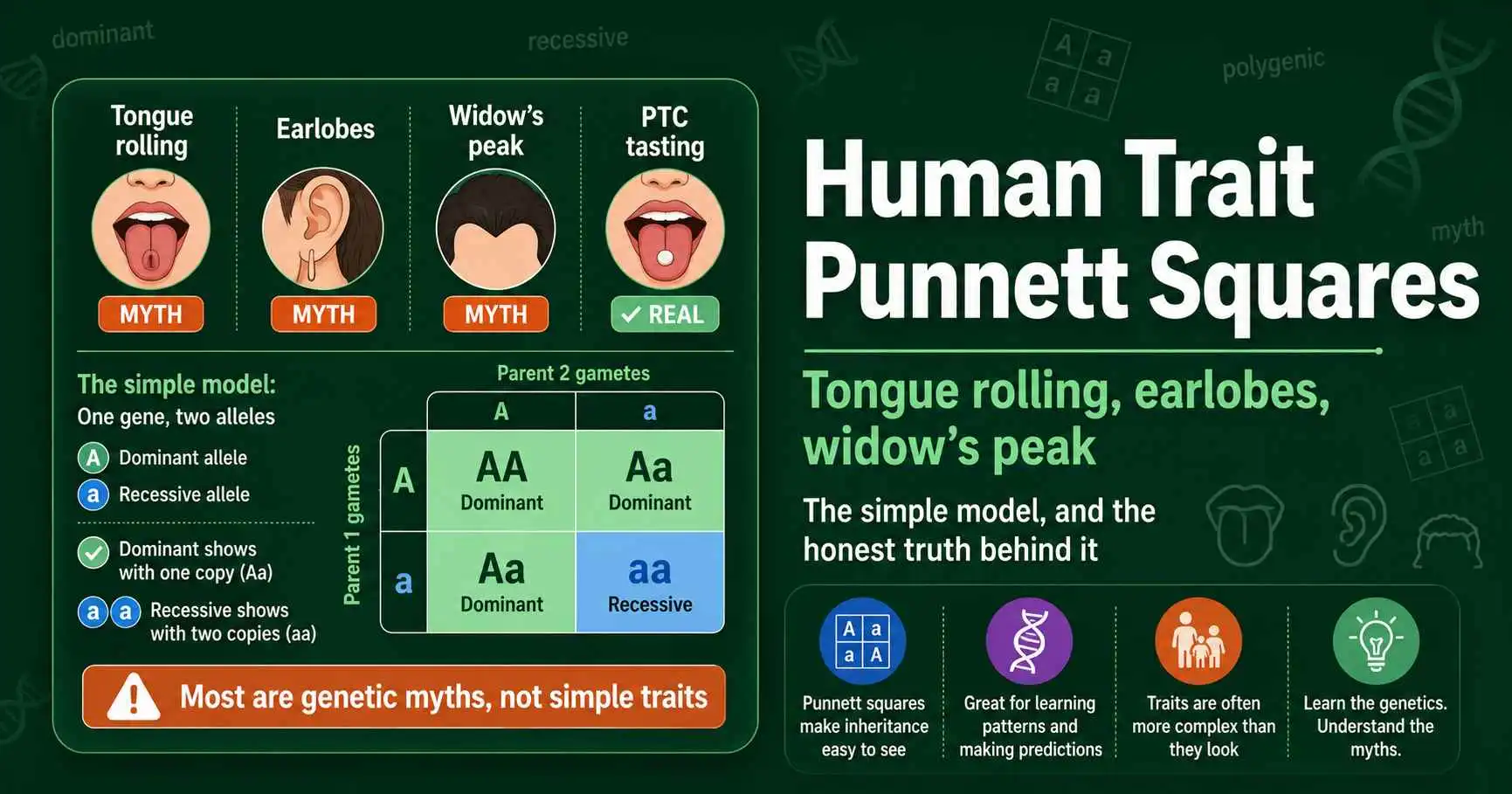
Classic human traits like tongue rolling, attached earlobes, and widow's peak are taught everywhere as simple dominant-recessive traits you can map with a Punnett square. In the textbook model, tongue rolling is dominant, free earlobes are dominant, and widow's peak is dominant, so two parents showing a recessive trait should only have recessive children. There is just one problem: for most of these traits, that simple model is wrong.
This is one of the most useful things to understand about human genetics. These traits make for easy classroom exercises, but decades of research show that almost none of them follow clean single-gene inheritance. This guide gives you the simple Punnett squares you came for, since they are what assignments ask about, and then tells you the honest truth about which traits actually fit the model and which are genetic myths. Knowing both makes you genuinely informed rather than repeating an oversimplification. For the basics of building any cross, our guide on how a Punnett square works covers the method. For classroom traits that use a simplified Mendelian model, build the cross in the Punnett square calculator or practise similar examples in the interactive worksheet.
The Classic Human Traits and Their Simple Model
For decades, biology classes have used a handful of visible human traits to teach Mendelian inheritance. They are appealing because students can observe them on themselves without any equipment. The usual list includes tongue rolling, earlobe attachment, widow's peak, hitchhiker's thumb, dimples, and cleft chin, among others.
In the simplified model taught for each, one version of the trait is labeled dominant and the other recessive. Tongue rolling is said to be dominant over non-rolling. Free, unattached earlobes are said to be dominant over attached earlobes. A widow's peak hairline is said to be dominant over a straight hairline. Dimples and cleft chin are likewise presented as dominant traits. In each case, the trait is treated as if a single gene with two alleles controls it, exactly like the traits Mendel studied in pea plants.
This model is convenient because it lets students build Punnett squares and predict offspring just as they would for any monohybrid cross. A trait labeled dominant gets a capital letter, the recessive version gets the lowercase, and the genetics looks reassuringly simple. The trouble is that this tidy picture does not match what geneticists have actually found for most of these traits. We will work through the simple Punnett squares first, because they are what homework asks for, and then look honestly at where the model holds and where it breaks.
Tongue Rolling: The Most Famous Example
Tongue rolling, the ability to curl the sides of your tongue up into a tube, is probably the single most common classroom example of human genetics. In the simple model, the rolling allele is dominant and the non-rolling allele is recessive. A roller could have the genotype with two rolling alleles or one of each, while a non-roller would have two recessive alleles.
Under this model, the Punnett square works like any monohybrid cross. If both parents are heterozygous rollers, you would predict a 3:1 ratio, three rolling children to one non-rolling child. If both parents are non-rollers, the model says they could only have non-rolling children, since neither would carry a rolling allele to pass on. This is the prediction the simple model makes, and it is what most assignments expect you to calculate.
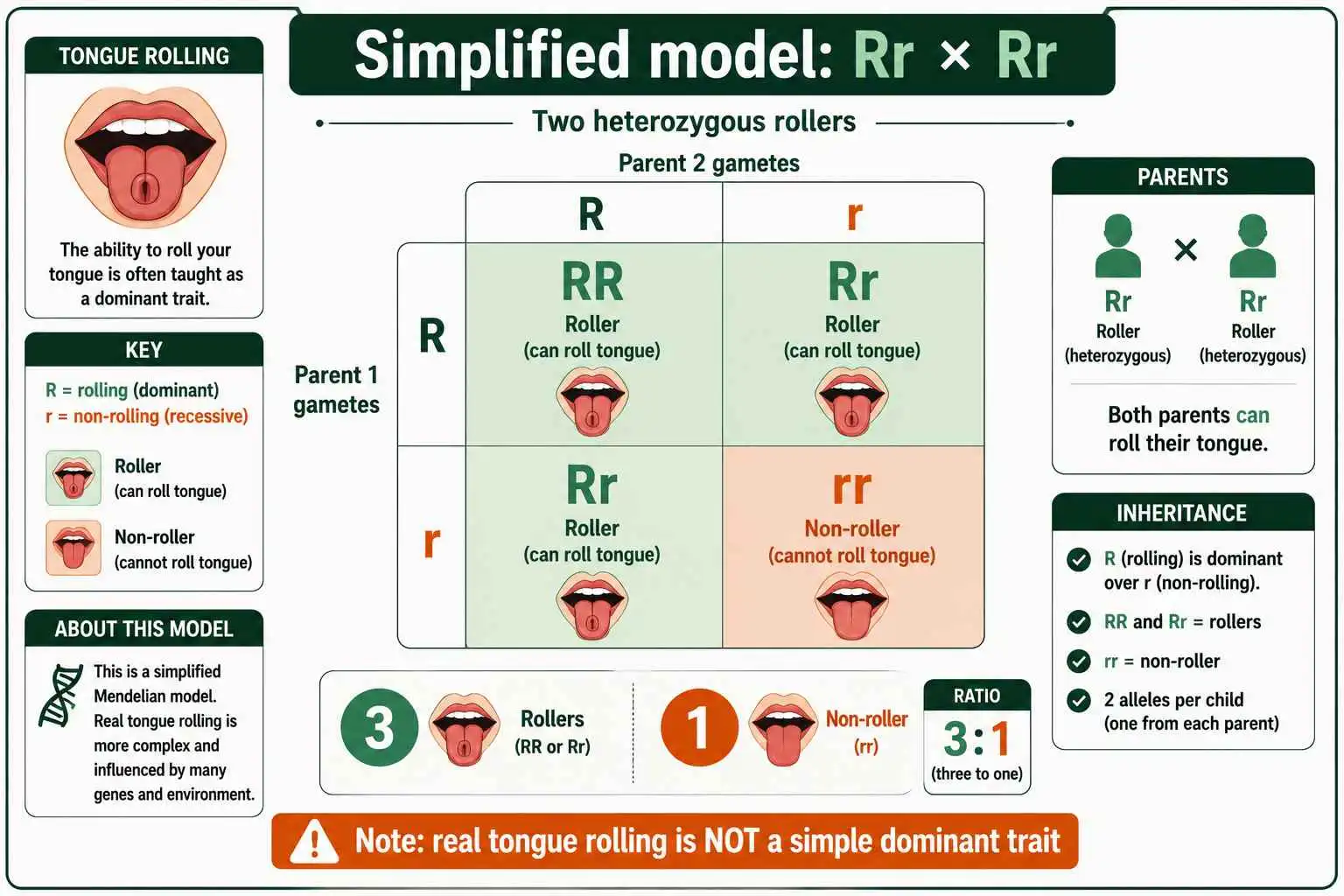
Here is where reality intervenes. Studies have repeatedly found rolling children born to two non-rolling parents, which is impossible under the simple dominant model. Even more telling, a 1952 study of identical twins found pairs where one twin could roll their tongue and the other could not, despite sharing identical genes. Since identical twins have the same DNA, any difference between them must come from non-genetic factors. One of the pioneers of genetics, Alfred Sturtevant, who had originally helped popularize the trait, later admitted he was embarrassed to see it still listed as a simple genetic case. Tongue rolling has some genetic component, but it is clearly not the clean single-gene trait the textbooks claim.
Earlobes: Attached vs Free
Earlobe attachment is another staple of genetics classes. People are sorted into two groups: those with free, hanging earlobes and those with attached earlobes that blend into the side of the head. The simple model says free earlobes are dominant and attached earlobes are recessive, controlled by a single gene.
Following that model, you would build the Punnett square the usual way. Two heterozygous free-earlobe parents would be predicted to have a 3:1 ratio of free to attached earlobes in their children, and two attached-earlobe parents should only have attached-earlobe children. Plenty of worksheets ask exactly this kind of question, treating earlobe attachment as a reliable recessive trait.
The reality is that this model fails on two counts. First, earlobes do not actually fall into two clean categories. Lobe attachment varies continuously, with many people having lobes somewhere between fully free and fully attached, which already breaks the two-allele assumption. Second, no published study has ever confirmed that a single gene controls the trait with free being dominant. The evidence points instead to multiple genes contributing to earlobe shape and attachment. So while the simple cross is easy to draw, it does not reflect how earlobes are really inherited, and the trait should not be used as a clean genetics example.
Widow's Peak and Other Classic Traits
A widow's peak, the V-shaped point a hairline can form in the center of the forehead, is another trait routinely taught as a simple dominant. The model holds that having a widow's peak is dominant over a straight hairline, and the Punnett square is built accordingly, predicting the familiar 3:1 ratio from two heterozygous parents.
As with the others, this is an oversimplification. No peer-reviewed study has ever conclusively identified a single gene for widow's peak. Hairline shape appears to result from a mix of multiple genes, hormonal effects, and chance during development, which is why it does not follow a tidy inheritance pattern. The same story repeats across many of the classic traits. Hitchhiker's thumb, cleft chin, and dimples are all presented as binary dominant-recessive characteristics, yet all of them actually show continuous variation rather than two clean categories, and none has a confirmed single-gene basis.
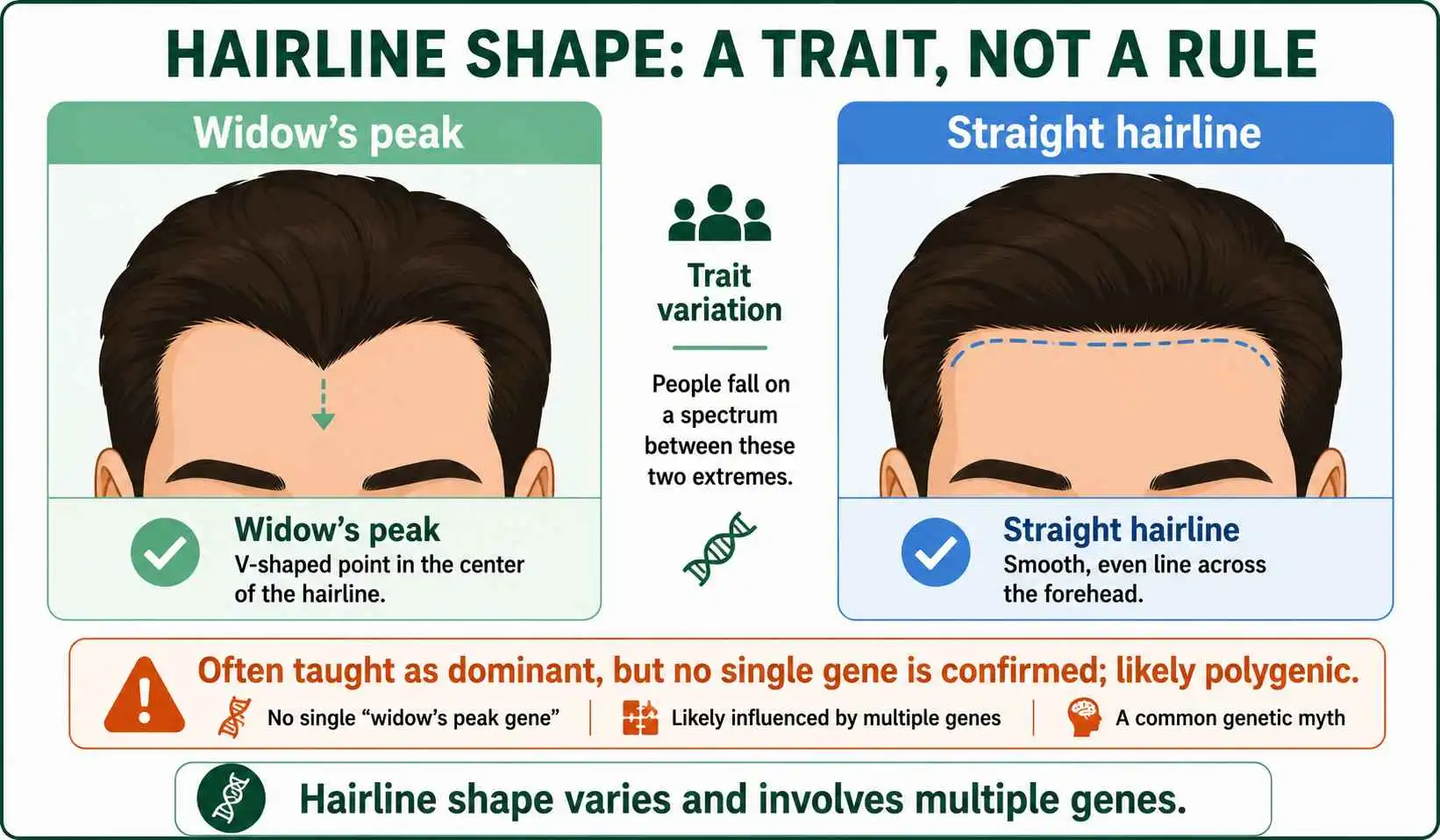
The pattern here is consistent and worth internalizing. A trait that varies smoothly across a population, rather than sorting people into two distinct groups, almost certainly involves several genes, not one. This is the same lesson that applies to eye color and height, both of which are polygenic. The continuous variation is the giveaway. When a textbook presents one of these traits as a simple dominant, it is offering a useful simplification for teaching the mechanics of a Punnett square, not an accurate account of human inheritance. To compare with a trait that truly is polygenic, our guide on the eye color Punnett square explores the same theme in depth.
The Honest Truth: Most Are Genetic Myths
It is worth stating plainly, because so many sources get it wrong: most of the common human traits used to teach genetics are genetic myths in the sense that they do not follow the simple inheritance pattern attributed to them. This is not a fringe claim. It is well documented in the genetics literature and in the standard reference catalog of human traits.
The core problem is twofold. First, many of these traits are continuous rather than discrete, meaning people fall along a spectrum rather than into two neat categories. Earlobe attachment, hitchhiker's thumb, and others all show this smooth variation. Second, even the traits that seem more clearly two-state, like tongue rolling, fail the genetic test because non-rolling parents can have rolling children and identical twins can differ. Both findings rule out the simple one-gene, two-allele, dominant-recessive model.
Why do the myths persist? They survive because they are memorable and easy to teach, a kind of useful oversimplification similar to teaching beginners that electrons orbit the nucleus in neat circles. There is real educational value in using a familiar trait to practice the mechanics of a Punnett square, as long as everyone understands it is a simplification. The harm comes when the model is presented as established fact, which can mislead students and, worse, fuel mistaken conclusions about family relationships. As the University of Utah's Learn.Genetics resource notes, earlobe attachment and similar traits are inherited but almost certainly involve many genes rather than one.
The One That Actually Works: PTC Tasting
Not every classic human trait is a myth. One commonly used example genuinely does follow a mostly Mendelian pattern, and it deserves recognition as the legitimate exception: the ability to taste the chemical PTC, or phenylthiocarbamide.
About 75 percent of people find PTC intensely bitter, while the other 25 percent cannot taste it at all. This trait is controlled mainly by a single gene that codes for a bitter-taste receptor on the tongue. Different alleles of this gene determine whether PTC tastes bitter or tasteless, with the tasting allele behaving as dominant and the non-tasting allele as recessive. Because a real single gene is largely responsible, PTC tasting follows a reasonably predictable inheritance pattern that a Punnett square can model with some accuracy.
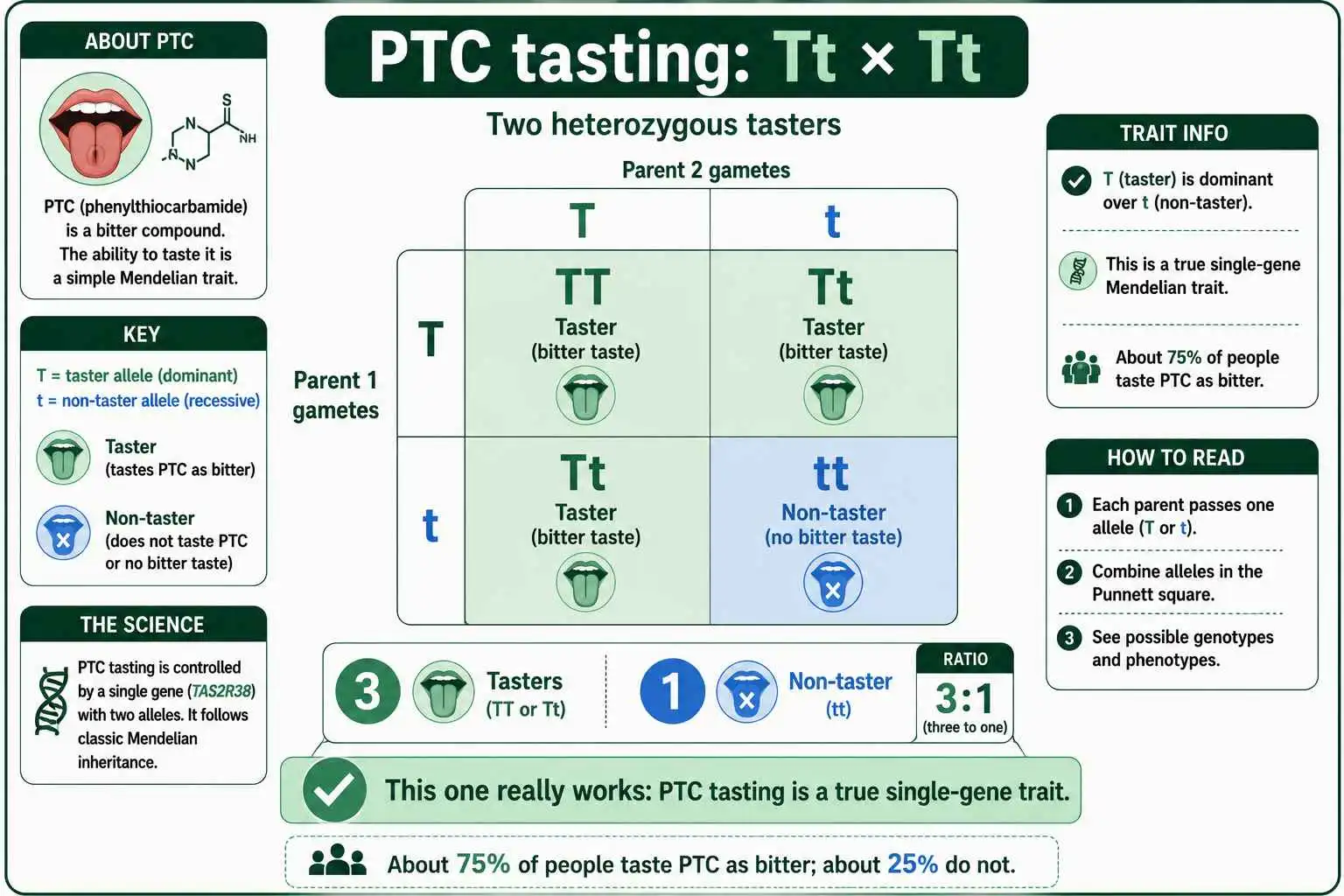
So if both parents are heterozygous tasters, the Punnett square genuinely predicts roughly three tasters to one non-taster among their children, and the prediction holds up reasonably well in practice. This makes PTC tasting a far better teaching example than tongue rolling or earlobes, because the genetics actually supports it. Even here, scientists note that the picture is not perfectly simple, since other genes can modify the perception of bitterness, but PTC tasting is much closer to a true Mendelian trait than the visible traits it is often grouped with. When you need a real human example of dominant-recessive inheritance, PTC is the one to reach for. It also has a fascinating practical history: PTC tasting was discovered by accident in 1931 when a chemist released some of the powder and a nearby colleague complained of the bitter taste while he noticed nothing, revealing the genetic difference between them.
Why These Myths Can Be Harmful
A genetics myth might seem harmless, but the earlobe and tongue-rolling oversimplifications can cause real damage when people take them literally. The most serious problem is the temptation to use these traits to judge family relationships, which the science simply cannot support.
Because the simple model says two recessive parents cannot have a dominant child, someone who believes the myth might conclude that a child with an unexpected trait could not belong to a parent. This reasoning is flawed from the start, because the traits do not follow the simple model. A non-rolling couple genuinely can have a rolling child, and earlobe attachment does not even sort into clean categories, so any conclusion about parentage drawn from these traits is worthless. The only reliable test of biological relationship is a DNA test, never a comparison of earlobes or tongue rolling.
The misconception also distorts how people understand genetics more broadly. If someone learns that visible traits follow neat dominant-recessive rules, they may expect inheritance to be far more predictable than it actually is, then feel confused or suspicious when real families do not match the textbook. Teaching these traits as established fact, rather than as simplified exercises, plants exactly this kind of misunderstanding. The honest framing, that these are practice models rather than truth, protects people from drawing wrong and sometimes hurtful conclusions about their own families.
How to Spot a Genuinely Mendelian Trait
Since so many famous human traits turn out to be myths, it helps to know what a real single-gene trait looks like. A few signs distinguish a genuinely Mendelian trait from one that only appears simple, and they are the same signs geneticists use.
The first sign is discrete categories. A true single-gene trait usually sorts people into clear, distinct groups with little in between, the way PTC tasters and non-tasters separate fairly cleanly. When a trait varies smoothly along a spectrum, like earlobe attachment or skin tone, that continuous variation signals multiple genes at work. The second sign is consistent inheritance in families and twins. A real Mendelian trait follows predictable patterns across generations, and identical twins almost always share it. When non-affected parents regularly produce affected children, or identical twins differ, the simple model is broken.
The third sign is confirmation in the genetic literature. Traits with a known single gene appear in the standard catalog of human genes with an identified locus, while the myth traits notably lack such confirmation despite a century of teaching. Genetic disorders like cystic fibrosis pass all three tests, which is why they are reliable Punnett square examples, as our guide to genetic disorders and Punnett squares shows. Applying these checks lets you judge for yourself whether a trait deserves the simple model, rather than trusting a worksheet that may be repeating an old error.
What Twin Studies Reveal
Twin studies are one of the most powerful ways to test whether a trait is truly genetic, and they have been decisive in debunking several of these myths. The logic is elegant and worth understanding, because it explains how scientists know these traits are not simple.
Identical twins share essentially all of their DNA, having developed from a single fertilized egg. So if a trait is controlled entirely by genes, identical twins should always match for it. If they sometimes differ, that difference cannot come from their genes, since their genes are the same. It must come from environment, development, or chance. This makes identical twins a natural experiment for separating nature from nurture, an insight that dates back to Francis Galton.
When researchers applied this test to tongue rolling, the results were clear. Multiple studies found pairs of identical twins where one could roll their tongue and the other could not. Since their genes were identical, tongue rolling could not be purely genetic, which directly contradicts the simple dominant model taught in classrooms. Twin studies have similarly shown that many supposedly simple traits are influenced by non-genetic factors. The lesson is broader than any single trait: when identical twins differ on a characteristic, that characteristic is not under strict genetic control, no matter how often a textbook claims otherwise. This is why twin research remains a cornerstone of human genetics and a reliable myth-buster.
How to Still Use These Traits for Practice
Given that most of these traits are myths, you might wonder whether the Punnett squares are worth doing at all. They are, with the right framing. The simple human-trait crosses remain a perfectly good way to practice the mechanics of genetics, as long as you treat them as exercises rather than literal truth.
The honest approach is to use the assumed dominant-recessive model to practice setting up gametes, filling the grid, and reading ratios, while remembering that the assignment's premise is a simplification. If a worksheet says tongue rolling is dominant and asks for the offspring ratio of two heterozygous parents, you can correctly answer 3:1 within the model, because the question is testing your Punnett square skills, not making a claim about real tongue-rolling genetics. Giving the expected answer while understanding its limits is exactly the right move.
This is also a chance to think more critically than the assignment requires. When you finish the cross, you can recognize that the real inheritance is more complex, which is a deeper understanding than simply memorizing that rolling is dominant. To predict the probability of a specific outcome in any such practice cross, the standard probability method handles the math, with the same caveat that the underlying model is simplified. The skill you build, setting up and reading crosses, transfers directly to traits that genuinely are Mendelian, like the genetic disorders and PTC tasting where the predictions actually hold.
Frequently Asked Questions
Can two non-tongue-rolling parents have a tongue-rolling child?
Yes. Studies have repeatedly found rolling children born to two non-rolling parents, which would be impossible if tongue rolling were a simple dominant trait. This is strong evidence that tongue rolling is not controlled by a single gene as commonly taught.
Is tongue rolling actually genetic?
Partly. Tongue rolling has some genetic component, since children of rollers are somewhat more likely to roll, but it is not a simple dominant trait. Identical twins can differ in tongue rolling, showing that environment and other factors also play a role.
Are attached earlobes recessive?
Not in the simple way often taught. Earlobe attachment varies continuously rather than falling into two clean categories, and no study has confirmed a single gene with free earlobes dominant. Multiple genes most likely contribute to earlobe shape.
Which human trait is actually Mendelian?
PTC tasting is the best example. The ability to taste the bitter chemical PTC is controlled mainly by a single gene with a dominant tasting allele, so it follows a reasonably predictable Punnett square pattern, unlike tongue rolling or earlobes.
What to Take Away
The classic human traits, tongue rolling, earlobes, widow's peak, and the rest, are taught as simple dominant-recessive traits, and you can absolutely build the textbook Punnett squares for them. But the honest reality is that most are genetic myths: they vary continuously or fail genetic testing, and they do not follow the single-gene model attributed to them. PTC tasting is the rare exception that genuinely fits, making it the trait to trust when you need a real Mendelian example.
The smart way to handle these traits is to use them for Punnett square practice while understanding their limits, which leaves you better informed than the worksheets themselves. You can run any of these practice crosses with the Punnett Square Calculator to sharpen the mechanics, remembering that the genetics behind most visible human traits is richer than the simple model suggests. For a thoughtful look at why these traits are not as simple as they seem, this article from the genetics literature is well worth reading.