Incomplete Dominance vs Codominance Explained
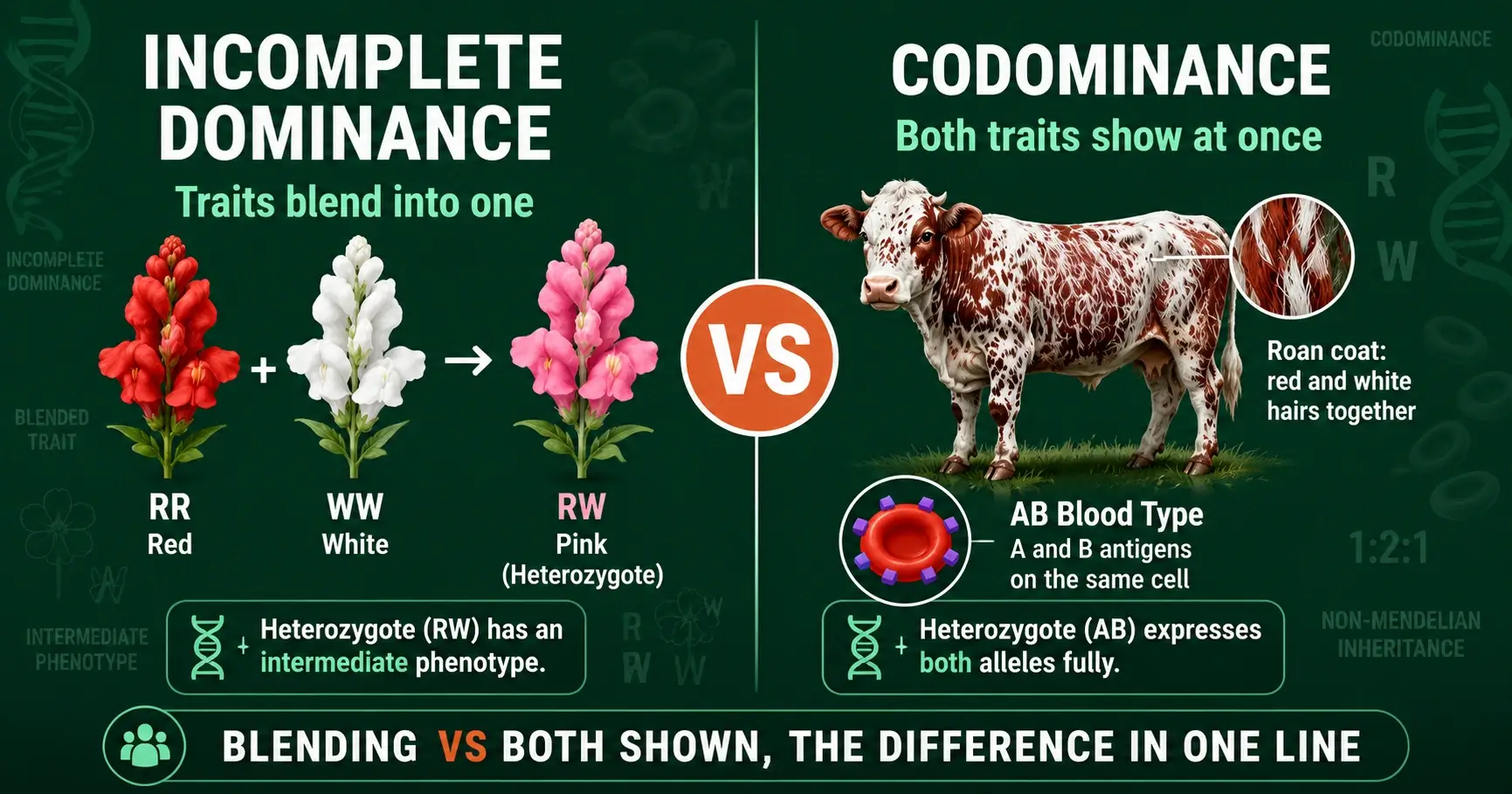
Incomplete dominance and codominance are two patterns of inheritance where a heterozygote does not simply show the dominant trait. In incomplete dominance, the two alleles blend into a single intermediate trait, like a red and a white flower producing pink. In codominance, both alleles show fully and separately at the same time, like the A and B alleles producing AB blood type. The quickest way to keep them straight: incomplete dominance mixes the traits, codominance displays both.
Both patterns break the simple Mendelian rule that one allele masks the other. That rule, complete dominance, is what gives a heterozygote the same look as a homozygous dominant parent. Incomplete dominance and codominance are exceptions to it, and they are exactly why genetics is more colorful than a strict dominant-recessive model suggests. This guide defines each pattern clearly, shows how to tell them apart in seconds, walks through their Punnett squares, and explains why both produce a 1:2:1 ratio instead of the familiar 3:1.
What Is Incomplete Dominance?
Incomplete dominance is a pattern where neither allele is fully dominant, so the heterozygote shows a blended, intermediate phenotype. The two alleles mix to produce a trait that sits between the two parent traits, and a new appearance emerges that neither parent had.
The classic example is the snapdragon flower. A true-breeding red snapdragon has the genotype RR, and a true-breeding white snapdragon has the genotype WW. Cross them and the heterozygous offspring (RW) are pink, a clear blend of red and white. The pink is not hiding red or white. It is a genuinely intermediate color, produced because the single red allele cannot make enough pigment on its own to turn the flower fully red.
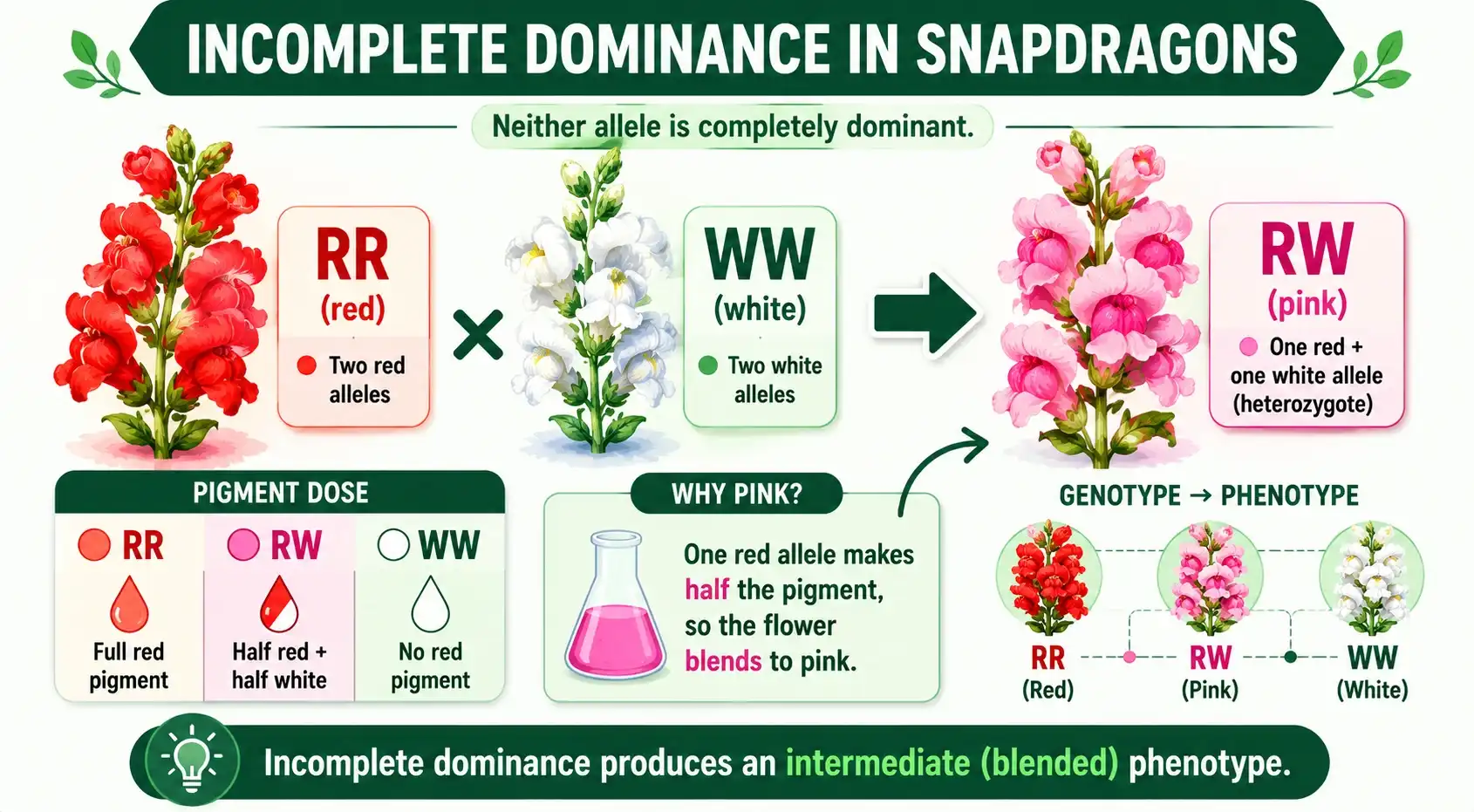
That last point explains the mechanism. In many cases of incomplete dominance, the dominant-looking allele codes for a product, such as a pigment, and one copy simply makes less of it than two copies would. A flower with two red alleles makes a full dose of red pigment and looks red. A flower with one red allele makes only half the dose, which reads as pink rather than red. The recessive white allele contributes no pigment at all. The result is a smooth, dose-dependent blend, which is the signature of incomplete dominance. The same pattern shows up in other organisms, from flower color in carnations and four o'clock plants to feather color in certain birds.
What Is Codominance?
Codominance is a pattern where both alleles are fully and separately expressed in the heterozygote, with no blending at all. Instead of mixing into a middle trait, each allele produces its own visible effect, and you see both at once. Both parental traits appear side by side in the same organism.
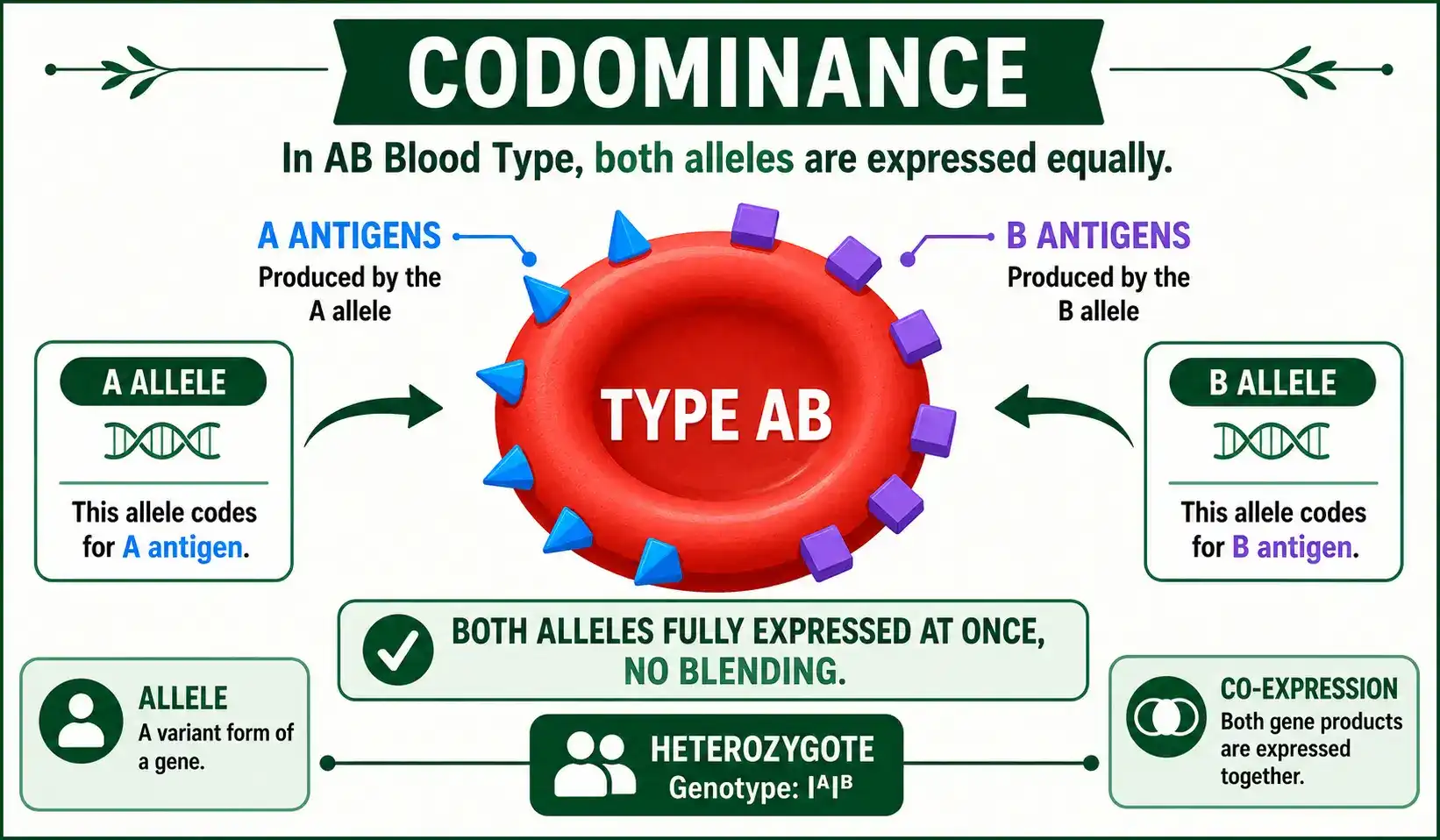
Human ABO blood type is the most familiar example. The A allele and the B allele are codominant with each other. A person who inherits one A allele and one B allele has type AB blood, and their red blood cells carry both A antigens and B antigens. The alleles do not average into a single "AB-blend" antigen. Each makes its own marker, and both markers are present together. That simultaneous, separate expression is the defining feature of codominance.
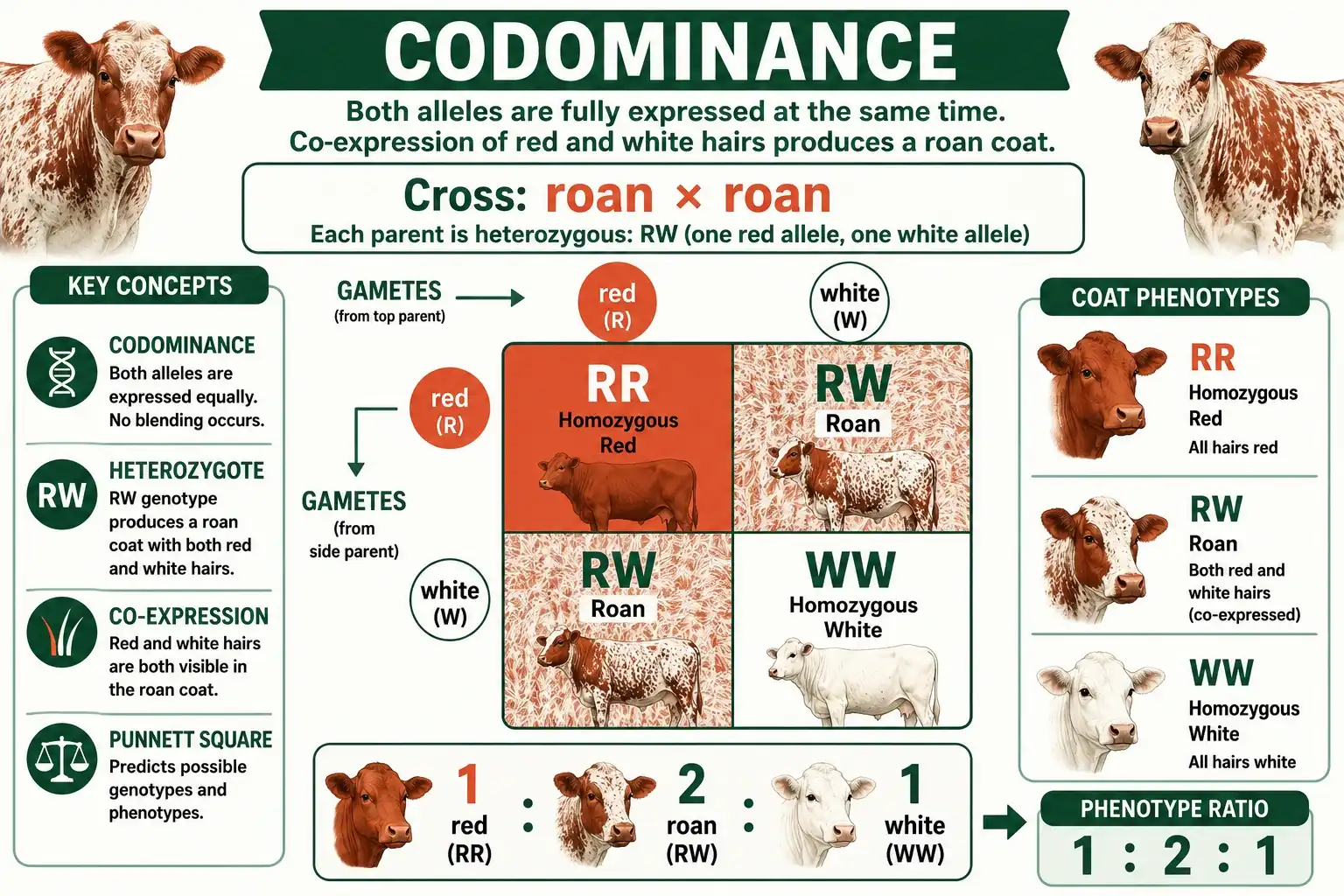
Coat color in roan cattle and roan horses is the visual version of the same idea. Cross a red-coated animal with a white-coated one, and the roan offspring do not turn pink. Instead they grow a coat with both red hairs and white hairs mixed together. Look closely and each individual hair is either red or white, never a blended shade. The same logic produces speckled chickens with separate black and white feathers. In every case the heterozygote wears both parental traits at full strength, distinctly, rather than averaging them.
Incomplete Dominance vs Codominance: The Key Difference
The entire distinction comes down to one question: do the two traits blend, or do they both appear separately? Incomplete dominance blends them into a new intermediate. Codominance shows both at full strength, side by side. Everything else flows from that single difference.
| Feature | Incomplete dominance | Codominance |
|---|---|---|
| Heterozygote trait | Blended, intermediate | Both traits shown separately |
| New phenotype | Yes, a brand-new look | No, a combination of existing traits |
| Classic example | Pink snapdragon | AB blood type, roan coat |
| What you see | One mixed trait | Two distinct traits at once |
| Allele expression | Partial, dose-dependent | Full, simultaneous |
A pink snapdragon shows incomplete dominance because pink is a single new color, not red patches next to white patches. A roan cow shows codominance because you can pick out individual red hairs and individual white hairs; the colors coexist without merging. If you mentally "zoom in" on the heterozygote and find one uniform in-between trait, it is incomplete dominance. If you find both original traits present and distinguishable, it is codominance.
Both patterns share something important, though. Neither follows complete dominance, so in both, the heterozygote is visually different from either homozygous parent. That shared trait is why students mix them up, and it is also why the two patterns produce identical genetic ratios, as we will see.
How to Tell Them Apart Quickly
When a problem describes a heterozygote, one fast test sorts the two patterns. Ask whether the heterozygote's trait is a single blended outcome or a visible mixture of both parent traits.
If a red parent and a white parent produce pink offspring, that is a blend, so it is incomplete dominance. Pink is a new, uniform color you could not point to in either parent. If a red parent and a white parent produce offspring with both red and white hairs, that is co-expression, so it is codominance. You can still see the original red and the original white, just together on one animal.
The wording of a question usually gives it away. Words like "intermediate," "blended," "in between," or a brand-new color name signal incomplete dominance. Phrases like "both traits appear," "spotted," "speckled," "patches," or "expresses both" signal codominance. Keep the snapdragon and the roan cow in mind as anchors, and you can classify almost any example on sight.
Incomplete Dominance in a Punnett Square
A Punnett square for incomplete dominance works exactly like a standard monohybrid cross, with one twist: every genotype maps to its own visible phenotype. Cross two pink snapdragons, RW by RW, and the grid gives one RR, two RW, and one WW.
Now read the phenotypes. RR is red, the two RW are pink, and WW is white. So the offspring appear in a 1:2:1 ratio of red to pink to white. Notice that this phenotype ratio is identical to the genotype ratio, because each genotype produces a distinct look. There is no masking to collapse two genotypes into one appearance, which is what would normally happen under complete dominance.
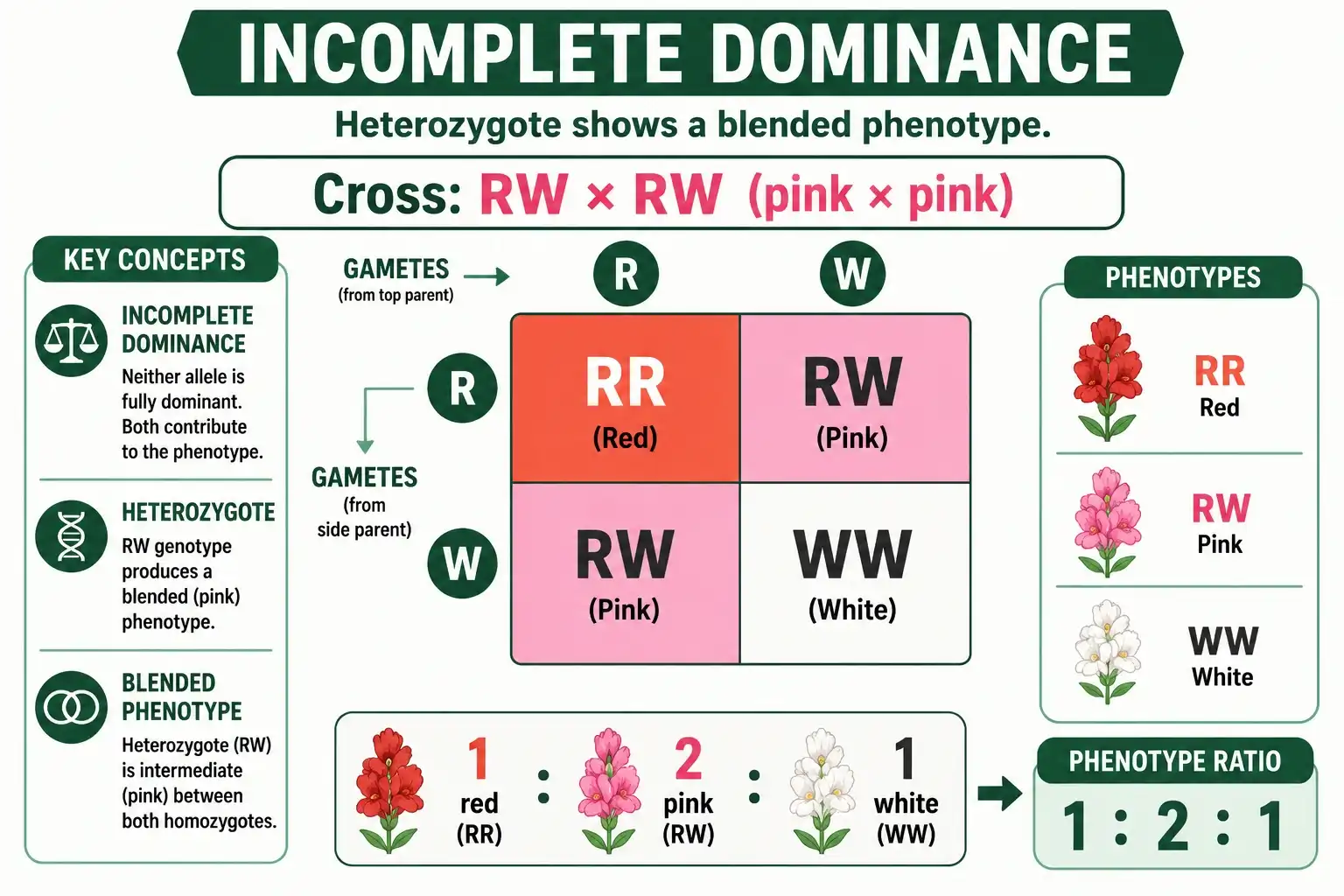
This is the practical payoff of incomplete dominance: you can read an organism's genotype straight from its phenotype. A pink snapdragon must be RW, a red one must be RR, and a white one must be WW. There is no hidden carrier state, because nothing is hidden. If you want to compare this directly with how a standard dominant-recessive cross behaves, the walkthrough of the monohybrid 3:1 ratio shows the contrast clearly.
Codominance in a Punnett Square
Codominance fills out a Punnett square the same way, and it produces the same 1:2:1 ratio, but each heterozygote box shows both traits rather than a blend. Take a cross between two roan animals, each carrying one red allele and one white allele.
The four boxes come out as one homozygous red, two roan, and one homozygous white, a 1:2:1 ratio. The difference from incomplete dominance is purely in appearance. The middle class here is roan, an animal displaying both red and white hairs, rather than a single blended color. The genetics is identical; the visible result is what differs.
Blood type crosses follow the same structure and are worth practicing because they appear constantly in genetics courses. Cross a type AB parent with another type AB parent and you get one type A child, two type AB, and one type B, again a 1:2:1 ratio. Each AB child expresses both antigens. Because every genotype gives a distinguishable phenotype, you can read genotypes directly here too, which is part of why blood typing is such a reliable real-world genetic test. A phenotype probability calculator can quickly turn any of these crosses into the exact proportions you need.
Why Both Patterns Give a 1:2:1 Ratio
It surprises many students that incomplete dominance and codominance produce the same ratios, but the reason is simple and worth understanding. In a cross between two heterozygotes, the genotype ratio is always 1:2:1, regardless of how the alleles interact. That part never changes, because it depends only on how gametes combine, not on dominance.
What changes is the phenotype ratio. Under complete dominance, the two heterozygous genotypes and the one homozygous dominant genotype all look the same, so three of the four boxes share one appearance and you get a 3:1 phenotype ratio. Under incomplete dominance or codominance, the heterozygote looks different from both homozygotes, so no boxes get grouped together. Each of the three genotypes keeps its own phenotype, and the phenotype ratio matches the genotype ratio at 1:2:1.
So the single deciding factor is whether the heterozygote is distinguishable. When it is not, you see 3:1. When it is, whether by blending or by co-expression, you see 1:2:1. This is why both non-Mendelian patterns share a ratio that differs from classical dominance, and it is a clean way to remember that the ratio reflects how alleles are expressed, not just how they are inherited.
Complete vs Incomplete Dominance vs Codominance
Students usually meet all three dominance patterns together, so it helps to see them lined up. Complete dominance is the classic Mendelian case, while incomplete dominance and codominance are the two main exceptions to it.
| Pattern | Heterozygote shows | Example | Phenotype ratio |
|---|---|---|---|
| Complete dominance | Only the dominant trait | Purple pea flowers (Pp) | 3:1 |
| Incomplete dominance | A blended, intermediate trait | Pink snapdragon (RW) | 1:2:1 |
| Codominance | Both traits, separately | AB blood type | 1:2:1 |
The single thing that separates these three is what the heterozygote looks like. Under complete dominance, the heterozygote is identical to the homozygous dominant parent, because the dominant allele fully masks the recessive one. A heterozygous purple pea looks exactly like a homozygous purple pea, which is why the recessive trait can hide for a generation.
Incomplete dominance and codominance both make the heterozygote stand out, just by different routes. Incomplete dominance produces one new intermediate trait, while codominance produces both original traits at once. This is why both share a 1:2:1 phenotype ratio while complete dominance gives 3:1. If you can answer the question "what does the heterozygote look like," you can immediately name which of the three patterns you are dealing with. That single check is the most reliable way to classify any cross you encounter.
A Note on Allele Notation
The way you write these genotypes differs from standard Mendelian notation, and getting it wrong is a frequent source of confusion. In complete dominance, you use a capital letter for the dominant allele and the lowercase version for the recessive one, such as Bb. The capital letter signals which allele wins.
Incomplete dominance and codominance have no clearly dominant allele, so that convention breaks down. For these patterns, alleles are often written as two different capital letters, such as R for red and W for white, giving the heterozygote RW. The point is to avoid implying that one allele dominates the other. Another common style uses a shared base letter with superscripts to mark each variant, which keeps related alleles visually grouped while still treating them as equals.
Blood type notation shows this clearly. The A and B alleles are written with superscripts on a shared symbol, and the recessive O allele uses a lowercase mark. The A and B alleles are codominant with each other, yet both are completely dominant over O, so a single gene can mix relationship types. The practical lesson is simple: when you see a trait described as incomplete dominant or codominant, do not assume the uppercase letter automatically wins, because the whole point of these patterns is that neither allele fully overrides the other.
Concrete cases make the two patterns memorable, and they show up well beyond the textbook flower and cow.
Incomplete dominance appears in many traits where a single allele produces a partial effect. Snapdragons and carnations give pink heterozygotes. Four o'clock flowers blend red and white into pink the same way. In some animals, coat or feather color shows intermediate shades in heterozygotes. Even certain human traits, like the degree of hair curliness, behave in a roughly incomplete-dominant way, with heterozygotes showing a result between the two homozygous states. The common thread is a dose-dependent blend.
Codominance shows up wherever two alleles each leave their own distinct mark. Human ABO blood type is the headline case, with AB individuals carrying both antigens. The MN blood group works the same way. Roan coats in cattle and horses display both hair colors at once, and speckled or spotted patterns in chickens and other animals do the same. A particularly important human example is sickle cell trait. People who carry one normal hemoglobin allele and one sickle allele produce both normal and sickle hemoglobin, so at the molecular level both alleles are expressed, a textbook case of codominance. As Lumen Learning notes, these patterns sit among several extensions of Mendel's original rules.
Codominance also has direct clinical weight. Because the A and B alleles are codominant, blood typing reads both antigens to determine which transfusions are safe, and a mismatch can trigger a dangerous immune reaction. Here the genetics of codominance translates straight into a life-or-death medical decision, which is part of why the ABO system is studied so closely.
Where These Patterns Fit in Genetics
Incomplete dominance and codominance belong to a larger group called non-Mendelian inheritance, which covers the many ways real traits deviate from simple dominant-recessive rules. Mendel's laws still hold underneath; these patterns just describe what happens when alleles interact in more nuanced ways.
Codominance often travels with another idea, multiple alleles. The ABO blood system, for instance, involves three alleles in the population, not two, even though any one person carries only two. The A and B alleles are codominant with each other, while both are completely dominant over the recessive O allele. That mix of relationships in a single gene shows how these patterns can layer together. Other extensions, such as polygenic traits and epistasis, add still more complexity, but incomplete dominance and codominance are the two you will meet first and most often. Understanding them prepares you for everything that follows, and you can model any of these crosses with the right setup in a Punnett square to see the outcomes laid out clearly.
Common Mistakes to Avoid
A few errors come up repeatedly with these two patterns, and each is easy to correct.
The biggest is confusing blending with co-expression. If you describe AB blood type as a "blend" of A and B, you have mistaken codominance for incomplete dominance. AB blood shows both antigens separately; it does not average them. Likewise, calling a pink snapdragon a case of "both colors showing" misreads incomplete dominance as codominance. Pink is one blended color, not red and white side by side.
A second mistake is expecting a 3:1 ratio out of habit. Both of these patterns give a 1:2:1 phenotype ratio, because the heterozygote is visible. Writing 3:1 for a snapdragon or blood type cross is a common slip. A third is mishandling notation. Because there is no clear dominant allele, these traits are often written with two capital letters or with superscripts rather than the usual capital-and-lowercase pair, so do not assume the uppercase letter "wins." Keeping the snapdragon-versus-roan distinction firmly in mind prevents most of these errors before they start.
Frequently Asked Questions
Is AB blood type codominance or incomplete dominance?
AB blood type is codominance. The A and B alleles are both fully expressed, so a person with type AB carries both A and B antigens on their red blood cells at the same time, with no blending into an intermediate antigen.
Why are pink snapdragons an example of incomplete dominance?
Pink snapdragons are incomplete dominance because the red and white alleles blend into a single intermediate color. One red allele produces only half the normal pigment, which reads as pink rather than full red, creating a brand-new phenotype between the two parents.
Do incomplete dominance and codominance have the same ratio?
Yes. Both produce a 1:2:1 phenotype ratio in a cross between two heterozygotes, because the heterozygote is visibly different from both homozygotes. This differs from complete dominance, which gives a 3:1 phenotype ratio.
Bringing It Together
Incomplete dominance and codominance both describe heterozygotes that refuse to follow simple dominance, but they do it in opposite ways. Incomplete dominance blends two alleles into a single intermediate trait, like a pink snapdragon. Codominance expresses both alleles fully and separately, like AB blood type or a roan coat. One mixes, the other shows both, and that single distinction settles every example.
Both patterns produce a 1:2:1 ratio because the heterozygote is distinguishable, which lets you read genotype straight from phenotype. The fastest way to see how any of these crosses play out is to lay them on a grid and read the results directly with the Punnett Square Calculator, which handles non-Mendelian patterns alongside the classic ones. For more worked examples of these inheritance types, this overview is a helpful reference.