Sex-Linked Traits: How to Do X-Linked Punnett Squares
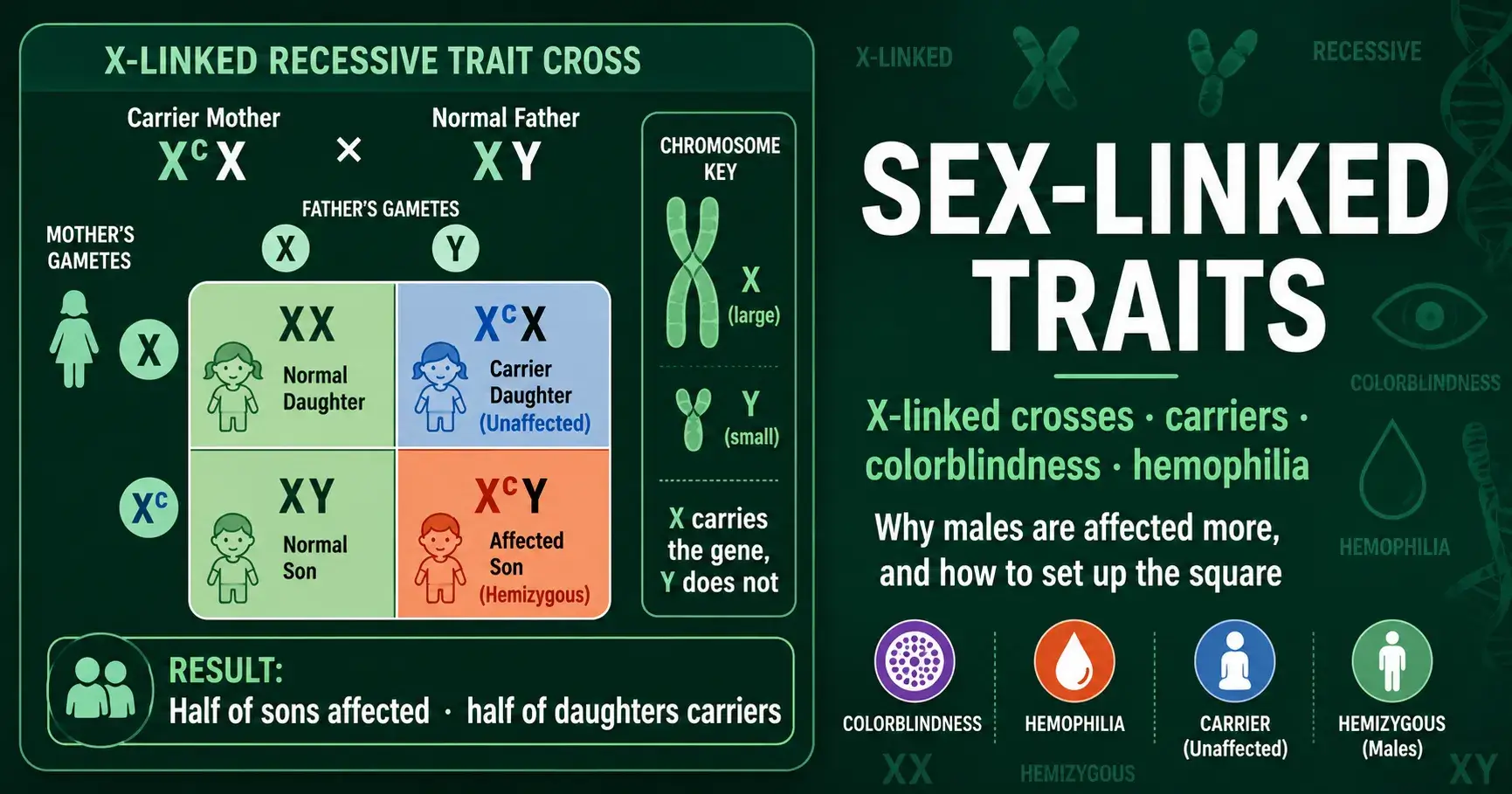
Sex-linked traits are controlled by genes on the sex chromosomes, almost always the X chromosome. Because males have one X and females have two, these traits do not follow the usual autosomal rules. A male inherits his single X from his mother, so a recessive allele on that X is expressed with no second copy to mask it. This is why conditions like red-green colorblindness and hemophilia appear far more often in males than in females.
That single chromosomal difference rewrites how you build a Punnett square. Instead of writing a pair of plain letters, you attach alleles to the X and Y chromosomes themselves. This guide explains sex-linked inheritance from the ground up, shows you how to set up X-linked crosses correctly, and works through the most common cases, including the carrier mother that trips up so many students. By the end you will be able to predict the odds for sons and daughters separately and explain exactly why the two differ.
What Are Sex-Linked Traits?
Sex-linked traits are determined by genes located on the X or Y chromosome rather than on the 22 pairs of autosomes. In humans, females have two X chromosomes (XX) and males have one X and one Y (XY). That difference in chromosome makeup is the entire reason these traits behave unusually.
Almost all sex-linked traits are X-linked, meaning the gene sits on the X chromosome. The Y chromosome is small and carries very few genes, so Y-linked traits are rare. The X chromosome, by contrast, carries over a thousand genes, including those for blood clotting and color vision. When one of those genes has a faulty allele, how it shows up depends heavily on whether the person is male or female.
The key consequence is the difference in copy number. A female has two copies of every X-linked gene, one on each X chromosome. A male has only one, because his single X is paired with a Y that lacks the matching gene. This means a male is neither homozygous nor heterozygous for an X-linked gene. He is hemizygous, carrying just one allele, and whatever that allele says, he expresses. That asymmetry drives every pattern in this article.
Why Males Are Affected More Often
Males inherit X-linked recessive conditions far more frequently than females, and the reason follows directly from having a single X. For a recessive allele to show its effect, it normally needs to be present in two copies, with no dominant allele to mask it. A male only ever has one copy of an X-linked gene, so a single recessive allele is enough to produce the trait.
Picture the difference. A female with one recessive disease allele on one X still has a normal allele on her other X, which usually produces enough functional protein to keep her healthy. She is an unaffected carrier. A male with that same single recessive allele has nothing to balance it, because his Y chromosome carries no corresponding gene. The recessive trait is expressed in full. There is no backup copy and no masking.
This is why red-green colorblindness affects roughly one in twelve men but only about one in two hundred women, and why hemophilia is overwhelmingly a male condition. For a female to be affected, she would need to inherit the recessive allele on both X chromosomes, one from each parent, which is far less likely. A male needs only one, supplied by his mother. The math of single versus double copies explains the entire imbalance.
How to Set Up an X-Linked Punnett Square
X-linked crosses use a special notation, and getting it right is the whole game. Instead of plain letters, you write the alleles as superscripts on the X chromosome and show the Y chromosome as carrying no allele at all.
Take colorblindness, an X-linked recessive trait. Use X with a superscript to mark the chromosome's allele. A normal X is written as X with a capital or plain label, and an X carrying the recessive colorblind allele is written X with a lowercase superscript, such as Xc. The Y chromosome is written plainly as Y, because it has no copy of this gene. With that system, every genotype tells you both the sex and the trait status of the individual at a glance.
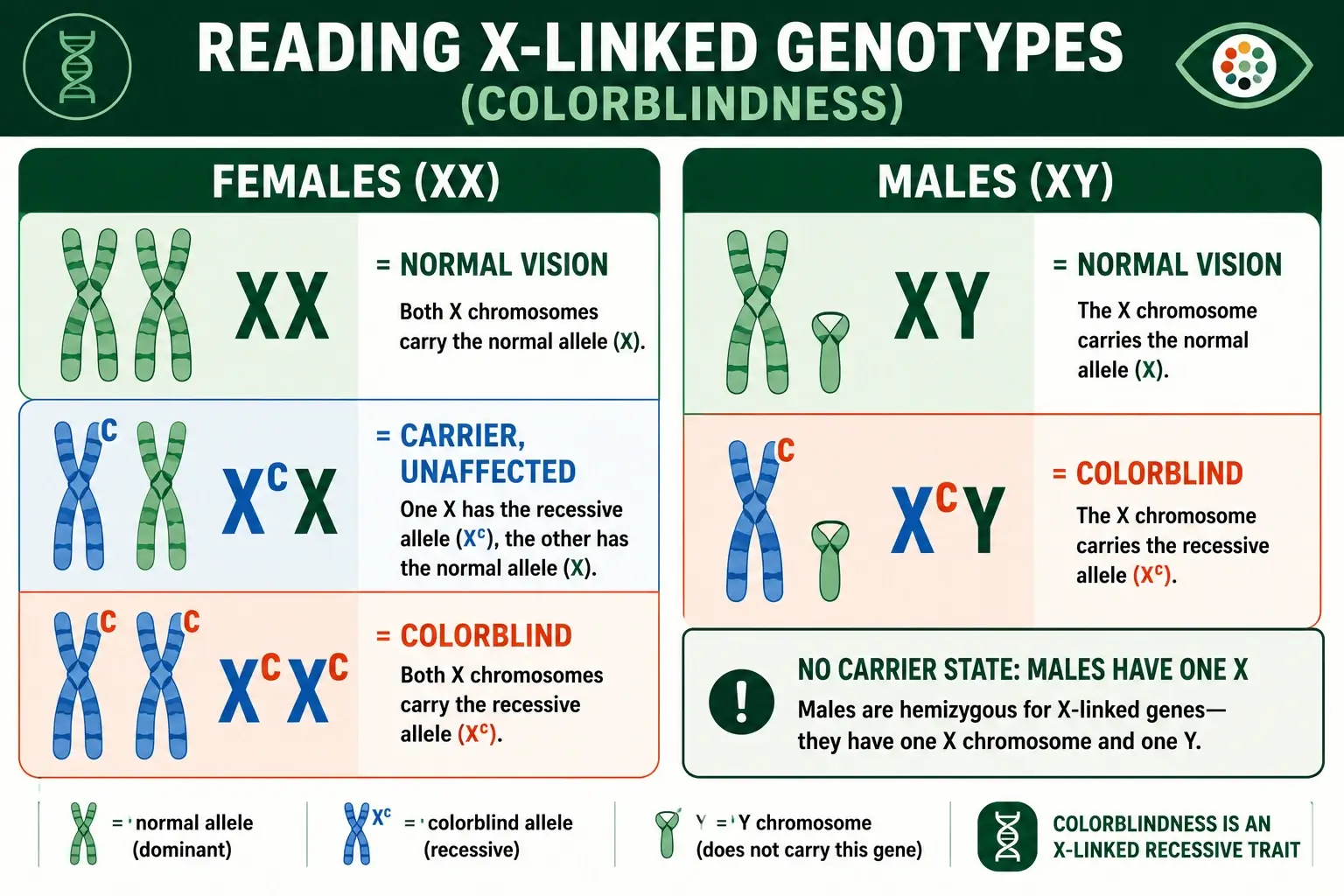
Here is how the genotypes read for colorblindness. A female can be XX (normal), Xc X (a carrier, unaffected but carrying one allele), or Xc Xc (colorblind). A male can be XY (normal) or Xc Y (colorblind). Notice there is no carrier state for males. Because he has only one X, a male is either normal or affected, never a silent carrier. The female carrier genotype, Xc X, is the single most important one to recognize, because it is how the allele travels quietly through a family. The same X-and-Y framework underpins more detailed tools like a sex-linked inheritance calculator, which automates the bookkeeping once you understand the setup.
When you fill the grid, place one parent's chromosomes across the top and the other's down the side, exactly as in any cross. The difference is that the boxes now combine whole sex chromosomes, so each box tells you both the offspring's sex and its trait. Always read sons and daughters as separate groups, because their odds are almost never the same.
The Most Common Cross: Carrier Mother and Normal Father
The carrier-mother cross is the classic sex-linked problem and the one worth mastering first. A mother who is an unaffected carrier (Xc X) has children with a father who has normal vision (XY). On the surface neither parent shows the trait, yet sons can still be affected.
Work out the gametes. The carrier mother produces two kinds of egg: one carrying the normal X and one carrying the colorblind Xc. The normal father produces two kinds of sperm: one carrying his normal X and one carrying his Y. Combine them in the grid.
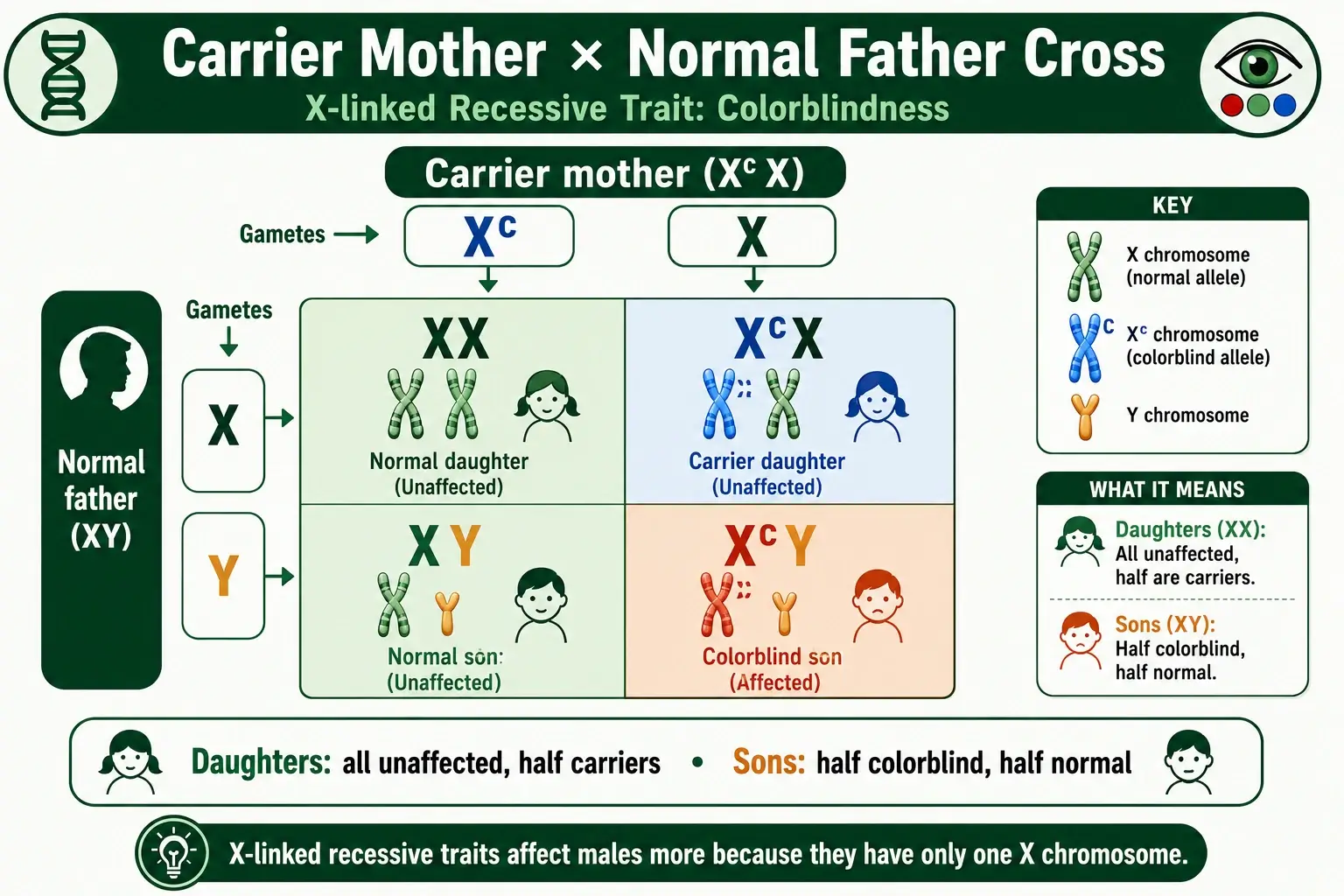
The four boxes come out as XX, Xc X, XY, and Xc Y. Translate each one. The XX daughter has normal vision. The Xc X daughter is an unaffected carrier, just like her mother. The XY son has normal vision. The Xc Y son is colorblind. So among the children, all daughters have normal vision, but half are carriers, while half the sons are colorblind and half are normal.
The probabilities are worth stating carefully because students often mix them up. Looking at all four children, there is a 25 percent chance of a colorblind son, a 25 percent chance of a carrier daughter, a 25 percent chance of a normal son, and a 25 percent chance of a normal daughter. But if you ask specifically about the sons, half of them will be colorblind. If you ask about the daughters, none will be colorblind, though half will be carriers. Separating the question by sex is the only way to get the right answer, and it is the skill this cross is designed to teach.
Why Some Carriers Show Mild Effects: X-Inactivation
The textbook rule says a female carrier is completely unaffected, and that is usually true, but the biology has a wrinkle worth understanding. In every female cell, one of the two X chromosomes is randomly switched off early in development, a process called X-inactivation. This keeps the dose of X-linked gene products roughly equal between males and females.
Because the choice of which X to silence is random in each cell, a carrier's body becomes a patchwork. In some cells the normal X stays active, and in others the X carrying the recessive allele stays active instead. Most of the time the cells with the working allele produce enough normal protein to keep the carrier symptom-free, which is why carriers are generally healthy. The single normal X doing the work in most tissues is what masks the recessive allele.
Occasionally, though, the silencing happens to favor the faulty X in enough cells that a carrier shows mild signs of the condition. Some hemophilia carriers, for instance, have somewhat reduced clotting factor and can bruise more easily, even though they are not classified as affected. This is also why a few carrier females have subtle color-vision differences. X-inactivation does not change the Punnett square predictions, but it explains why "carrier" is not always a perfectly silent state, and it is a detail that separates a surface understanding from a deeper one.
Hemophilia, a disorder where blood does not clot properly, follows the same X-linked recessive pattern as colorblindness, and it has a famous history that makes it easy to remember. Queen Victoria of England was a carrier of the hemophilia allele, and through her many descendants the condition spread into the royal families of Europe, earning it the nickname "the royal disease."
The genetics behind that history is exactly the carrier-mother cross. Victoria was an unaffected carrier, Xh X, where the lowercase h marks the hemophilia allele. Crossed with an unaffected king (XY), she had a 50 percent chance of passing the allele to each child. Her sons who inherited the Xh allele developed hemophilia, while her daughters who inherited it became carriers and passed it on to the next generation. This is precisely why the disorder appeared in her sons and grandsons but traveled silently through her daughters.
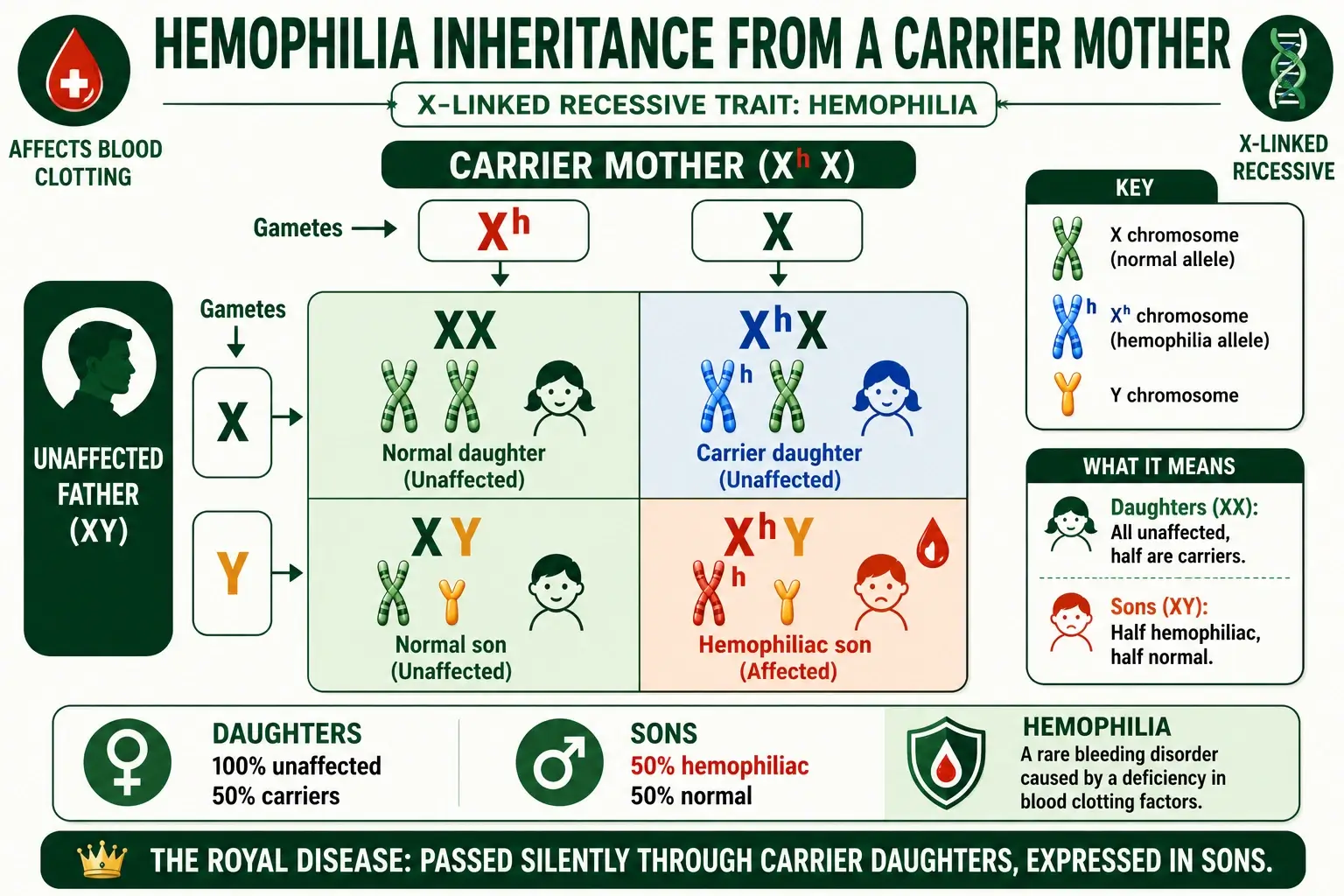
The pattern reveals a general rule of X-linked recessive inheritance. An affected son must have inherited the allele from his mother, because his only X comes from her. His father gave him the Y. So when an X-linked recessive condition appears in a boy whose father is unaffected, the allele came through the mother's line. Carrier females like Victoria are the conduit, which is why genetic counselors trace these conditions through the maternal side. To estimate the chance that a specific woman is a carrier given her family history, a carrier probability calculator applies this same logic with real numbers.
What Happens With an Affected Father
An affected father changes the inheritance pattern in a way that surprises people, because of which chromosome he passes to each child. A father gives his X chromosome to every daughter and his Y chromosome to every son. So an affected father's allele can only reach his daughters, never his sons.
Consider a colorblind father (Xc Y) and a mother with normal vision who is not a carrier (XX). Every daughter receives the father's Xc plus a normal X from the mother, making all daughters carriers (Xc X). They are unaffected but carry the allele. Every son receives the father's Y plus a normal X from the mother, making all sons XY and normal. None of the sons are affected, because they got the Y, not the colorblind X.
This produces a striking generational skip. An affected man's sons are all clear, but his daughters all become carriers, and those carrier daughters can then have affected sons of their own. The trait appears to skip a generation, jumping from an affected grandfather to affected grandsons through unaffected carrier daughters in between. Recognizing this skip is a hallmark of reading X-linked pedigrees correctly, and it is one more reason fathers cannot pass X-linked recessive conditions to their sons.
How Can a Female Be Affected?
A female can have an X-linked recessive condition, but it requires two copies of the recessive allele, which is much rarer than a male needing only one. She must inherit the recessive allele on both X chromosomes, one from each parent. That means her father must be affected and her mother must be at least a carrier.
The cross looks like this. An affected father (Xc Y) and a carrier mother (Xc X) can have a daughter who receives the father's Xc and the mother's Xc, giving the Xc Xc genotype and the full trait. Half their daughters, on average, would be affected and half would be carriers. Half their sons would be affected as well, since the mother can pass her Xc to them too.
Because this requires an affected father, X-linked recessive conditions are rare in females in the general population. A colorblind woman, for example, must have a colorblind father and a mother who carries the allele. As the Children's Hospital of Philadelphia explains, these conditions are far more common in males precisely because males need only a single copy. The double-copy requirement for females is the mirror image of the single-copy rule that makes males so frequently affected.
X-Linked Recessive vs X-Linked Dominant
Most well-known sex-linked conditions are X-linked recessive, but a smaller group are X-linked dominant, and the distinction changes who gets affected. Under X-linked dominant inheritance, a single copy of the allele causes the trait, even in females with their two X chromosomes.
The clearest difference shows in how fathers pass the trait. An affected father with an X-linked dominant condition passes it to all of his daughters, because they all receive his X, but to none of his sons, who receive his Y. An affected mother, if heterozygous, passes the condition to about half her children of either sex. So X-linked dominant conditions can affect females readily, unlike the recessive versions where females are usually just carriers.
A practical tell separates the two patterns in a pedigree. X-linked recessive conditions affect mostly males and can skip generations through carrier females. X-linked dominant conditions affect both sexes, never show male-to-male transmission, and show the distinctive pattern of an affected father passing the trait to all daughters and no sons. Keeping these signatures in mind lets you classify a sex-linked pedigree quickly, even before building a single Punnett square.
How to Spot X-Linked Inheritance in a Pedigree
Beyond Punnett squares, you will often need to recognize sex-linked inheritance from a family tree, or pedigree. A few telltale signs make X-linked recessive conditions stand out from autosomal ones, and learning them lets you classify a family pattern at a glance.
The strongest clue is a heavy bias toward affected males. When far more men than women in a family show a trait, an X-linked recessive cause is likely, because males need only one copy. A second clue is the way the trait travels through unaffected females. An affected man's daughters typically show no symptoms, yet their sons may be affected, so the condition seems to skip a generation, passing from grandfather to grandson through a carrier mother in between.
One pattern essentially rules X-linkage in: the absence of male-to-male transmission. Because a father gives his sons a Y and not an X, an X-linked recessive trait cannot pass directly from an affected father to an affected son. If you see a father and son both affected in a true X-linked condition, the allele reached the son through his mother, not his father. When a pedigree does show direct father-to-son inheritance of a trait, you can usually rule X-linkage out and look to an autosomal explanation instead. Reading these signatures correctly is a core skill in genetic counseling, and it rests entirely on the chromosome logic this article has built up. To trace a trait through several generations and test which inheritance pattern fits, a pedigree analyzer can map the whole family tree for you.
A handful of errors account for most wrong answers in sex-linked problems, and each is easy to fix once you see it.
The first is using plain-letter notation. An X-linked cross needs the alleles written on the X and Y chromosomes, like Xc Y, not as a bare "cc" or "Xc." Dropping the chromosomes hides the sex information that the whole problem depends on. The second is treating males as if they can be carriers. A male has one X, so for an X-linked gene he is either normal or affected, never a silent carrier. Writing a male carrier genotype is a sure sign something has gone wrong.
The third mistake is reporting a single combined probability when the question asks about one sex. Sons and daughters almost always have different odds, so "half the children are affected" is usually wrong. State the chance for sons and daughters separately. The fourth is forgetting that fathers pass their X only to daughters. Expecting an affected father to pass an X-linked recessive trait to his sons leads to impossible answers. Laying out the actual chromosomes in a grid prevents nearly all of these slips, because the notation forces you to track sex and allele together.
Frequently Asked Questions
Why are males more likely to be colorblind?
Males have only one X chromosome, so a single recessive colorblind allele on that X is expressed with no second copy to mask it. Females have two X chromosomes, so they usually need the allele on both to be affected, which is far rarer.
Can a father pass colorblindness to his son?
No. A father passes his Y chromosome to his sons and his X chromosome only to his daughters. Since the colorblind allele is on the X, an affected father can pass it to his daughters as carriers, but never to his sons.
What does it mean to be a carrier of an X-linked trait?
A carrier is a female with one recessive allele on one X chromosome and a normal allele on the other. She does not show the trait because the normal allele masks it, but she can pass the recessive allele to her children.
What is hemizygous?
Hemizygous describes a male's single allele for an X-linked gene. Because he has one X and one Y, he carries just one copy of each X-linked gene rather than a pair, so he is neither homozygous nor heterozygous for it.
Bringing It Together
Sex-linked inheritance comes down to one fact: males have a single X chromosome, so a recessive allele on it is expressed with nothing to mask it. That is why colorblindness and hemophilia strike males far more often, why mothers are usually the carriers who pass these conditions on, and why an affected father gives the trait to his daughters but never his sons. The carrier-mother cross, with its half-affected sons and half-carrier daughters, is the pattern to know cold.
The reliable way to solve any of these crosses is to write the alleles on the X and Y chromosomes and read sons and daughters as separate groups. You can set up and check any X-linked cross with the Punnett Square Calculator, which keeps the sex chromosomes and allele tracking organized for you. For a clear academic walkthrough of X-linked inheritance, this overview is a solid reference to read here.