Common Punnett Square Mistakes and How to Fix Them
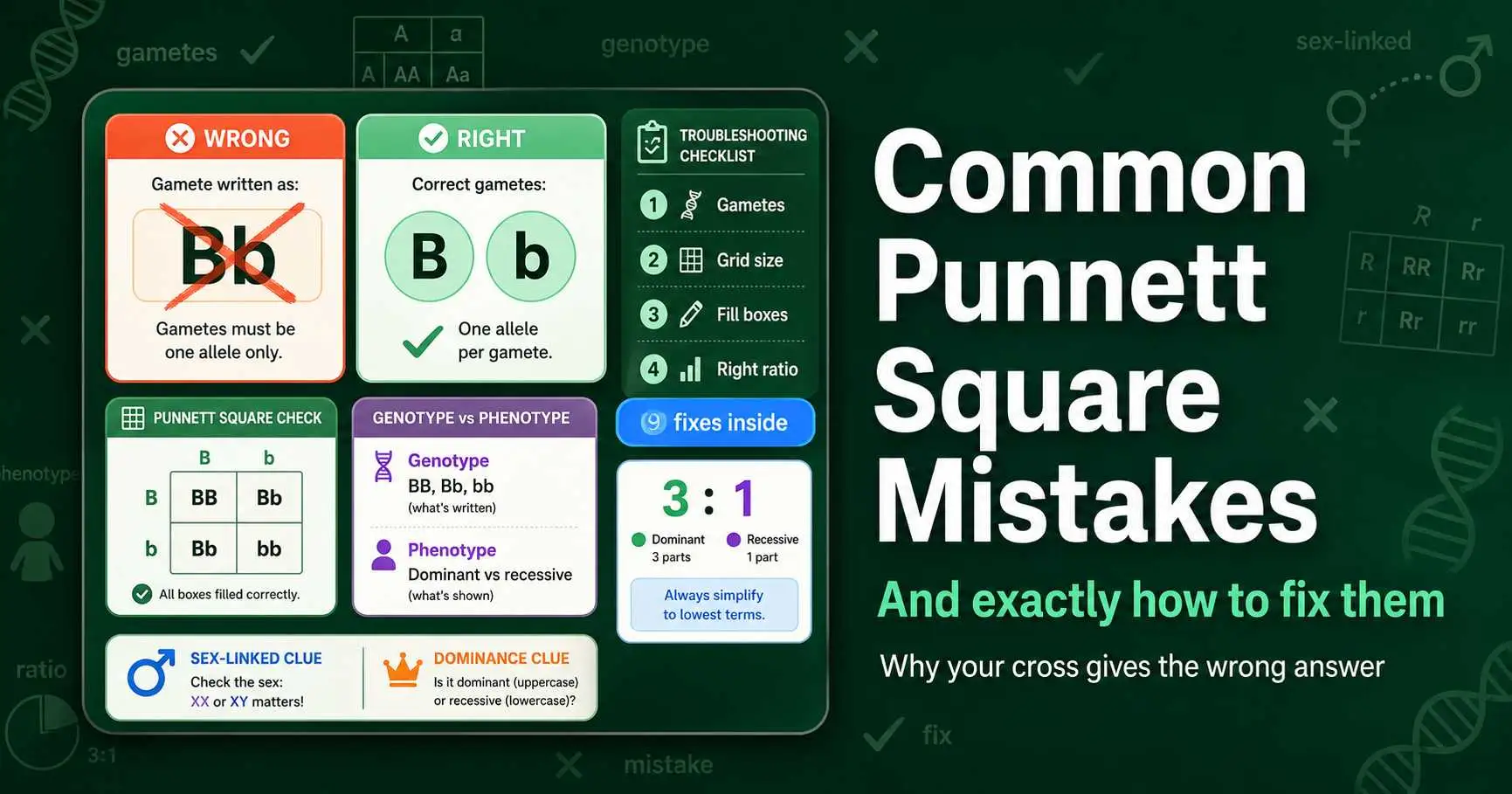
If your Punnett square keeps giving the wrong answer, the cause is almost always one of a handful of predictable mistakes. The most common are writing a whole genotype as a gamete, confusing the genotype ratio with the phenotype ratio, mishandling sex-linked crosses, and assuming a dominant allele must be common. Each of these has a clear fix once you know what to look for, and correcting them is the fastest way to raise your genetics score.
This guide walks through the mistakes that trip up students most often, explaining why each one happens and exactly how to avoid it. Think of it as a troubleshooting checklist: when a cross does not work, run through these and you will usually find the culprit. The errors are easy to make but just as easy to fix once you understand the underlying logic. If you want to review the correct method from the start, our guide on how a Punnett square works lays it out step by step. You can then test the fix in the online Punnett square practice worksheet.
Mistake 1: Writing a Whole Genotype as a Gamete
The single most common Punnett square error is putting a complete genotype where a gamete should go. A gamete is a sex cell, and it carries only one allele for each gene, not both. So a parent with the genotype Bb produces gametes carrying B or b, never a gamete written as "Bb."
This mistake comes from forgetting what a gamete actually is. During meiosis, the two alleles of a gene separate, so each gamete receives just one. Writing "Bb" as a gamete would mean both alleles ended up in the same sex cell, which does not happen for genes on separate chromosomes. The error becomes even more common in dihybrid crosses, where a parent with genotype RrYy should produce four gametes, RY, Ry, rY, and ry, each carrying one allele from each gene. Students sometimes wrongly write gametes like "RR" or "rrYy," which scrambles the whole cross.
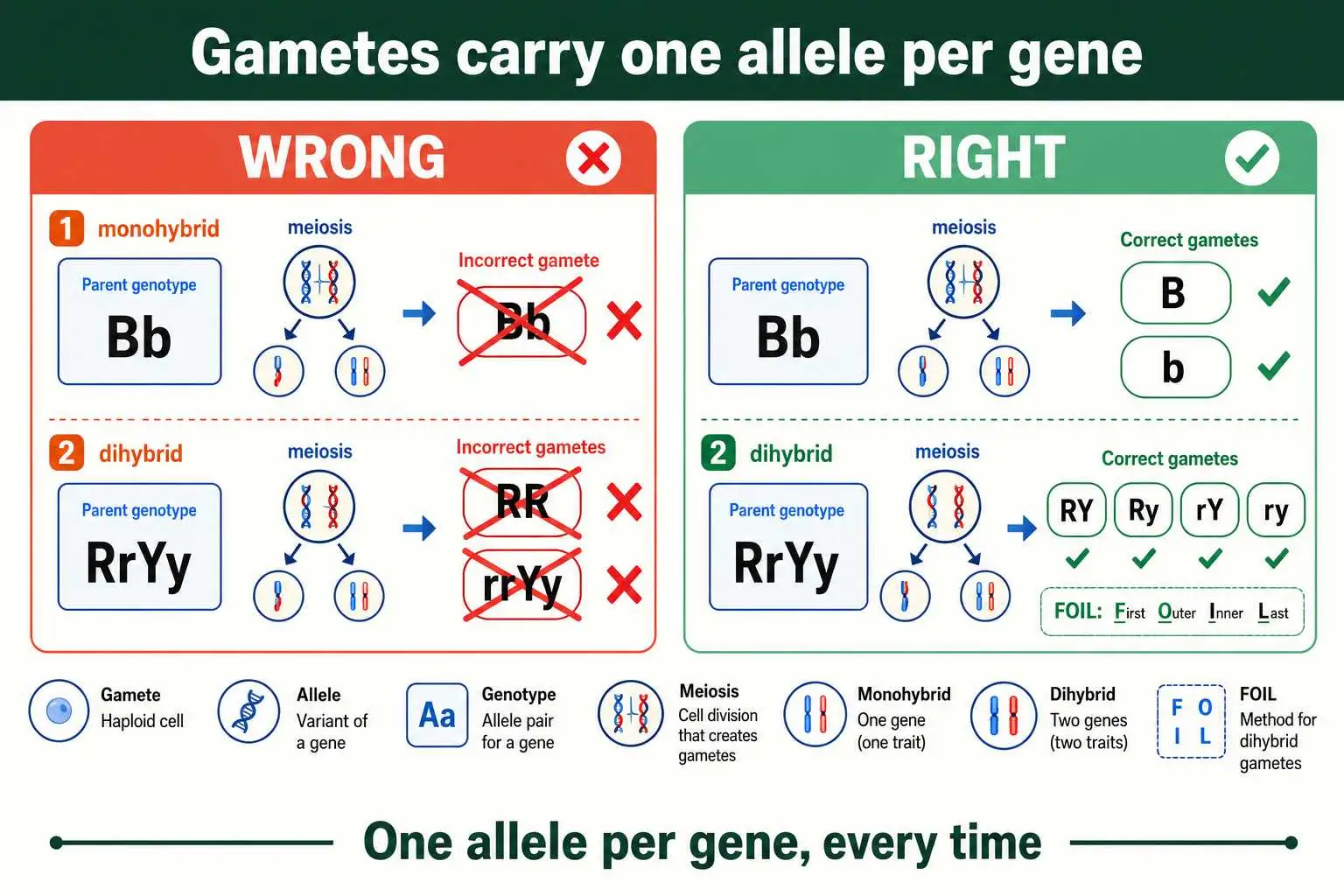
The fix is a simple check. Every gamete must contain exactly one allele for each gene in the cross. For a one-gene cross, each gamete has one letter. For a two-gene cross, each gamete has two letters, one from each gene, never two of the same gene. Before you fill the grid, look at your gametes and confirm this. If you see a doubled-up allele like "BB" or a full genotype like "Bb" sitting in a gamete position, you have found your error. Getting the gametes right is the foundation, because every box in the square is built from them.
Mistake 2: Confusing Genotype and Phenotype Ratios
The second frequent mistake is giving the genotype ratio when the question wanted the phenotype ratio, or the reverse. These are two different numbers that come from the same grid, and mixing them up is a classic way to lose marks even when your square is perfect.
The distinction is straightforward once you see it clearly. The genotype ratio counts the allele combinations in the boxes. For a monohybrid cross of two heterozygotes, that is 1 BB : 2 Bb : 1 bb, or 1:2:1. The phenotype ratio counts the visible traits. Under simple dominance, the three boxes with at least one B all look the same, so the phenotype ratio collapses to 3 dominant : 1 recessive, or 3:1. Same square, different grouping, different answer.
The fix is to read the question carefully and decide which ratio it wants before you write your final answer. If it asks for genotypes, list the allele combinations. If it asks for phenotypes, group the boxes by appearance. A useful habit is to write both ratios under your square, labelled clearly, so you can give whichever the question asks for and show that you understand the difference. This small step prevents one of the most avoidable errors in genetics, and it demonstrates exactly the understanding examiners are testing.
Mistake 3: Mishandling Sex-Linked Crosses
Sex-linked crosses cause more errors than any other type, because they break the simple symmetry of an ordinary cross. The mistake is treating a sex-linked gene like a regular one and giving a single combined ratio, when sons and daughters actually have different outcomes.
The root of the problem is the notation and the chromosomes. Sex-linked genes sit on the X chromosome, so you must write the alleles on the sex chromosomes, such as X with a superscript for the allele, and remember that the Y chromosome carries no copy of the gene. A male has only one X, so a single recessive allele on it is expressed, with nothing on the Y to mask it. This is why X-linked recessive conditions affect more males than females, and why a father cannot pass an X-linked trait to his sons at all, since he gives them his Y.
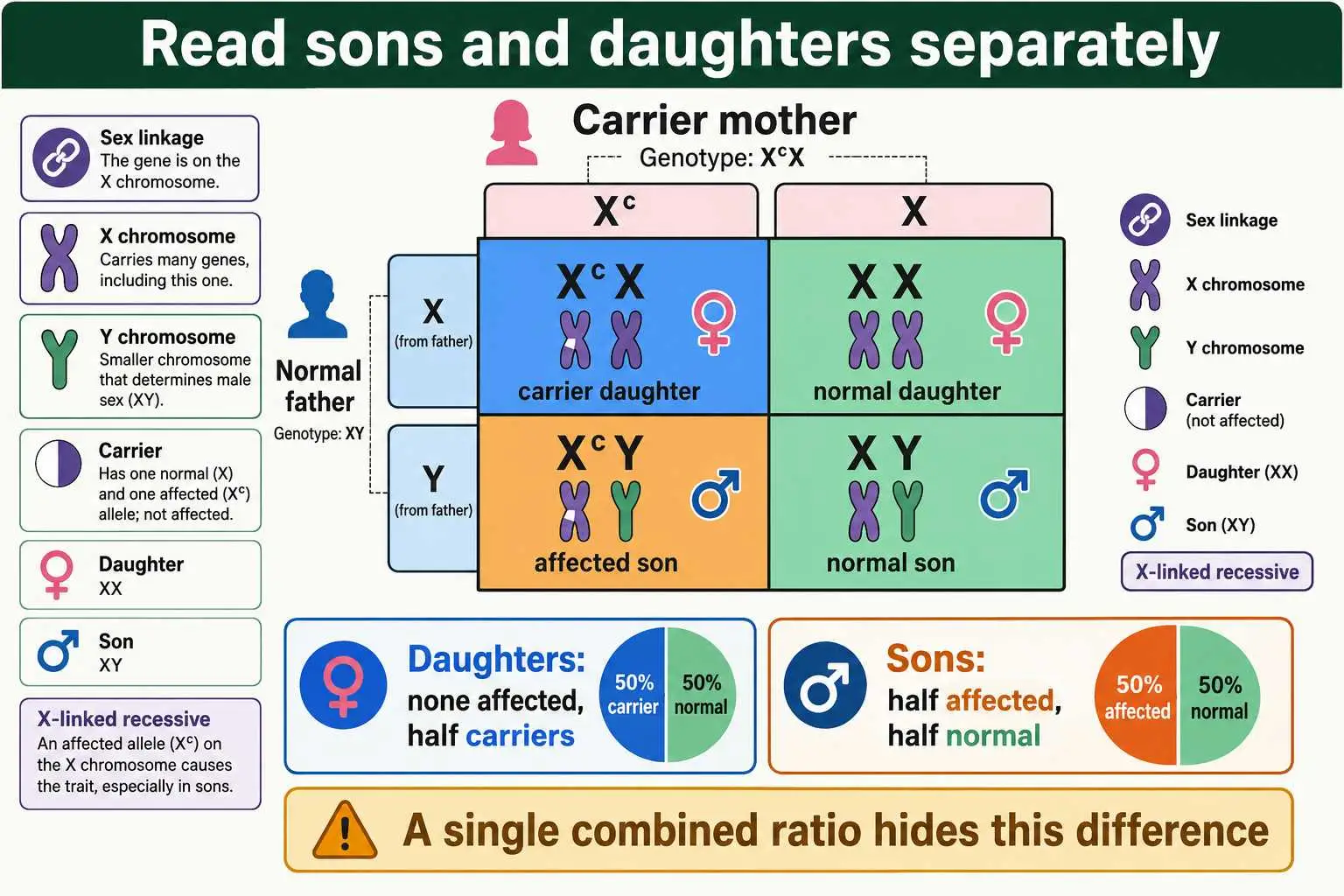
The fix is to always read sons and daughters as separate groups in a sex-linked cross. After filling the grid, sort the offspring by sex and state the outcome for each, rather than blending them into one ratio. For example, in a cross of a carrier mother and a normal father, half the sons may be affected while none of the daughters are, which a single combined ratio would obscure. Writing the X and Y chromosomes explicitly in every box keeps the sexes visible and prevents the blending error. Our guide to sex-linked Punnett squares shows the correct approach in detail.
Mistake 4: Assuming Dominant Means Common
A deep conceptual mistake, rather than a mechanical one, is believing that a dominant allele must be more common in a population than a recessive one. Dominance has nothing to do with how frequent an allele is. It only describes how the allele behaves when paired with a different allele in an individual.
This misconception confuses two unrelated ideas. Dominance is about expression: a dominant allele shows its effect even when only one copy is present, masking a recessive partner. Frequency is about how often an allele appears across a whole population, which depends on history, selection, and chance, not on dominance. The clearest proof is polydactyly, the condition of having extra fingers or toes, which is caused by a dominant allele yet is quite rare. Meanwhile many recessive alleles are extremely common. So a dominant trait can be rare and a recessive trait can be widespread.
The fix is to keep the two concepts firmly separate in your mind. When a problem describes an allele as dominant, that tells you only how it will appear in a heterozygote, not how many individuals in the population carry it. This matters for interpreting results correctly and for answering the conceptual questions that often accompany a Punnett square. Remembering the polydactyly example is an easy way to anchor the point: dominant does not mean common, and recessive does not mean rare.
Mistake 5: Treating Ratios as Guarantees
Another common error is reading a Punnett square ratio as a promise about exact numbers of offspring. A 3:1 ratio does not mean that out of any four offspring, exactly three will be dominant and one recessive. The ratio is a probability, not a guarantee.
This mistake stems from misunderstanding what the square predicts. Each box represents the probability of that outcome for each individual offspring, and each fertilization is an independent event, like a coin flip. A 3:1 ratio means each offspring has a 3 in 4 chance of the dominant phenotype, but a small family could easily have all dominant offspring, or more recessive ones than expected, just as four coin flips will not always give two heads and two tails. The predicted ratios only emerge reliably across large numbers of offspring, which is one reason Mendel used thousands of pea plants.
The fix is to phrase your conclusions in terms of probability. Rather than saying "three of the four children will be unaffected," say "each child has a 75 percent chance of being unaffected." This is more accurate and is often explicitly required for full marks. It also helps you avoid the related error of assuming a couple who already has one affected child is somehow less likely to have another, when in fact each pregnancy carries the same independent probability. Treating the square as a probability model rather than a fixed prediction is both more correct and better rewarded.
Mistake 6: Using the Wrong Ratio for Non-Mendelian Patterns
Students who have mastered the 3:1 ratio often apply it automatically, even when the cross involves codominance or incomplete dominance, where it does not hold. This is a subtle but frequent error, because the habit of expecting 3:1 is strong.
The issue is that codominance and incomplete dominance make the heterozygote visibly different from both homozygotes. In simple dominance, the heterozygote looks like the dominant homozygote, so two of the three genotype classes share a phenotype, giving 3:1. But when the heterozygote shows its own distinct phenotype, such as a pink flower from red and white parents or roan coat from red and white alleles, all three genotype classes look different. The phenotype ratio then matches the genotype ratio of 1:2:1, not 3:1.
The fix is to check the type of dominance before assuming any ratio. Ask whether the heterozygote has its own appearance. If it does, you are dealing with codominance or incomplete dominance, and the phenotype ratio will be 1:2:1 for a cross of two heterozygotes. If the heterozygote looks like the dominant parent, simple dominance applies and the ratio is 3:1. Our guide to incomplete dominance vs codominance explains how to tell these patterns apart so you apply the correct ratio every time.
Mistake 7: Setting Up the Grid Incorrectly
Mechanical setup errors quietly ruin many crosses. These include drawing the wrong size grid, placing gametes incorrectly, or combining the alleles in the wrong order when filling the boxes. They are easy to overlook because the square still looks complete.
The most common setup slip is using the wrong grid size for the number of gametes. A cross where each parent makes two gametes needs a 2x2 grid, while a dihybrid cross where each parent makes four gametes needs a 4x4 grid. Using a 2x2 grid for a dihybrid cross, or forgetting boxes, throws off every result. Another slip is mismatching the gametes to the axes, or filling a box with both alleles from the same parent instead of one allele from each parent. Each box should combine one gamete from the top and one from the side.
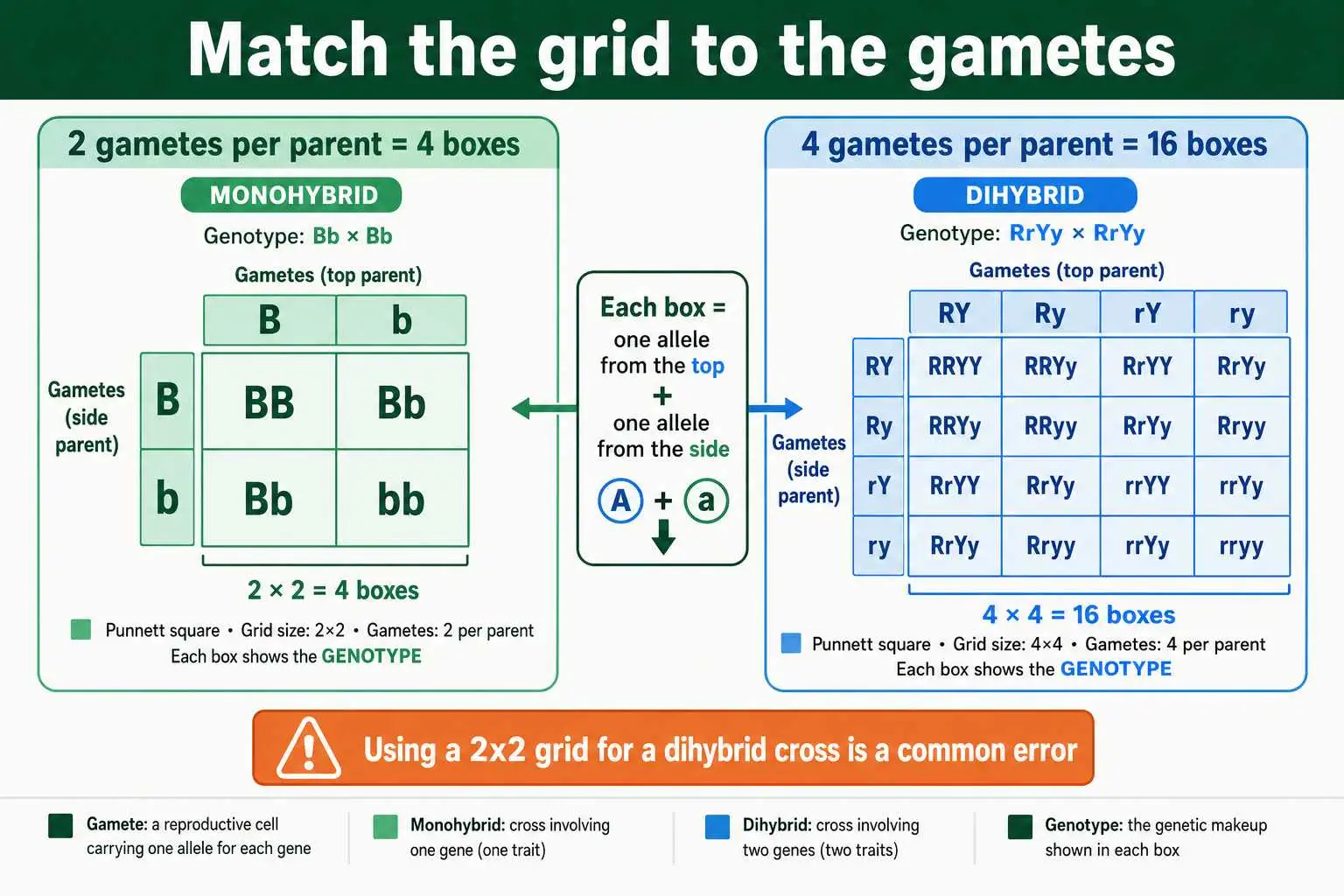
The fix is a quick structural check before reading results. Confirm the grid size matches the gametes: two gametes per parent means four boxes, four gametes per parent means sixteen boxes. Check that each box contains one allele contributed by the column gamete and one by the row gamete, never two from the same source. For multi-letter genotypes, write the alleles in a consistent order, such as always putting the first gene's allele before the second, so genotypes like RrYy are easy to read and count. These small habits prevent the silent errors that a finished-looking but wrong square can hide. Checking your grid against a calculator is a fast way to catch setup mistakes while you learn.
Mistake 8: Not Working Out the Parent Genotypes First
A surprising number of errors happen before the square is even drawn, when students start filling in boxes without correctly establishing the parents' genotypes. If the parental genotypes are wrong, every box that follows is wrong too, no matter how neat the grid.
The trouble usually arises when a problem gives phenotypes rather than genotypes. A question might say "a brown-eyed parent and a blue-eyed parent," leaving you to deduce the genotypes. The blue-eyed parent, showing the recessive trait, must be homozygous recessive. The brown-eyed parent could be homozygous dominant or heterozygous, and which one you choose changes the entire outcome. Jumping straight to the grid without settling this is a recipe for a confident but wrong answer. The same issue appears when a parent is described as a carrier, which specifically means heterozygous, a detail that is easy to skim past.
The fix is to write out both parental genotypes explicitly before drawing anything. Translate each phenotype into the possible genotypes, use any clues in the problem to narrow them down, and only then set up the cross. If a parent's genotype is genuinely uncertain, the problem usually expects you to consider the most likely case or to state your assumption. Pausing to establish the parents first, rather than rushing to the grid, prevents a whole category of errors and is a habit that pays off on every genetics question.
Mistake 9: Forgetting Independent Assortment in Dihybrid Crosses
In dihybrid crosses, a conceptual error can creep in when students forget that the two genes assort independently, and instead treat the alleles as if they travel together in fixed pairs. This produces the wrong gametes and a distorted ratio.
The mistake shows up in how the gametes are formed. For a parent with genotype RrYy, independent assortment means the R gene and the Y gene sort into gametes separately, giving all four combinations: RY, Ry, rY, and ry. A student who wrongly assumes the alleles inherited together stay together might produce only RY and ry, as if the dominant alleles always travel as a unit and the recessive alleles as another. This halves the gamete types and gives a ratio that looks like a monohybrid cross rather than the correct 9:3:3:1. The error reflects a misunderstanding of Mendel's law of independent assortment, which applies to genes on different chromosomes.
The fix is to generate the gametes systematically using a method like FOIL, taking one allele from each gene in every possible combination. This guarantees you capture all four gamete types for a double heterozygote. It is worth remembering that independent assortment is exactly what breaks down when genes are linked on the same chromosome, which is why a dihybrid cross of linked genes does not give 9:3:3:1. For unlinked genes, though, always produce all four gamete combinations, and the ratio will come out right.
A Quick Diagnostic Checklist
When a cross gives an answer that feels wrong, you do not need to redo everything from scratch. Running through a short diagnostic checklist usually pinpoints the error in seconds, since the mistakes above tend to leave recognisable signatures.
Start at the gametes, because errors there cascade into everything else. Confirm each gamete has exactly one allele per gene, with no doubled alleles or full genotypes. Next, check the grid size against the gamete count: two gametes per parent means a four-box grid, four gametes means a sixteen-box grid. Then look at how you filled the boxes, making sure each combines one allele from the top and one from the side, in a consistent order. Finally, check the question wording to confirm whether it wants a genotype ratio, a phenotype ratio, or a probability, and for sex-linked crosses, whether it wants sons and daughters reported separately.
This top-to-bottom scan, gametes, grid size, box-filling, then the requested output, catches the large majority of errors. As Biology LibreTexts and other standard references emphasise, the discipline of checking each stage in order is what separates reliable genetics work from guesswork. Build the habit of running this checklist whenever an answer surprises you, and the troubleshooting becomes almost automatic. Over time you will start to avoid the mistakes in the first place, because the checklist trains you to set up each cross correctly from the beginning.
Frequently Asked Questions
Why does my Punnett square give the wrong ratio?
The most likely causes are incorrect gametes, using the wrong grid size, or giving a genotype ratio when a phenotype ratio was asked for. Check that each gamete has one allele per gene, that the grid matches the gamete count, and that you grouped the boxes correctly for the ratio requested.
Can a gamete have two alleles of the same gene?
No. A gamete carries only one allele for each gene, because the two alleles separate during meiosis. A Bb parent makes B and b gametes, and an RrYy parent makes RY, Ry, rY, and ry, each with one allele per gene. Writing "Bb" as a gamete is a mistake.
Why is the phenotype ratio different from the genotype ratio?
Because multiple genotypes can produce the same phenotype under simple dominance. A monohybrid cross gives a 1:2:1 genotype ratio, but the two heterozygote classes look like the dominant homozygote, so the phenotype ratio becomes 3:1. They are the same square grouped two different ways.
Does a dominant allele appear more often in a population?
No. Dominance describes how an allele behaves in a heterozygote, not how common it is. A dominant allele can be rare, like the one causing polydactyly, and a recessive allele can be very common. Frequency depends on the population, not on dominance.
Fix It and Move On
Most Punnett square errors come from the same short list: writing genotypes instead of gametes, confusing genotype and phenotype ratios, blending sons and daughters in sex-linked crosses, assuming dominant means common, treating ratios as guarantees, applying the 3:1 ratio to non-Mendelian patterns, and setting up the grid incorrectly. Each has a simple fix, and most trace back to two core ideas: gametes carry one allele per gene, and a Punnett square predicts probabilities, not certainties.
When a cross gives an answer that seems wrong, run through this checklist and you will usually find the problem quickly. Check your gametes first, then your grid size, then which ratio the question wants. With these fixes in hand, the mistakes that once cost you marks become easy to spot and avoid. You can confirm any cross and catch your own errors with the Punnett Square Calculator, which shows the correct gametes, grid, and ratios for comparison. For another clear rundown of genetics pitfalls, this overview from Shmoop is a helpful companion read.