How to Do a Punnett Square: A Step-by-Step Guide
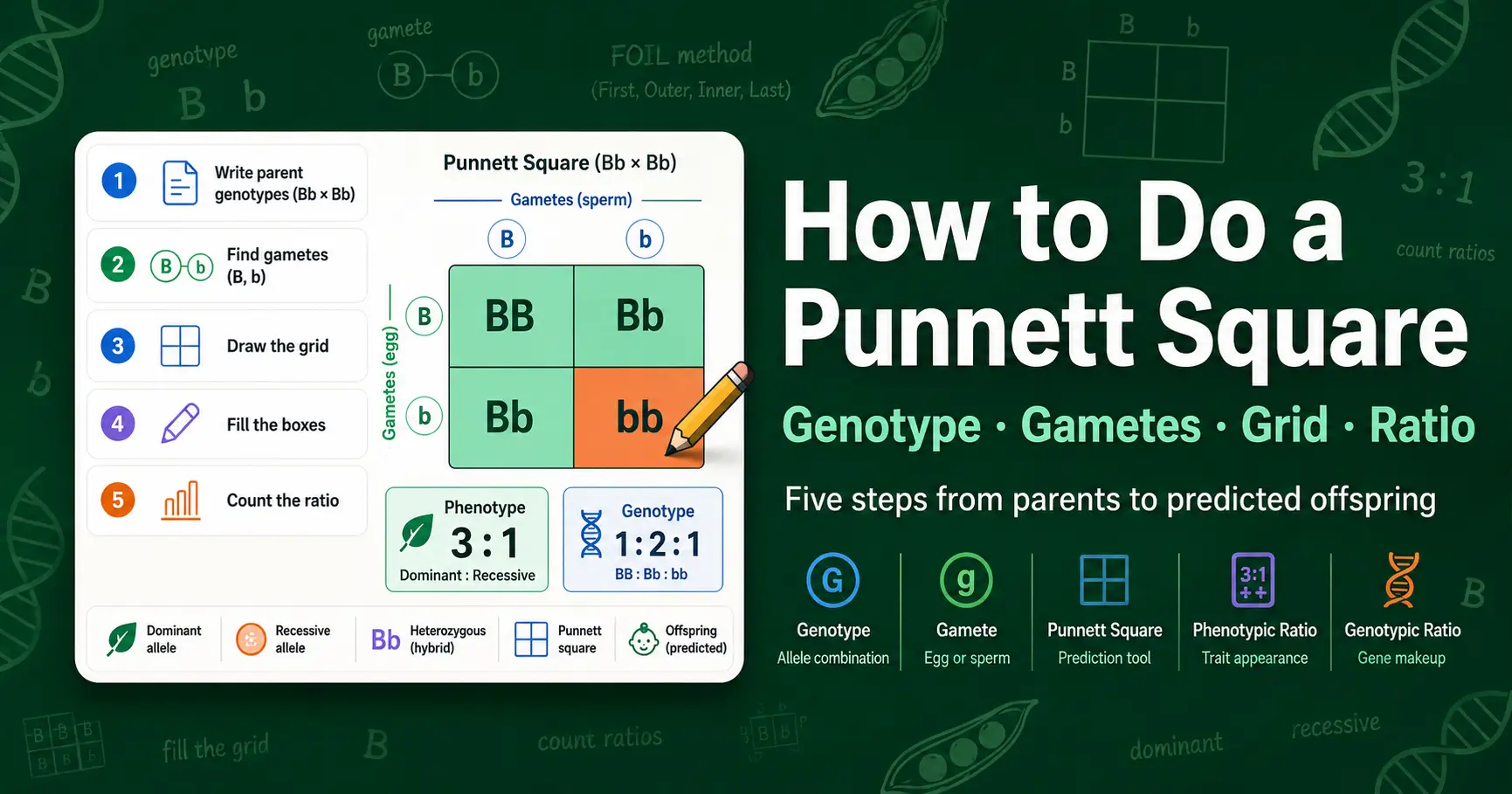
To do a Punnett square, you find each parent's genotype, work out the gametes they can make, draw a grid, fill each box with one allele from each parent, then count the results to get your ratios. Five steps, and the whole thing takes a minute once you know the order.
This guide walks through each step with a worked example you can follow along with. If you are still fuzzy on the basics, start with what a Punnett square is first, then come back here to build one. Prefer to skip the pencil work entirely? The Punnett Square Calculator fills the grid for you. Once the method makes sense, use the interactive Punnett square practice worksheet to solve problems with instant answer checking.
Before You Start: Read the Genotypes
Most genetics problems hide the genotypes inside a word problem. Your first job is to translate the words into letters.
A few terms do the heavy lifting. Homozygous means two identical alleles, so BB or bb. Heterozygous means two different alleles, so Bb. Dominant traits use a capital letter, and recessive traits use the lowercase version of that same letter.
Say a question reads: "A breeder crosses two guinea pigs that are both heterozygous for coat color, where black (B) is dominant over white (b)." Heterozygous tells you each parent is Bb. That is your starting point.
Step 1: Write Out Each Parent's Genotype
Set the two genotypes side by side before you draw anything. For our guinea pigs, that is Bb and Bb.
Writing them out first stops a common error: mixing up which letters belong to which parent. Keep parent one on the left and parent two on the right and the rest of the process stays clean.
Step 2: Work Out the Gametes
A gamete carries only one allele per gene. This is the step people get wrong most often, so slow down here.
A parent with the genotype Bb makes two kinds of gamete: B and b. You split the pair, you do not copy it. So Bb does not become "Bb" in a gamete. It becomes either B or b.
For a single trait this is simple. For two traits it takes a small trick. A parent with the genotype AaBb makes four gametes, because you take one allele from each gene and combine them every possible way. The result is AB, Ab, aB, and ab. The FOIL method (first, outer, inner, last) gives you the same four combinations quickly.
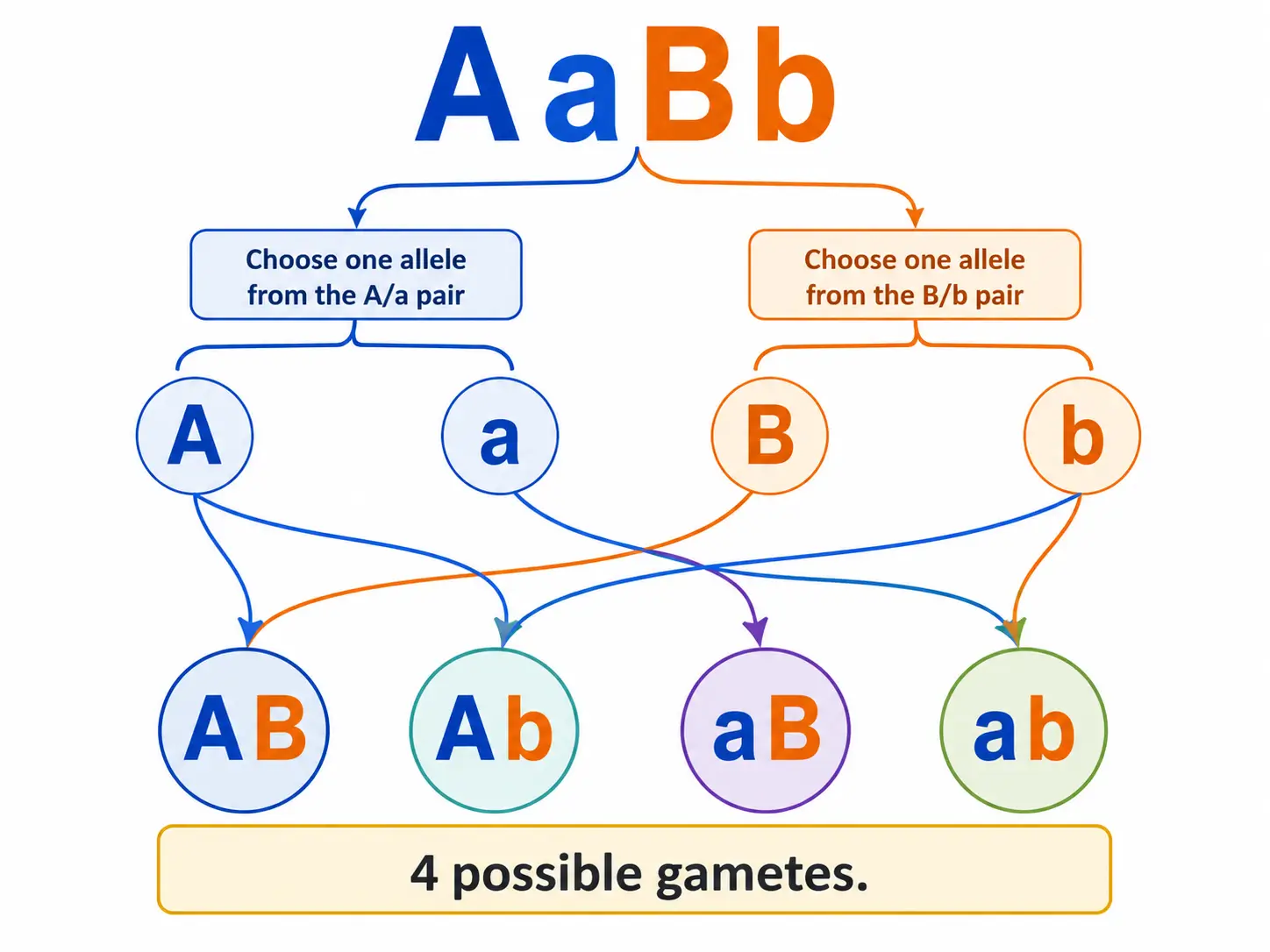
Getting the gametes right matters because they become the labels on your grid. A mistake here breaks everything downstream. When you reach crosses with two or more traits, the forked-line method calculator is a faster way to keep the combinations straight.
Step 3: Draw the Grid
The grid size matches the number of gametes. Two gametes per parent gives you a 2x2 square with four boxes. Write parent one's gametes across the top, one per column. Write parent two's gametes down the left side, one per row.
For our Bb by Bb cross, both B and b sit across the top, and both B and b run down the side. The grid is ready to fill.
Step 4: Fill In the Boxes
Move through the grid one box at a time. Each box combines the allele from its column with the allele from its row.
Always write the dominant allele first by convention, so a box reading "b" and "B" becomes Bb, not bB. For the guinea pig cross, the four boxes come out as BB, Bb, Bb, and bb. That is it. The grid is complete.
Step 5: Count the Genotypes and Phenotypes
Now read your results. Tally the genotypes first, then group them by phenotype.
In our example you have one BB, two Bb, and one bb. The genotype ratio is 1:2:1. For phenotypes, both BB and Bb produce black coats because B is dominant, while only bb produces white. So the phenotype ratio is 3 black to 1 white.
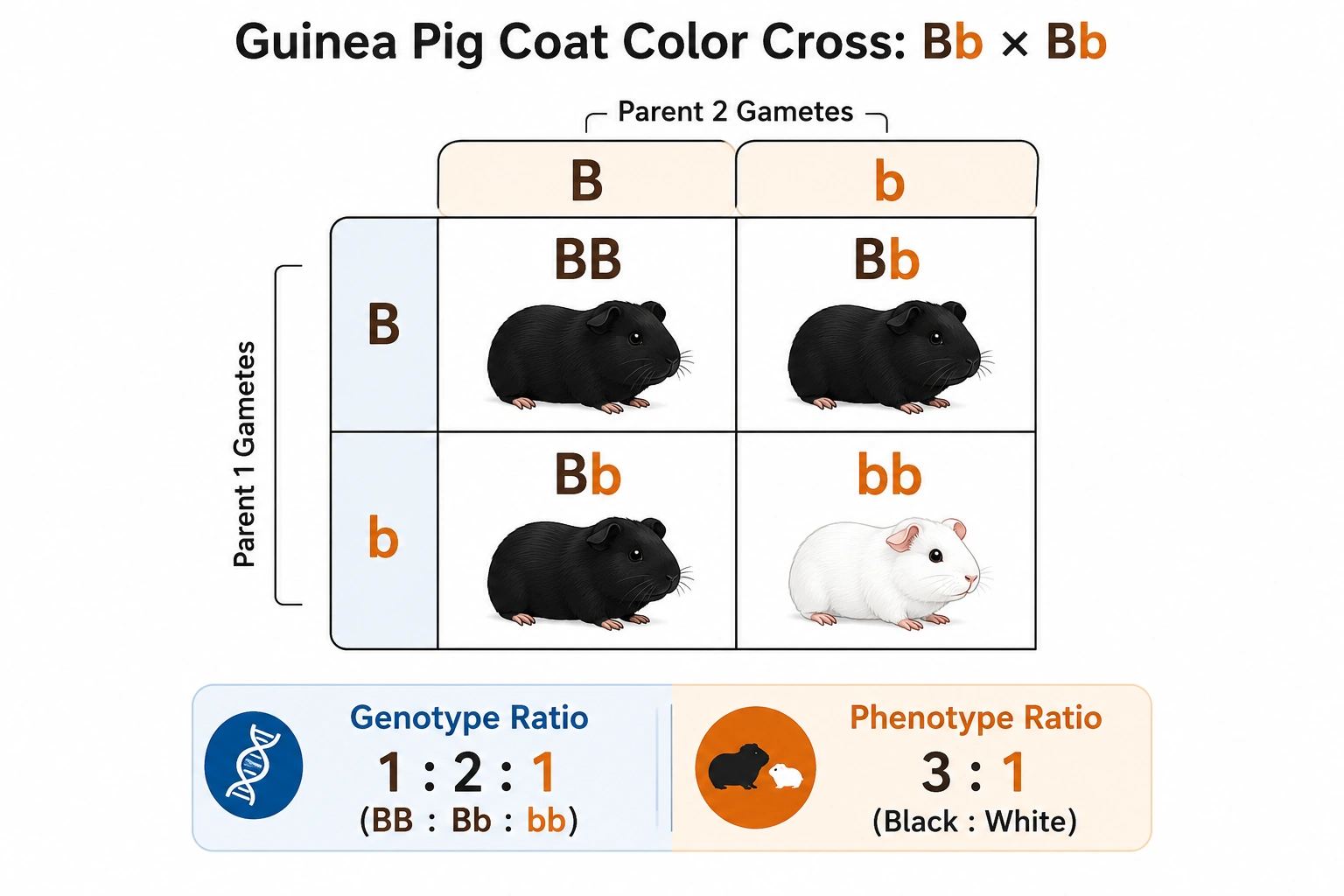
Turn those ratios into percentages when you need them. Three out of four boxes are black, so 75 percent of offspring are likely black. One out of four is white, so 25 percent are likely white. To pull the odds for a single trait without counting boxes by hand, use the phenotype probability calculator. This whole cross, by the way, is a textbook example of Mendel's law of segregation in action. You can read more about the single-trait cross on Wikipedia.
Doing a Two-Trait (Dihybrid) Cross
The five steps stay the same when you add a second trait. The grid just gets bigger.
Each heterozygous parent now makes four gametes, so the square becomes 4x4 with sixteen boxes. Cross AaBb with AaBb and you get the classic 9:3:3:1 phenotype ratio. Filling sixteen boxes by hand works, but it is slow and easy to slip up on. The dihybrid cross probability calculator handles it instantly, and a trihybrid cross with sixty-four boxes is really only practical with a tool.
Common Mistakes to Avoid
Three errors trip up most beginners.
The first is copying the whole genotype into a gamete. Remember that Bb splits into B and b, never "Bb." The second is mismatching gametes when there are two traits, like writing "Aa" instead of pulling one allele from each gene. The third is confusing the genotype ratio with the phenotype ratio. They are different numbers from the same grid, so label which one you are reporting.
One more habit worth keeping: always draw the square instead of guessing the ratio from memory. The work catches mistakes the memory misses. If you want to verify a result against expected ratios, run it through a chi-square calculator. For the deeper background on why these ratios appear at all, the Nature Education overview of Mendel's principles is a solid read.
Let the Calculator Do the Heavy Lifting
You now have a repeatable method: read the genotypes, find the gametes, draw the grid, fill the boxes, count the results. Practice it a few times by hand so the logic sticks. After that, let the Punnett Square Calculator build any cross for you, from a single trait up to five, with the ratios worked out automatically.